
Lalith Sharan
Lalith Sharan participated in a virtual interview about his work in IA applied to surgery and medical computing. The interview conducted by Facundo Strizzi, edited by the NoSeQueEstudiar team. Below is a visual summary of the interview in PDF, his professional profile, the key details of his career and the video interview.
Visual summary of the interview with Lalith Sharan
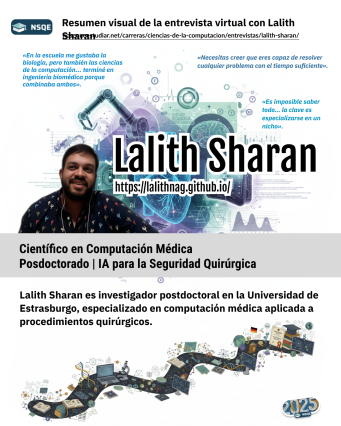
Lalith Sharan is a Medical Computing Scientist and Postdoctoral Researcher at the Universidad de Estrasburgo (France), where he develops the next IA-based surgical system to improve patient safety and optimize medical procedures.
His approach combines artificial intelligence, computer vision and robotics to revolutionize computer-assisted surgeries, with the goal of reducing human error and personalizing healthcare.
Location: Estrasburgo, France
Field of specialization: surgical IA, Computer Vision, Machine learning applied to medicine.
Outstanding Career Path
Postdoctoral Researcher – IHU Strasbourg & CAMMA Research Group:
- Leader in the development of AI systems for large-scale surgical data analysis.
- Research in vision-language models for surgeries and real-time detection of critical events.
PhD in Computer Science – University Hospital Heidelberg (Germany):
- Designed smart MVR, an AI tool for heart valve repair with millimeter precision.
- 15+ publications in high-impact journals (IEEE JBHI, MICCAI) and 8+ awards at international conferences.
Biomedical Engineer – StartUp in India (Early years): He combined his training in biomedical engineering and computer science to solve clinical problems.
Pioneer in surgical AI: Partial autonomy in robotic surgeries and automated documentation of procedures.
Mentorship: He has supervised 8+ young researchers and promotes scientific communication in Europe.
Conferences: Invited to speak on trustworthy AI in hospitals and technology events.
Academic Background
PhD in Computer Science – Universidad de Heidelberg (Germany), specializing in AI-assisted surgical systems.
Master's in Biomedical Engineering – Universidad Otto-von-Guericke de Magdeburg (Germany), specializing in AI applied to medicine.
Bachelor's in Biomedical Engineering – Instituto Tecnológico de Manipal (India), focusing on medical computing.
Technical skills: Computer vision · Deep learning · Surgical robotics
Languages: English (fluent), Hindi (professional), Tamil (native/bilingual), Kannada (native/bilingual), German (professional), French (basic).
Interview with Lalith Sharan
1. Introduction and career path
Facundo Strizzi: Today we are with Lalith Sharan, researcher at the University of Strasbourg (France), who is developing the next AI-based surgical system. Thank you for sharing your career path with us.
Lalith Sharan: Thank you for the invitation. I am currently a postdoctoral researcher in Strasbourg, where I work as a Medical Computing Scientist. My education began in biomedical engineering, but I later specialized in computer science, earning a PhD focused on surgical applications.
My work focuses on computer-assisted surgeries, a field where technology and medicine integrate. Medicine is not only about direct patient care, but also about the technologies that support it. My role is to research how tools like software and AI can optimize surgical procedures, making interventions more precise and safer.
2. Choosing the career field
Facundo Strizzi: What led you to choose this field? Was it a clear decision from the start or something you discovered over time?
Lalith Sharan: In school, I was passionate about both biology and computer science. At first, I struggled to decide between the two areas. During my undergraduate degree, I was looking for something that integrated these two worlds, and that's how I discovered biomedical engineering.
What attracted me was its multidisciplinary approach: it combines medicine with technology. But it was during my master's degree that I understood the true potential of computing applied to healthcare. Computer science proved to be a powerful tool for solving complex medical problems.
This revelation led me to specialize in medical computing during my PhD. Today, as a Medical Computing Scientist, I apply AI and computational techniques to develop innovative solutions in the surgical field.
3. Influences and mentors
Facundo Strizzi: In your professional development, did you have mentors or key people who influenced your journey? Or was it a more individual path?
Lalith Sharan: I have been very fortunate to have excellent mentors at every stage. It all started at school, where some extraordinary physics, chemistry and mathematics teachers awakened my fascination with science. They were the ones who planted that first seed of scientific curiosity that led me toward engineering.
During my doctorate, I was lucky to work with an exceptional supervisor and brilliant colleagues, who taught me not only the technical aspects of research, but how to tackle complex real-world problems. This is where I really learned what it means to do high-level research.
But perhaps some of my most valuable mentors have been the surgeons I have collaborated with. Their practical experience and their unique perspective on the real challenges in the operating room have given direction and tangible purpose to my technical work.
I am deeply grateful to all these people who have believed in me, have recognized my potential and, above all, have challenged me to continuously improve myself. Their guidance has been essential to getting where I am today.
4. Key skills for success
Facundo Strizzi: In your field of AI applied to surgery, what skills do you consider crucial for success? What should a student focus on beyond the technical side like mathematics or programming?
Lalith Sharan: I would highlight three fundamental aspects:
Problem-solving mindset: Before technical skills, you need to believe that with time and dedication you can solve any problem. Intellectual curiosity is your best engine - that genuine desire to understand and solve.
Experiential learning: Theory alone is not enough. The practical skill of experimenting, trying things and learning by doing is invaluable. Work on real projects even if they are small; that's where you'll discover your areas for improvement and how you react to unexpected challenges.
Contextual adaptability: The tech industry evolves rapidly. What I needed when I started is no longer the same as today. It's vital to understand the current landscape - talk to professionals, stay up to date and be flexible to adapt your skills.
"Technical foundations are important, but your ability to apply them in a changing context and with real problems is what really makes the difference".
5. Migration experience
Facundo Strizzi: How was it leaving India? How did you feel about it? Basically, how do you make that connection?
Lalith Sharan: When I originally moved, after finishing my bachelor's degree, I worked a couple of years at a Startup in India and then I chose to do my master's degree in Germany because, at that time, medical computer science was a very emerging field and there was a lot of research in Germany, so I thought it was a good place to come.
My experience, like that of any other expatriate, is a mixture. It's a bit difficult to leave behind everything that is familiar and to encounter a completely new culture, completely different ways of working. But I also feel that this struggle was really worth it, not only for my work but also as a person. I think I've grown a lot. I've broadened my horizons and met people from many cultures.
As a person, I think I really grow when I put myself in these kinds of situations. So I think the struggle was worth it. If I were given the opportunity, I would do it again. Maybe I would even have done it earlier in my career. Yes, essentially, having exposure to a wide variety of experiences is what I think is guiding me.
6. Social impact of AI
Facundo Strizzi: How do you see the changes AI is creating in our everyday life?
Lalith Sharan: The fundamental goal of Computer Science is to identify what things can be automated or solved through technology, right? The idea is to integrate knowledge to create systems capable of performing increasingly complex tasks that help people.
From my perspective, AI represents a significant advance as a society. Before we had search engines that simply indexed information. Now we have AI that can understand that information - to a certain extent - and it keeps improving.
However, to be honest, although we work on these advanced technologies, the full social effects are still something we are grappling with as a society:
- How it affects people
- Its impact on employment
- Its influence on everyday life
These are not easy questions to answer. That's why I urge everyone to think seriously about these issues, because:
For each person, the effects can manifest differently. The degree of impact varies for each individual,
I notice that generally we are more focused on the past than on the future.
We need to redirect our thinking to imagine possible scenarios:
What would a world where these technologies exist look like? What could a future where AI benefits (or does not benefit) everyone look like?
My key message is this: our opinions should be based not only on what is popular, but on our direct experience with technology. Only then will we achieve:
- Greater awareness of how it works.
- Better ability to use it for our benefit.
Because my conviction is clear: "If we cannot imagine a future where technology is truly useful to us, we will never be able to build it." That is the fundamental first step.
7 Future of AI in surgery
Facundo Strizzi: You have been working on in-depth developments in artificial intelligence applied to biomedicine. What is the next step? What is your next challenge? Could we say that this is the future?
Lalith Sharan: In the field of medicine, and particularly in surgery, we already face very challenging tasks. We have big dreams, like autonomous surgery, which remains a long-term goal.
A key area is the use of surgical videos. In minimally invasive or endoscopic surgeries, where small incisions are made, the endoscope essentially works as a camera that generates a large amount of images and videos. Just as phone cameras have created huge datasets that we can analyze, endoscopes also generate a lot of data that we can now process to:
- Reduce manual work in documentation
- Help with measurements and surgical decision-making
- Improve autonomy and workflow efficiency
Theoretically, many of the capabilities we have developed to make "smart cameras" could be applied in surgery.
On the other hand, we see significant growth in surgical robotics, where we are moving toward:
- Autonomous surgeries (at least partially)
- Robotic assistants for surgical teams
- Automation of parts of the surgical process
The ultimate goal is to automate any aspect of the surgical workflow that is possible, especially in documentation. Surgeons spend a lot of time documenting manually, from discharge summaries to different parts of the procedure, and it is difficult to analyze this data without reviewing the entire video.
Currently, in surgery we are working to reach the level of general AI applications. Much of it is still in the research phase, because bringing these technologies to real industry requires many checks and balances.
In terms of technology adoption and applying AI to surgical problems, there is still a lot of work to do. This field is more challenging than general computer vision problems.
In the coming years, we will remain focused on:
- Collecting more surgical data.
- Developing better automation systems.
Although there are aspects of surgery that can be automated, others such as patient care definitely cannot be automated. The idea is to support the surgeon to:
- Standardize procedures
- Minimize human errors
- Provide the best possible care
- Allow them to focus on the most crucial aspects
The ultimate goal, as we always say, is to achieve the best outcomes for patients. But this can be achieved in different ways:
- Personalizing surgery for each patient
- Maintaining high standards of standardization
- Minimizing the impact of human factors
- Avoiding surgical errors and human oversights
Surgery as a discipline will always keep humans in the loop. Our approach is to selectively automate the parts that can be automated, to make the surgeon's job easier and improve outcomes.
8. AI and education
Facundo Strizzi: How do you see the impact of AI on education? As someone who also works in this field, I constantly observe how tools like ChatGPT are transforming even the way we think, something radically different from a year ago. Given these advances, do you think we should rethink how we educate ourselves?
Lalith Sharan: To be completely honest, we have evolved from traditional books to online libraries that indexed those books, and now we have systems that can synthesize and present that information. We must accept that information is more accessible than ever, and that language models like ChatGPT can solve complex tasks.
My position is that we should embrace these technologies, not ban or limit their use. However, we need to implement them creatively. For example:
We could return to in-person assessments to measure critical reasoning on specific topics.
Implement collaborative activities where teams solve problems together.
Use AI as a learning assistant for everything else, speeding up the process.
The traditional classroom model, inherited from the industrial era, where many students learn the same thing at the same time, lacks:
- Personalized interaction.
- Individualized feedback.
The ability to ask spontaneous questions and receive immediate answers
Now, with AI as an assistant, we can offer that personalized attention to each student. In my own research, I have experienced how these systems allow me to:
- Understand new concepts more quickly.
- Get immediate answers to my questions.
- Significantly speed up my learning process.
The real challenge lies in:
- Rethinking assessment methods (we need to be more creative).
- Redesigning traditional educational models.
I believe AI is a net benefit for education, empowering people to learn faster. The key is to reinvent educational systems to take full advantage of its potential.
9. Staying up to date
Facundo Strizzi: How do you manage to stay up to date with all the news and new information in your field? Especially in the area of AI, where there seems to be a new breakthrough almost every week.
Lalith Sharan: Yes, it's really hard to stay up to date. This is something common in any new or emerging field, where there is a lot of information, many things happen very quickly and develop at great speed.
I believe the best strategy is specialization. What has worked for me, and what I have generally observed, is that it works best when:
- You find a specific area of application that interests you;
- You identify a particular niche within that field;
- You focus deeply on that niche.
Today it is very difficult to be a generalist. In this type of environment it is practically impossible to know a lot about a particular field, even if it is relatively small. That's why my recommendation would be:
- Find an application that you really like;
- Identify a specialized subtask or subarea within it;
- Focus on developing expertise in that specific niche.
This same concept of specialization also applies to the world of work. The focus should not be solely on the technical area of application, but also on other important factors such as:
- Interpersonal relationships;
- Team collaboration;
- People management.
These human skills are irreplaceable. In an era where artificial intelligence is becoming more accessible, I believe these human aspects will be valued more and more.
As a result, I see this as an opportunity to:
- Focus more on these human dimensions of work;
- Change our perspective on technology;
- Learn to think about how we can collaborate with these tools;
- See them as a valuable complement to our professional life.
This will obviously involve significant changes in the nature of work, but I believe they will be positive changes that will allow us to:
- Be more productive;
- Develop more creative approaches;
- Work more effectively together with these technologies.
These tools will continue to exist and develop, whether people want them to or not. Our challenge is to find effective ways to:
- Integrate them into our workflows;
- Identify application opportunities;
- Incorporate them as a natural part of our professional life.
This is not a new phenomenon. Throughout history we have seen how technology transforms our society - from radio to television, each technological advance has generated disruptions. What makes AI different is the scale of its impact, which is greater than any previous technology.
This magnitude makes it harder to be fully prepared for its effects, but I firmly believe that it is possible to find our personal space where we can effectively coexist with these tools, rather than being displaced by them.
10. Final reflections and advice
Facundo Strizzi: Is there anything else you would like to share or messages you consider important?
Lalith Sharan: In my experience, there are two key aspects I would like to highlight, especially for students: University: a safe space to experiment.
When you are at university, you are in a low-risk environment. This means you have the freedom to try new things without fear of serious consequences. It's easy to stay in your comfort zone and feel safe there, but when you go out into the professional world, you will have to learn to fend for yourself.
The university years are the best time to explore, change direction, and try different approaches. If something doesn't work, you can always course-correct and keep moving forward. Make the most of it. Connect with people of different ages and backgrounds-
During university, we mainly interact with people our own age. However, it's important to seek out mentors or older friends, because they allow you to see how the real world works.
Education doesn't have a fixed value: its importance changes according to the needs of the world. From inside the academic system, it's sometimes hard to perceive that. That's why platforms like NoSeQueEstudiar are great, because they help people better understand these dynamics.
On a personal level, I've learned a lot from interacting with people from different generations, understanding their perspectives and experiences. Thank you for providing that value through your work. As for the field of computing and technology, it's a space that is increasingly interdisciplinary. Over the years, I've seen interest grow because the problems we face require collaboration across multiple areas. And with the new tools that are emerging, new opportunities are opening up that hadn't even been imagined.
In the end, technology has expanded our possibilities in an incredible way. So I believe it's a great time to leverage it in a smart and creative way.
Thank you for the opportunity. Lalith Sharan