
The Route Begins
The #RutaNSQE: a journey that changed the way we discover universities
The #RutaNSQE began in 2016 in Madrid, Spain, with a very simple idea: if we wanted to help people discover where to study, we also had to get to know universities up close and create virtual reality tours.
On July 6 we started our first 360° experience. We wanted to show something that at that time was still unusual: what a university was like inside. Not just its name, its address or the degrees it offered. We wanted to go in, tour its spaces and bring that experience closer to someone who might be hundreds or thousands of kilometers away. That same year, the agreement we signed with the Google Street View team allowed us to work with 360° images and also improve the way to locate institutions on the map.
But the #RutaNSQE had the goal of getting to know better those who were part of NSQE: students, educational institutions, teachers and professionals.
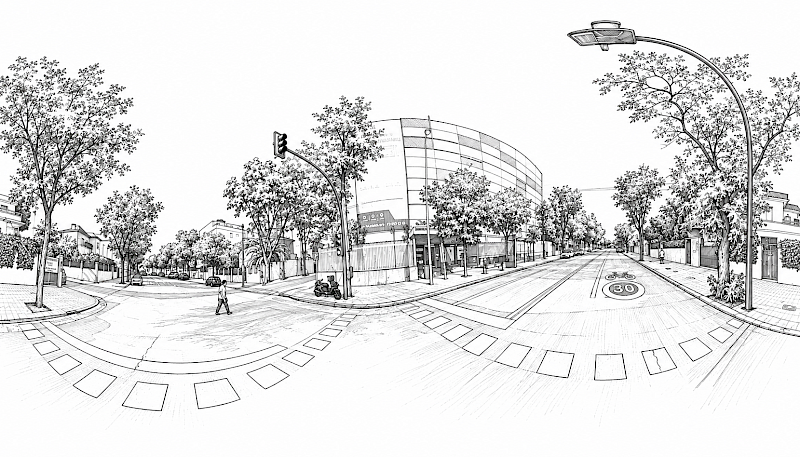
From Madrid to universities in different countries
What began in Spain grew in different stages and dates.
The #RutaNSQE took us to discover institutions in Spain, Argentina, Colombia, Uruguay, Chile and Germany.
Each visit was different, because each university was different too.
We met with teachers, specialists, managers and deans. They gave us guided tours, we toured classrooms, laboratories and other spaces, we discovered projects and, on some occasions, we shared classes.
We also came back with something very characteristic of those years: folders, brochures, programs, curricula and all kinds of printed material that we later used to expand the information available on NSQE.
Photographs and 360° tours were important, but the Route ended up being much more than that.
It allowed us to enter the universities and meet the people behind them.
Not all visits went as planned
Touring institutions left us with quite a few stories.
There were meetings prepared for weeks that were canceled at the last moment, changes of plans, trips that ended up being very different from what we had imagined and situations that were difficult to foresee.
During the Route in Valdivia, Chile, we even experienced a tremor.
On another occasion we were even summoned to a morgue.
They are anecdotes that over time became part of the history of the #RutaNSQE and that also show something we learned quickly: going out to truly get to know an institution is very different from looking up information about it from a computer.
Every door that opened could lead us to a completely different experience.
Showing a university from the inside is not always easy
In our experience, in several European institutions opening the doors, showing us the facilities, introducing us to professors and letting us observe how they worked felt quite natural. In Latin America we also had excellent experiences and met people who became deeply involved in the project, but many times we encountered more reluctance when it came to showing the day-to-day workings of an institution.
We wanted to see, listen, walk through and understand.
We were also experimenting with a new technology
Working with 360° images in those years was very different from doing it today. The cameras had limitations, processing the material could become a problem and, when something failed, the support available to fix it was quite scarce.
We photographed, processed, tested different tools and looked for the best way to allow a person to virtually tour an educational space. And the content started to work very well.
The Ruta changed form
At some point we stopped getting on a plane to visit each university.
But we never stopped wanting to get to know them.
And that is probably the most important part of this story.
Everything we had learned during the #RutaNSQE —entering institutions, talking with professors and administrators, learning how they taught and looking beyond institutional information— ended up turning into a new way of working.
Thus, over time, that experience gave way to the NoSeQueEstudiar Verification Program.
Today a university, business school, academy, institute or educational center can participate for free and request its inclusion in the NSQE catalog.
The process can be carried out through virtual interviews with professors and other people from the institution, in addition to learning about its educational offering and accessing current samples of courses, classes and materials.
After that process, NSQE reviews the institution and decides whether its profile can be added to the catalog as verified.
What the #RutaNSQE left us
The #RutaNSQE was a very important stage in the history of NoSeQueEstudiar.
It took us through different countries, allowed us to enter very different universities, talk with professors, specialists and deans, tour classrooms and laboratories, experiment with 360° images and see firsthand a part of the educational world that from the outside is often not seen.
There were also mistakes, cameras that didn't cooperate, unexpected situations and many hours of travel.
The #RutaNSQE stopped being a physical journey.
But the idea that set it in motion remains part of our way of working.