
Strategic degrees
Energy, food, technology and logistics connect different degrees with the development of Argentina, Uruguay, Brazil and Peru. Public priorities, student participation and employment outcomes help to understand the contribution of each program and the conditions for practicing it.

Degrees with strategic value for development
A degree gains strategic value when its knowledge helps solve important needs of a society. Producing safe food, ensuring electricity supply, preventing disease, training teachers and maintaining infrastructure are activities that require specific professional skills. Its continuity depends both on training new generations and on the conditions that allow these people to work.
That value changes according to the territory, its productive structure and the problems it faces. A specialty can be essential for one region and have few opportunities in another. It can also be necessary for the country.
Student demand, employment opportunities and the social importance of a degree can follow different paths. The number of students shows educational participation; hiring reflects labor needs; and strategic value includes contributions whose results may appear in the long term.
The strategic value refers to the contribution of a program to productive, social or territorial needs. Development plans help identify public priorities; university offerings show how the capabilities linked to them are developed.
Students, employment, and the country's needs
Student demand includes interest in enrolling and effective participation in studies. Applications, new admissions and enrollment describe different moments along that path. Enrollment brings together those pursuing a program; course registrations show participation in those subjects. Location, schedules and commuting costs also influence the possibilities for studying.
Job prospects comprise the possibility of finding work and the conditions in which it takes place. The relationship between tasks and training, stability, pay, and job location are all part of that picture. For people who change careers the possibility of taking advantage of prior knowledge and experience is also important.
Argentina and training for strategic activities
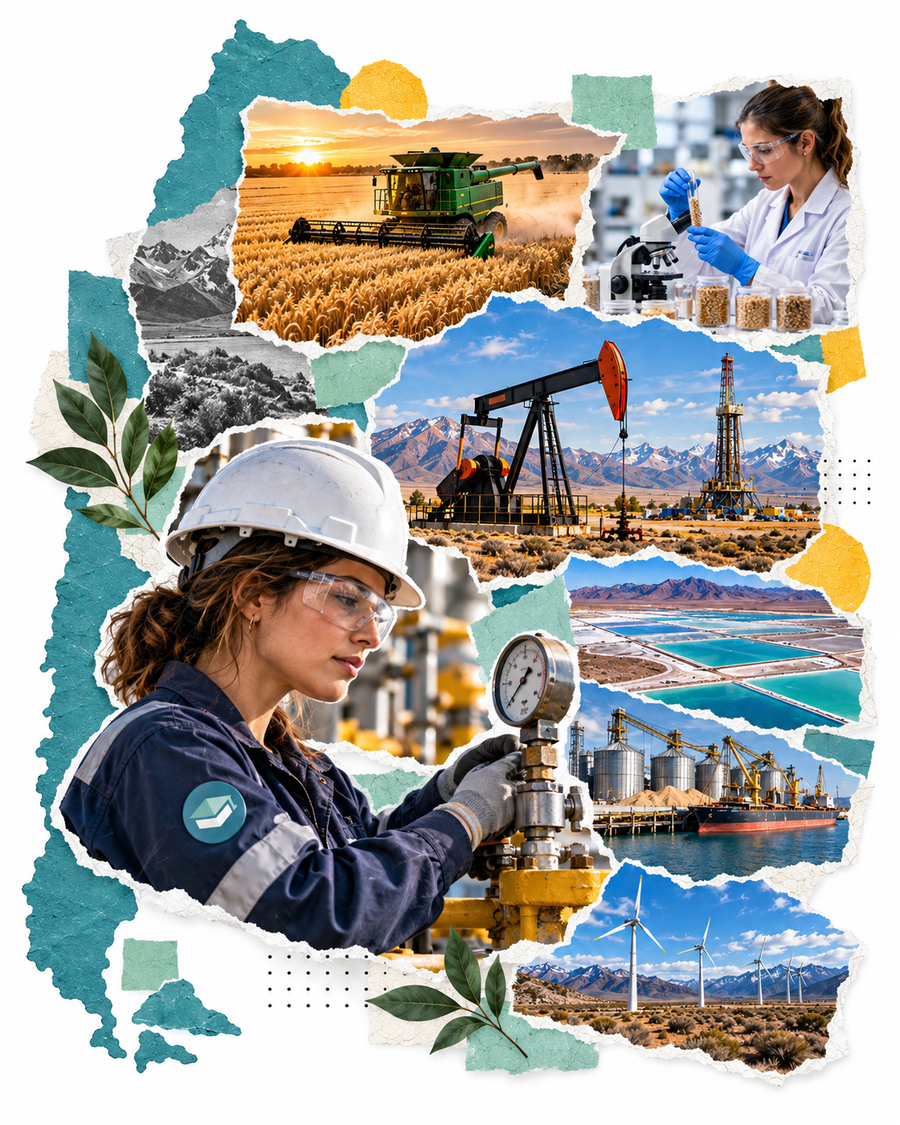
Training linked to the country's development covers different paths. An energy facility needs people capable of building it, operating it, maintaining it, designing it and improving its technology. Working with data also brings together programming, analysis, model development and research tasks. Courses, vocational training, technical programs, undergraduate degrees and postgraduate programs contribute different capabilities to these activities.
The Manuel Belgrano Scholarships are a support tool for pre-degree and degree programs. Their 2026 call covers Energy and Hydrocarbons; Mining and Geosciences; Logistics and Infrastructure; Agroindustry and Biotechnology; Information Technologies and Systems Control; Teacher training in strategic areas; and Exact and Natural Sciences.
These priorities make it possible to identify fields of public interest. Within them, the offerings from universities and technological bodies include programs with different requirements, certificates, and scopes. Their value is understood by connecting what they teach with the task they prepare you for.
Courses for incorporating specific tools
The updating of knowledge can also contribute to a strategic activity. The INTI includes in its offerings the course Energy management systems, aimed at learning about the IRAM-ISO 50001 standard and tools to analyze consumption, establish indicators, and improve the energy performance of an organization. The program is live virtual, does not require academic prerequisites, and provides an attendance certificate subject to participation conditions. Its availability and fee are confirmed when each edition is scheduled.
In the digital field, the training courses by the Cámara Argentina de Comercio y Servicios include online, self-paced, free programs on Business Intelligence, information security, e-commerce, and agile project management. They address specific tasks in commerce and services, such as interpreting information to make decisions, organizing projects, or adopting digital channels. In selected courses, those who meet the requirements can request a certificate of completion endorsed by Universidad CAECE and the CAC.
The INTI course focuses on energy management; the CAC programs develop tools connected with commercial and business activity. Their contribution lies in complementing knowledge and work practices. Each training program sets its own participation and completion conditions.
Professional training to work on facilities and processes
The skilled trades training in technical fields has its own place. The Consejo Federal de Educación approved the reference framework for Renewable Energy Electrical Systems Installer, corresponding to Initial Vocational Training. This framework guides the training and certification approval criteria, while the jurisdictions organize the curricular proposals and their implementation.
Training linked to companies and industrial organizations
Training from technology companies provides another path for staying up to date. The SIMATIC S7 TIA Portal Básico course from Siemens SITRAIN Argentina covers programming of programmable logic controllers (PLCs), configuration of equipment and diagnostic tools. The listing shows a five-day online format, aimed at programmers and configuration and commissioning engineers, and requires basic automation knowledge.
Its contribution focuses on learning to use a specific industrial automation platform through practical exercises on a model system. It is a paid training course that can complement the technical or university education of those who work with this equipment. The content makes it possible to assess its usefulness according to the technology used in the job or professional project.
Undergraduate studies and technical programs for operation and maintenance
The Tecnicatura Universitaria en Energías Sustentables at the UTN Facultad Regional La Plata has a published duration of two and a half years with in-person classes. Its training covers renewable energies, energy efficiency and operation and maintenance of equipment. It includes a supervised practice of at least 100 hours, which can be carried out in organizations in the sector or in the university's laboratories.
The school connects the profile with solar installations, low-power wind energy, measurements, diagnostics and technical support. Those functions explain its relationship with the use and maintenance of energy systems. For admission, secondary school documentation is requested; the degree is self-financed, with enrollment and fees. Equivalencies for previous studies are evaluated according to content and course load.
Undergraduate degrees to design, analyze and develop solutions
At the undergraduate level, the Ingeniería en Energía de la UNSAM offers in-person training lasting five and a half years. It integrates basic sciences, programming, conventional and alternative energies, efficient use of energy and environmental and regulatory aspects. Its profile connects design and technological development with the use of energy resources.
Within that field, the Energy Engineering, Mechanical Engineering and Electronic Engineering can contribute to the same project from different tasks. The difference appears in the contents of each curriculum and in the professional responsibilities for which it prepares.
Data Science provides tools to analyze information and build models applicable to problems in different areas. To explore this field, the contents of mathematics, statistics, programming and data analysis make it possible to distinguish the scope of each educational offering.
Food production provides another example. The Bachelor's Degree in Food Technology from Universidad Católica de Córdoba lasts four years and is taught in person. It provides training in processing and product development, quality and food safety. Its curriculum includes microbiology, bromatology, safety management and technologies from different food industries. The field of Food Science and Technology connects that knowledge with the preparation and control of products intended for consumption.
Specializations to deepen a professional practice
For those who already have university education, the Specialization in Food Technology at Universidad Católica de Córdoba explores production technologies, quality management and food innovation in depth. It combines synchronous virtual theory classes with intensive in-person practical sessions and includes a 100 clock-hour professional internship in industry, a laboratory or a pilot plant.
It is aimed at graduates in Food Technology, Nutrition, Pharmacy, Biochemistry, Veterinary Science, Agronomic Engineering, Biotechnology and related degrees. The program connects prior knowledge with issues involving raw materials, processing, quality and marketing. The practical component makes it possible to work on situations from the agri-food sector within a postgraduate program.
Master's degrees and doctorates to develop technological capabilities
The Master's Degree in Engineering at Instituto Balseiro has a published duration of two years and is in-person. Its initial guidance areas are related to nuclear, mechanical and telecommunications engineering. Admission requires a university degree of at least four years, solid foundations in mathematics and physics and passing the selection process. The 2026 call includes up to 20 full CNEA scholarships for 24 months, awarded through competition.
In the Doctorate in Engineering Sciences at Instituto Balseiro, training is organized around original research work and a thesis. Projects are developed in groups at Centro Atómico Bariloche, with the possibility of completing part of the work at another scientific-technological institution if authorized. Before applying for admission, each applicant must agree with a researcher on supervision, the work and training plan and the potential source of funding.
Doctoral research contributes new knowledge; specialization deepens a practice; degrees develop a broad education; and technical programs and vocational training prepare students for specific technical profiles. The strategic value depends on the capability that each path allows to be developed and on its application to a concrete need. Recognition of studies between programs is established through the plans, admission requirements, and agreements of each institution.
Uruguay and Training Linked to the Territory
In Uruguay, the location of educational opportunities is part of the discussion about development. Studying near one's place of residence can facilitate the continuity of a trajectory and the relationship with activities in the region. This dimension coincides with the priorities of decentralization, equity of access, and quality of training reaffirmed by the Ministry of Education and Culture in September 2026.
Food, logistics, biotechnology, and sanitation allow us to observe how different types of training complement one another. A food product needs controls during its preparation, adequate storage and transportation conditions, and processes that manage water and waste. Each stage brings together different knowledge and responsibilities.
Which degrees are related to strategic activities in Uruguay?
The educational offering of UTEC includes the Bachelor's Degree in Dairy Science and Technology, the Bachelor's Degree in Food Analysis, and the Engineering in Logistics. These programs connect technological training with the preparation and analysis of foods, and with the organization of their circulation and distribution.
The fields of Food Science and Technology and Logistics let you explore those activities through their content and professional tasks. Each institution defines the degree name, curriculum, and internships of its program.
In private education, the Biotechnology Engineering at Universidad ORT Uruguay offers another training path. Biotechnology uses biological knowledge to develop processes and products. Its connection to food, health, or the environment takes shape in the subjects, internships, and projects of each program.
Technical training and progression toward the degree
The Logistics Engineering at UTEC offers a five-year program, with the intermediate qualification of Logistics Technologist upon completing the third year. It is taught in Rivera and Fray Bentos. This structure recognizes a stage of training within a longer degree.
The technologist profile includes managing processes and supervising logistics centers. The engineering program adds the design and management of supply chains, as well as improvement projects and applied research. The difference between the two qualifications is reflected in their educational scope and in the responsibilities they prepare you for. Product distribution, warehouse organization, and transport coordination connect that learning to concrete activities.
Courses and training for those already working
The Cámara de Industrias del Uruguay provides training in business logistics, foreign trade, supervision and occupational health and safety. It also organizes tailored programs for companies. This type of training makes it possible to address specific problems, such as coordinating a team or improving the organization of an operation.
For its part, the INEFOP training catalog brings together job training options with their own requirements. Continuing education can complement a person's experience or introduce knowledge for a new role. A course certificate, its content and its admission requirements make it possible to identify what learning it certifies and how it relates to a technical or university degree.
Specializations and master's degrees in water and sanitation
The UTEC Postgraduate Program in Water and Sustainable Development shows how the same need can be addressed through different paths. The program, developed with IHE Delft, includes individual four- to five-week courses, a Specialization in Sanitary Engineering and Sanitation and academic and professional master's degrees with a Sanitary Engineering profile.
Its field of application includes effluent treatment plants, water and sanitation services and environmental control agencies. The master's degrees include a thesis, academic or professional depending on the path. The program combines online and in-person activities; it also allows access to courses and the specialization without an undergraduate degree when the institution verifies the required education and work experience. This option has specific conditions and is not equivalent to automatic admission to the master's degrees.
What participation and employment data show
The territorial dimension can be seen in the UTEC community. Its institutional report records 3,497 students in 2024 and an origin that, at the end of that year, reached 193 localities in the 19 departments.
The employment linkage survey prepared in the second half of 2024 indicates that 74.9% of graduates were working and 19.6% were looking for employment without working. Among those who were working, 82.4% indicated that their main job was related to their qualification. These are UTEC institutional results. They allow observing the link between education and work in that community, while the previous proposals explain what skills are developed in each field.
Brazil and education to transform production
In Brazil, the Nova Indústria Brasil organizes its priorities around agroindustry, health, infrastructure and mobility, digital transformation, bioeconomy and energy transition, and defense technologies. These activities require knowledge to develop products, improve processes and use technologies in specific situations.
What degrees are related to Brazil's industrial priorities?
Digital transformation helps understand how different degrees relate to the same priority. Computer Science provides foundations for developing computer solutions. Training in control and automation focuses on the operation of systems, equipment and processes. Both can be involved in an industrial facility, although their tasks and their curricula are different.
Training for these activities includes updating courses, technical education, higher degrees and postgraduate studies. In an industrial plant, improving production may involve maintaining equipment, integrating controls, analyzing data or researching a new process. The necessary preparation depends on the task and its complexity.
Courses to incorporate knowledge on sustainable production
The course Descarbonização da Indústria de Sebrae Santa Catarina has a published workload of six hours, online modality and free access. It is aimed at business owners, managers and industrial professionals. It includes energy efficiency, circular economy and technologies to reduce emissions.
Its purpose is to introduce tools and criteria for management. A short training course with these characteristics can help recognize improvement opportunities and communicate with specialized teams. The development of technical projects requires knowledge and professional attributions appropriate to each intervention.
Technical education and higher technology degrees
The Técnico em Automação Industrial de SENAI São Paulo prepares students to develop and integrate automation solutions considering technical, quality, safety and environmental requirements. It belongs to technical education linked to the Brazilian secondary level.
The Curso Superior de Tecnologia em Automação Industrial belongs, on the other hand, to higher education and trains technologists. It includes development, integration and management of automated systems, connectivity, energy efficiency and process supervision. In Brazil, the technologist qualification corresponds to a higher education degree. This distinction avoids confusing it with an upper-secondary technical course or with a training certificate.
Professional specialization and research training
The Specialization in Industrial Automation, Control and Robotics at SENAI CIMATEC deepens knowledge of instrumentation, industrial networks, robotics and control systems. It is an example of a postgraduate program aimed at updating and expanding professional skills in a defined field.
The Master's in Computational Modeling and Industrial Technology works with modeling and simulation in complex systems, cognitive systems and industrial processes. The SENAI CIMATEC postgraduate catalog also includes the doctorate in that field.
The specialization, the master's degree and the doctorate have different objectives and requirements. In the Brazilian system, specializations are part of lato sensu postgraduate programs, while master's degrees and doctorates belong to the stricto sensu category. Research expands the ability to formulate and study problems; its industrial application depends on the projects, teams and resources available.
Student participation and working conditions
In 2023, Brazil's in-person and distance undergraduate programs recorded 112.056 enrollments in Computer Science and 22.197 in Control and Automation Engineering. These are national enrollments in two programs related to technology adoption. Their scale describes educational participation, while industrial missions explain in which activities that knowledge can be applied.
The connection to work appears in the functions performed by its graduates. Programming a solution, integrating sensors, controlling a process or maintaining an automated system are activities that require different combinations of knowledge. The labor market by occupation helps complement educational information with the characteristics of tasks and their distribution.
These data make it possible to keep two aspects separate. Enrollments describe participation in certain degrees; occupational profiles help identify tasks and work environments. Industrial priorities explain why these capabilities may be relevant, and actual hiring depends on the investments and projects of each organization and region.
Peru and training for productive activities and services
In Peru, the territorial dimension helps to understand what different professionals are trained for. The agricultural production, mining activity, infrastructure and services require specific knowledge, the practice of which depends on the characteristics of each project and the region where it is carried out.
The same activity needs training at various levels. Operating equipment requires technical capabilities; designing systems demands broader preparation; and evaluating new solutions may require specialization or research. This relationship makes it possible to understand the contribution of each program without reducing all strategic training to a university degree.
Which degrees are linked to the regional needs of Peru?
Systems Engineering addresses problems related to computer systems and information; Mining Engineering, mining activity processes; and Agronomy, crop production and management. These programs develop different skills to work in technological and productive activities.
Electricity courses and industrial updating
The Tecsup Industrial Electricity Fundamentals course covers electrical principles with the support of measuring instruments and simulation tools. It represents a focused training option within a broader field, useful for understanding what knowledge is involved in the operation of electrical equipment.
For technological updating, the TECH SENATI Diploma in Industrial Automation 4.0 lists a duration of six months and live remote classes. It includes industrial controllers, communication networks, process supervision and an integrative project. Its purpose is to apply this knowledge to an automation solution. It is presented as a technological updating diploma, with a different scope than that of a professional career or a master's degree.
Technical training for electrical systems
The degree in Industrial Electricity with a specialization in Electric Power Systems at Tecsup develops competencies related to power generation, transmission, distribution and use systems. It includes analysis, implementation, automation, maintenance and management of electrical systems.
The link to development lies in the continuity and safety of the service, as well as in the operation of equipment used in different activities. Electric companies, industrial facilities and maintenance services are areas where these skills are applied. Its presence as a professional field makes it possible to identify where the training is used; the number of openings requires specific labor market information.
Undergraduate degree to design and integrate technology
In Peru, the term undergraduate degree includes degrees such as engineering degrees. The Mechatronics Engineering at the Pontificia Universidad Católica del Perú combines mechanics, electronics, control and computing. This integration prepares students to work with equipment and systems where these technologies operate together.
Its contribution can be understood in the design and development of automated systems. A degree of this type provides a foundation for addressing problems from several disciplines. Refresher courses, for their part, can deepen specific tools throughout working life. Continuity between both paths depends on the academic requirements and recognition of each institution.
Master's degrees to evaluate energy projects and solutions
The Master's in Energy at PUCP focuses on the analysis of energy systems, the evaluation of alternatives and the formulation of solutions. Its scope includes conventional and renewable sources, as well as energy uses in productive activities, transport and buildings.
The value of this postgraduate education lies in decisions that require comparing technical options and considering their feasibility and sustainability. At this level, prior education is deepened to work on more complex problems, technological development, or applied research. The relevance of postgraduate study depends on the field in which the person seeks to practice and on the knowledge they need to gain.
What student data from a regional university shows
The programs offered by the Universidad Nacional del Altiplano illustrate this diversity in a specific institution. During the second semester of 2024, as of October 17, it recorded 546 students in Systems Engineering, 518 in Mining Engineering, and 489 in Agricultural Engineering. The student numbers show participation in those programs within the university. Professional tasks explain what skills each one develops.
These figures correspond to one institution and a defined period. Within that scope, they show participation in programs associated with computing, mining, and agricultural production. Their connection to the previous proposals lies in the diversity of skills a region may need, from crop management to facility operation and systems development.

The value and impact of degrees
The strategic value of a degree is understood by identifying what it enables you to do, whom it benefits, and under what conditions it can make its contribution.
Productive importance and social contribution
Professional skills can contribute to improving processes, developing products, sustaining services, or solving environmental problems. Training in food allows you to take part in its production and control; logistics, in supply and distribution; and engineering, in effluent treatment and sanitation.
Social contribution also covers education, health, culture, and scientific knowledge. Teaching, preserving heritage, or researching a problem with no immediate commercial application yet has different objectives than increasing production. Its evaluation needs to consider the services it sustains, the people it reaches, and the knowledge it preserves or develops.
Importance of a career and personal choice
The career guidance connects these dimensions with each person's situation. The interests, the tasks they wish to perform, their prior education, the time available and the possibility of relocating are part of a sustainable decision.

International training and development experiences
Italy and Australia show two strategies. In Italy, the ITS Academy link technological training and work. In New South Wales, Australia, the Country Universities Centres bring university support to regional communities. Their objectives and methods of evaluation help to understand how an education policy can respond to different needs. The follow-up studies conducted in Spain, Ireland and Argentina broaden this perspective by observing job placement, educational continuity and the relationship between employment and training.
Italy and technical training connected with work
The ITS Academy combine technological training, internships and company participation. The 2025 national follow-up includes 450 training pathways completed in 2023, with 11,834 participating students and 8,588 graduates. 43% of the hours were internships and 74% of the teaching hours were delivered by professionals from the world of work.
Twelve months after earning the qualification, 84% of graduates were employed. Among those who were working, 93% had an occupation consistent with their training. The results document high job placement in the pathways analyzed. The involvement of professionals and internships show how the link with work is organized; graduate tracking makes it possible to learn about their subsequent employment situation.
The Italian analysis can be expanded with the research Ieri in aula oggi in azienda, published by INAPP in 2023. In the Higher Technical Education and Training —IFTS— courses studied, completed in 2017, approximately 73% of participants were working twelve months after finishing. The research also identifies a full match between training and employment for around 60% of those employed through this training pathway.
The organization of these pathways allows learning in situations related to professional activity and learning about workplace procedures during training. Internships and the involvement of professionals constitute concrete mechanisms linking teaching and work.
The national monitoring of ITS Academy adds another part of the strategy. Observing the completion of studies and subsequent situation of graduates makes it possible to evaluate outcomes beyond the number of enrolled students. It also provides information for reviewing training and its relationship with productive activities.
Australia and university access from regional communities
The Country Universities Centres in New South Wales offer study spaces, internet connection and support for pursuing higher education without moving. The government review published in 2024 notes that more than 80% of graduates found work in their home community or in other regional areas. 51% of students were the first generation in their family to access higher education.
The full evaluation of the Country Universities Centres, available as a PDF, reports on a 2022 student experience survey in which 89% of respondents said that the centre's support increased their chances of continuing their studies. This percentage expresses a perception of the support received, so it should be distinguished from an actual retention or graduation rate.
The report also provides a finding on the transition to work: 39 of the 45 graduates who answered that question, equivalent to 86.7%, said that the studies completed with the centre's support had helped them get their current job. The figure corresponds to those responses and shows how participants valued the employment usefulness of their training.
The evaluation was conducted by the Social Policy Research Centre de la UNSW. It included surveys, interviews with students, staff and community members, and an analysis of operating costs. The research found that, without these centres, many people from rural and regional areas would not have started or completed their university studies.
The strategy consists of sharing a local support space for people studying at different universities. Internet, study places and support are integrated into a community infrastructure. Its contribution makes it possible to analyse access to training together with the possibility of developing a professional activity in the region, especially in health, education and social work.
Spain and tracking employment outcomes
In Catalonia, the Employment Integration of Vocational Education 2024 study, published in 2025, analyzes the situation of those who finished their studies in the 2022–2023 academic year. Among higher vocational graduates, 66.78% were working, including both those working exclusively and those combining work with studies. Among those who were working, 72.78% saw a link between their occupation and the training they had completed.
In the Basque Country, the Lanbide follow-up of the 2023 Vocational Training cohort shows that 51% of respondents were working in October 2024, while 40% were in the studies or other situations category. Among employed people who answered about how well their job fit, 75% said it had a direct link or some link to their studies. The report shows both access to work and its characteristics.
Follow-up is also applied to university education. The 2023 AQU Catalunya report, referring mainly to the 2018–2019 and 2019–2020 cohorts, notes that 91% of graduates were working. Among those employed, 72.5% performed roles specific to their degree. In this case, observation takes place several years after completing their studies.
Ireland educational continuity
In Ireland, the report Graduate Outcomes for NFQ Level 6 & 7 Graduates — Class of 2023, published in 2025 by the Higher Education Authority, looks at the situation nine months after graduation. 40.8% were employed and 55.1% were continuing their studies. Regarding the link between education and work, 65% felt their course was relevant or very relevant to their job. Continued education is essential to interpreting the share who had entered the labour market.