What to study if I like technology
The technology may attract you for very different reasons. Maybe you're interested in understanding how systems work, working with artificial intelligence, analyzing data, automating processes, designing digital products, building machines, or discovering how a company can make better use of new tools.
That's why, knowing you like technology still leaves many possibilities open. The decision starts to become clearer when you identify what you'd like to do with it.
Besides, choosing a technology degree today requires looking ahead. Artificial intelligence is already changing tasks that until recently seemed inseparable from the work of programmers, analysts, designers, and other professionals. Learning to use these tools will be important, but so will developing abilities that allow you to decide what to build, understand problems, evaluate results, spot errors, and apply technology in real situations.
If you still don't have it clear which area might fit you best, the Career Test from NoSeQueEstudiar can help you connect your interest in technology with other characteristics of yours, such as your skills, preferences, and way of working. The result doesn't have to decide for you: it can help you discover options you can later research in more depth.
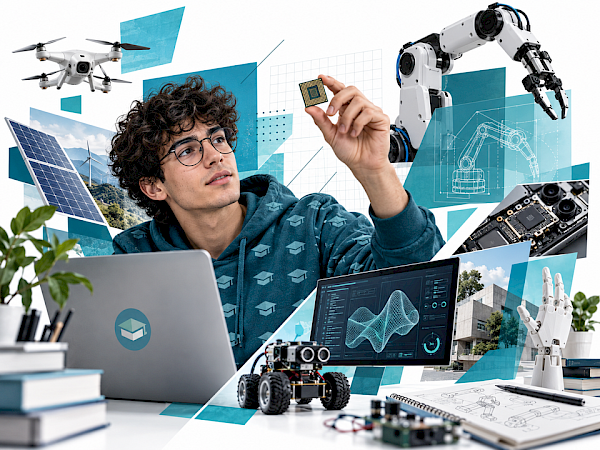
What is it about technology that really attracts you?
Think about what happens when you use an app, a computer, an artificial intelligence tool, or any new device.
Some people immediately want to discover how it works inside. Another person thinks about how to improve it. Someone else wonders what information can be obtained from all the data it generates. Another imagines a completely new product.
You may also be interested in technology because it allows you to solve problems that are not strictly technological: improve a hospital, organize a factory, predict demand, protect information, design an easier experience for a user or automate a repetitive task.

If you want to understand how computers and systems work
Informatics and the different disciplines related to computing remain important paths for those who want to understand how digital systems are built and how they work.
But the reason for studying them is changing. For many years, learning to program was practically synonymous with learning to produce software by writing large amounts of code. The artificial intelligence is automating a growing part of that work. A professional needs to understand how a system is structured, what information it uses, how its components interact, what its weak points may be and what technical solution is appropriate for a given problem.
They can use artificial intelligence to generate part of the code and, at the same time, need enough knowledge to know whether that code really does what it should do.
If you are interested in that level of understanding, you can explore Computer Engineering, Computer Science, Software Engineering and other related programs.
Does it make sense to study programming if artificial intelligence can write code?
Yes, it can, but not necessarily for the same reason as a few years ago.
The value of learning programming should no longer be measured only by your ability to manually write hundreds of lines of code.
Programming also teaches you to break down problems, work with logic, represent information, understand algorithms, detect errors and think about how a system should behave.
In an environment where an AI can generate much of a solution, those skills can help you direct the tool better and evaluate what it produces.
Imagine that an artificial intelligence generates in seconds a seemingly finished application.
There are still important questions left:
- Does it really solve the problem?
- Is it safe?
- Can it work with thousands of users?
- Is it using the information correctly?
- What happens if it receives unexpected data?
- How does it connect with other systems?
- Can we trust the result?
- Are we building the right thing?
Technology can dramatically reduce the amount of code a person needs to write and, at the same time, increase the importance of understanding what system is being built and why.
If you are interested in artificial intelligence
Feeling curiosity about AI doesn't lead to just one degree either.
You might want to develop models and algorithms, which usually brings you closer to fields like Computer Science, Computer Science, Mathematics, Statistics, Data Science or certain engineering fields.
You might also want to use artificial intelligence within another sector.
For example:
- AI applied to healthcare.
- AI applied to business.
- AI applied to design.
- AI applied to education.
- AI applied to industry.
- AI applied to scientific research.
- AI applied to finance.
In those cases, a combination can be very valuable:
understanding the technology + deeply understanding the field where you want to apply it.
This combination will probably become even more important as AI tools become more accessible.
If anyone can use a powerful tool, the difference may lie in knowing which problem is worth solving and how to do it correctly.

If you like data and finding relationships
Maybe you are not especially interested in creating applications. What you enjoy is getting insights from large amounts of data.
- You want to find patterns.
- Compare.
- Measure.
- Predict.
- Discover why something happened.
- Make a better decision.
In that world you'll find Data Science, Statistics, Economics, analytics and certain areas of Computer Science.
Artificial intelligence is also transforming this work.
It will be increasingly easy to ask a tool to prepare data, produce charts, write queries, or perform certain analyses.
But automatically producing an analysis does not necessarily mean understanding it.
Someone has to decide what question to ask, check whether the data is suitable, detect misleading relationships and correctly interpret the result.
If you combine technology, numbers, and curiosity to understand information, this group of degrees deserves attention.
If you're interested in robots, machines, and automation Not all technology lives inside a screen.
A machine that automatically adjusts how it works, an industrial robot, a vehicle with sensors, or a system that controls a production line combine software with physical elements.
Here you'll find different engineering fields related to electronics, mechanics, automation, control, systems industrial systems and robotics.
Artificial intelligence can make these systems increasingly capable of interpreting information and making certain decisions.
But it is still necessary to understand how software, sensors, energy, materials, mechanisms, and processes interact.
This path may be especially interesting to you if you enjoy seeing how a digital idea produces an action in the physical world.

If you're interested in technology and business
You don't necessarily have to choose between being a “technology” person or a “business” person.
Companies need professionals capable of connecting both worlds.
Think of a company that wants to automate part of its production using artificial intelligence.
Before implementing any tool you have to answer questions like:
- Which process should be automated?
- Will it really save time?
- What data do we need?
- How will people's work change?
- What risks arise?
- How does it integrate with existing systems?
- How do we measure whether it works better?
Industrial Engineering may be especially interesting if you are drawn to technology, numbers, organization, businesses and process improvement.
You can also find paths in information systems, business analytics, Administration, digital transformation and other related areas.
Here the professional does not necessarily build each technology from scratch.
Often their work consists of deciding how to use it to solve a specific problem.

If you are interested in designing technological products
Technology also needs people who understand how human beings interact with it.
Think of an app that technically works perfectly but that no one understands.
Maybe you enjoy observing how screens are organized, why certain buttons feel intuitive, what elements create confusion or how a task could be simplified.
You can explore digital product design, user experience, interfaces, Graphic Design, Industrial Design and other fields where design and technology meet.
Artificial intelligence is also changing these careers because it makes it possible to produce images, interfaces and prototypes much faster.
That makes it even more important to know how to choose what to design, for whom and with what goal.
Generating twenty options can be easy. Recognizing which one works best for a real person still requires judgment.

If you are interested in cybersecurity
The more we depend on digital systems and artificial intelligence, the more important it becomes to protect information, infrastructure and identities.
Cybersecurity may appeal to people who enjoy researching systems, detecting vulnerabilities and thinking about what could happen if someone tries to break the rules.
It can involve networks, software, cryptography, operating systems, incident analysis, data protection and many other areas.
The AI can also be used both to detect threats and to try to create them, so this field will probably continue to evolve rapidly.
Curiosity, attention to detail, analytical ability and technical knowledge are usually especially important.
If you enjoy fixing technological problems
There are people who, when something stops working, prefer to immediately call someone else.
And there are those who feel the need to figure out what happened.
- They change settings.
- They look for information.
- They try alternatives.
- They compare possible causes.
That kind of reasoning can appear in Computer Science, tech support, systems, electronics, networks, etc.
But try to distinguish what kind of problem you enjoy.
- Software errors?
- Computers and devices?
- Networks?
- Machines?
- Complete systems?
If you like video games
That you enjoy playing very much does not mean necessarily that you should study video game development.
But there may be something in them that interests you professionally.
Maybe you want to understand how a character's behavior is programmed.
You may be more interested in animation and graphics.
Maybe you constantly analyze the rules and decisions that make a game fun.
Or what really attracts you are the stories, the worlds, the sound or the players' experience.
A video game combines technology with programming, design, art, storytelling, music, data and many other disciplines.
Before deciding, identify which part you would like to create, not just which product you like to consume.
If you want to create technology without spending all day programming, it is also possible.
The development of technological products involves profiles that define needs, research users, design solutions, organize projects, analyze data, make decisions and coordinate teams.
As IA automates more technical tasks, the value of people capable of moving between different worlds will probably increase.
Someone who understands technology enough to work with it, but also deeply understands business, health, industry, design or any other sector, can have a very interesting profile.
That is why do not reduce your options to:
“programmer or non-programmer”.
There is a huge territory between both extremes.
If you are still studying, think about the capabilities that can last longer than a tool When a technology changes fast, learning a specific tool is not enough.
What dominates an industry today may be replaced in a few years.
That is why it is worth observing which capabilities can help you develop a career.
- Understand problems.
- Think logically.
- Work with data.
- Model systems.
- Learn quickly.
- Make decisions with incomplete information.
- Research.
- Design.
- Understand people.
- Work with teams.
- Evaluate results.
- Combine different disciplines.
- Use artificial intelligence effectively.
- Supervise what it produces.
These capabilities can adapt to new tools.
Do I need to be good at Math to study technology?
It depends on the path.
Math is usually quite important in different engineering fields, Data Science, artificial intelligence, computing and other quantitative disciplines.
In other technology areas they may appear during your studies without necessarily becoming the center of professional work.
Don't confuse either: "Math is hard for me" with "I don't want to use Math".
If you struggle with it but you're really interested in a degree, you can improve.
If you really don't enjoy quantitative thinking and want to avoid it being central to your career, then it's worth looking at the curriculum and the real work before deciding.
Do I need to know how to code before starting a technology degree?
No.
But trying it can help you decide a lot.
You don't need to study programming for years. A small project can show you if you enjoy the process.
The same applies to other areas.
- If you're drawn to data, try analyzing something you're really interested in.
- If you're interested in design, try creating a prototype.
- If you like machines, experiment with electronics or basic automation.
- If you're interested in AI, try building something with it instead of just using it as a search engine.
Hands-on experience lets you quickly discover which part of technology you enjoy and which only seemed interesting from the outside.

What degrees could you explore?
Depending on the type of technology and problems that interest you, options may include:
- Computer Engineering.
- Computer Science.
- Data Science.
- Statistics.
- Industrial Engineering.
- Electronic Engineering.
- Mechanical Engineering.
- Mathematics.
- Economics.
- Business Administration.
- Industrial Design.
- Graphic Design.
And other engineering and specialized training programs. You don't need to research them all.
Select those that match the type of activity you want to do.
A way to narrow down the options
Choose the two options that appeal to you most from this list:
- Create digital systems.
- Work with artificial intelligence.
- Analyze data.
- Build or automate machines.
- Protect systems.
- Design digital products.
- Apply technology to businesses.
- Use technology to solve scientific problems.
- Combine technology with another field I'm interested in.
Then research which degrees most often lead to those activities.
For example:
- Data + AI can lead you toward Data Science, Computer Science, Statistics or Mathematics.
- Business + automation can bring you closer to Industrial Engineering and other areas of technology management.
- Machines + software can point you toward different engineering degrees.
- Design + technology opens completely different paths.
With two elements combined, the map starts to become much more manageable.
Use the Career Test to add your other characteristics
Your interest in technology is only one part of the decision.
It also matters whether you enjoy numbers, whether you are creative, how you solve problems, how much contact you want to have with other people, whether you prefer working with physical objects or digital systems and what kind of professional environment you imagine.
The NoSeQueEstudiar Career Test can help you combine these characteristics and show you degrees you might not have been considering yet.
If an unfamiliar degree appears, research it. If one you had already considered appears, try to understand which of your characteristics may relate to it. And if something does not fit you, keep looking. Also research what the work will be like, not only what you will study, a degree can have subjects that interest you and end up leading to a way of working you had not imagined.
When you find three or four options, research how their professionals really work.
- Do they spend much of the day in front of a computer?
- Do they work with clients?
- Do they coordinate teams?
- Are they in factories or laboratories?
- Do they analyze information?
- Do they build products?
- Do they do research?
- Do they need to constantly learn new tools?
- Do they regularly use AI?
- Is technology the center of their work or a tool?
A choice improves a lot when you can imagine not only what you will study for a few years, but also what problems you might be solving afterwards.

So, what to study if you like technology?
- You don’t need to find the most “technological” degree.
- You need to find the type of technology and problems you really want to learn about.
- If you want to understand and build computing systems, look into Computer Science and Computing.
- If you’re drawn to information and patterns, look at Data Science, Statistics, and related fields.
- If you want to work with machines, sensors, and automation, explore different engineering degrees.
- If you’re interested in technology, organization, and business, look into Industrial Engineering and other paths that combine management and systems.
- If you want to protect infrastructure and information, dig deeper into cybersecurity.
- If you’re interested in AI, first decide whether you want to develop it, apply it to another industry, or use it to create products and solve problems.
And if you still don’t know which of those paths fits you best, you don’t need to choose blindly. Explore, experiment, compare degrees, and use tools like the Career Test to also factor in what you do well and how you want to work.
Technology will probably change many times during your working life.