
Flight Attendant
Are you fascinated by the idea of traveling and connecting with people from different cultures?
Then, consider becoming a Passenger Cabin Crew Member. This career is one of the most sought-after by young people around the world, as it offers a unique combination of independence, travel and personal development.
Degree in Passenger Cabin Crew
The degree in passenger cabin crew member (TCP), commonly known as flight attendant, is an attractive but also demanding occupation. Its role is vital, as they are the main point of contact with passengers during a flight, taking care of their comfort and safety.
To enter this degree, there are several requirements to consider. First, you must be over 18 years old and have completed secondary or high school education. In certain cases, a basic level of English is also needed. In addition, due to the specific conditions of working on board an aircraft, certain physical standards must be met, such as height and weight, in order to move easily in confined spaces.
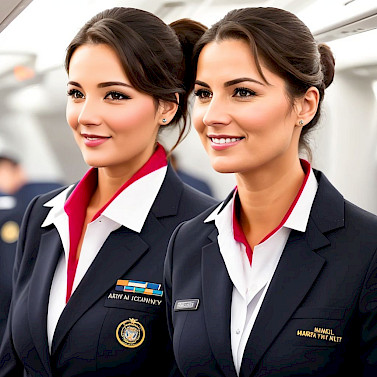
For years, the Passenger Cabin Crew Member (TCP) position was known as Flight Attendant for women and Flight Purser for men, terms that are still used in some contexts.
The main responsibility of TCPs is to ensure compliance with all safety measures on the aircraft, both under normal conditions and in emergency situations.
TCPs must be highly responsible in their duties, both inside and outside the aircraft, to ensure a safe and comfortable flight for all passengers. In addition to their technical skills, it is crucial that TCPs possess a high degree of empathy and a basic understanding of psychology, given that they interact with passengers in the unique and confined environment of an aircraft.

Do you feel called to travel and explore the world while you work?
The career of Cabin Crew Member could be ideal for you. This role is especially popular among global young people who value independence, travel opportunities and social interaction. Crew members usually have a flexible schedule of between 15 to 20 flight hours per week, which allows them to effectively combine their work and personal life.
In general, training programs are made up of theoretical and practical subjects.
The theoretical subjects include:
1. Aeronautical Knowledge
2. Obligations and Responsibilities
3. Public Relations and Social Behavior
4. Human Factors
5. Emergency Procedures
6. Land Survival
7. Water Survival
8. Swimming and Lifesaving
9. Tourism Geography
10. Airport Security
11. Search and Rescue
12. Aeromedical Information and First Aid
13. Transport of Dangerous Goods
14. Accident Prevention
15. Meteorology
16. Aeronautical Technical English
17. (Optional) Conversational English
As for the practical subjects, the following are covered:
1. Land Survival;
2. Water Survival;
3. Swimming and Lifesaving;
4. Aircraft Emergencies.
Admission Requirements:
- Minimum age of 18;
- Completed secondary education;
- Psychophysical exam;
- Swimming and floating skills;
- Knowledge of conversational English.
This course will provide you with all the skills and knowledge needed to become a well-rounded professional in the aviation industry.
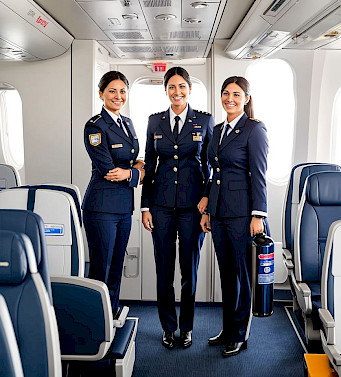
The Flexibility that Changes Lives
Crew members usually fly between 15 and 20 hours per week. This flexibility in the schedule and the lack of routine allow balancing professional and personal life, giving the opportunity to devote time to other activities or studies.
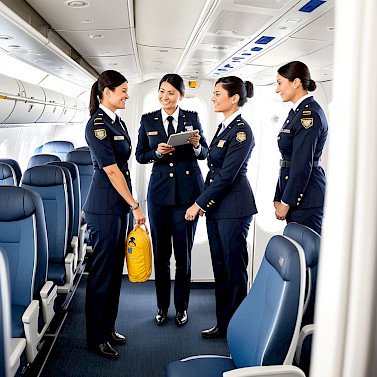
A Constant Adventure
The career offers the freedom to travel, explore new environments and connect with people from different cultures and social classes.
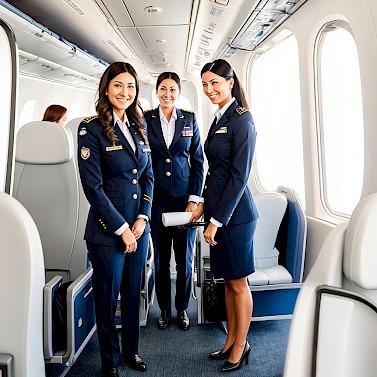
A Promising Future in Aviation
Airlines always need qualified aircraft dispatchers. This is a high-responsibility career with enormous potential for professional growth.
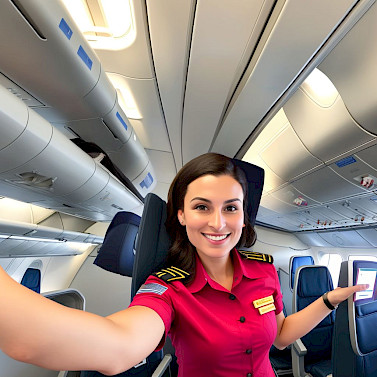
Key Aspects of the Career
- Responsibility;
- Technical knowledge;
- Career projection;
- Safety;
- Competitive compensation.
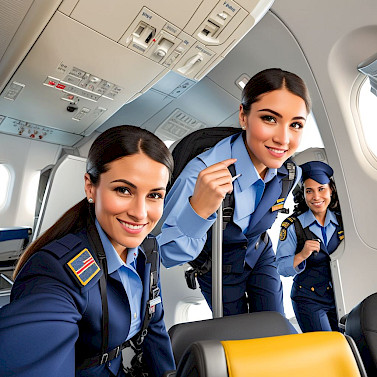
Frequently Asked Questions about Passenger Cabin Crew Member (TCP)
What responsibilities does a Passenger Cabin Crew Member (TCP) have on a flight?
The main role of the Passenger Cabin Crew Member (TCP) is to ensure safety during the flight. This includes prior preparation, handling emergency situations, possible incidents or accidents, and crucial participation in the evacuation of the aircraft if necessary.
Are Passenger Cabin Crew Members (TCP) only responsible for safety?
Although safety is the main function, Passenger Cabin Crew Members (TCP) are also responsible for supervising and providing onboard services. They are considered the face of the company to passengers and must have excellent public and human relations skills to handle various situations during the flight.
What forms of communication do Passenger Cabin Crew Members (TCP) use?
While Passenger Cabin Crew Members (TCP) employ a variety of forms of communication, non-verbal or gestural communication is often more prominent than verbal communication. This type of communication is essential, especially in situations where noise or stress can hinder verbal communication.
What is meant by leadership in the context of a Passenger Cabin Crew Member (TCP)?
Leadership in a Passenger Cabin Crew Member (TCP) is shown through their ability to handle difficult situations with authority and calm. This involves conveying calm and order to passengers, and ultimately ensuring that proper procedures are followed in case of unforeseen events or emergencies.
What additional services do Passenger Cabin Crew Members (TCP) provide?
Apart from focusing on safety, the Passenger Cabin Crew members (TCP) offer a full range of on-board services. This includes everything from customer service and managing individual needs to providing food service. They are also responsible for providing clear information and communication to passengers.
How does the performance of a Passenger Cabin Crew member (TCP) impact the perception of the airline?
The Passenger Cabin Crew members (TCP) are often the most visible staff of an airline, and their performance can have a significant impact on how passengers perceive the company's service. Good service and a sense of safety can make a big difference in an airline's reputation.
Is it important for Passenger Cabin Crew members (TCP) to have skills in psychology and empathy?
While it is not a formal requirement, the ability to empathize and understand passengers' emotional needs is very beneficial. This is especially useful in stressful situations where staying calm and composed is essential.
Can Passenger Cabin Crew members (TCP) be considered sales representatives for the airline?
Yes, to a certain extent. By providing exceptional service and ensuring passenger safety, the Passenger Cabin Crew members (TCP) become unofficial ambassadors for the airline, which can have a positive impact on customer loyalty and on the public perception of the company.
Studying to become a flight attendant in Argentina
A variety of institutions in Argentina offer training courses for TCP. These courses include theoretical and practical training, and usually last between 4 and 18 months. It is vital to ensure that the institution is approved by the National Civil Aviation Administration (ANAC).
The Instituto Superior de Enseñanza Aeronáutica Palomar (ISEAP) offers a curriculum made up of 9 theoretical subjects, complemented by practical training in on-board services and swimming.
The Centro Nacional de Estudios Aeronáuticos (Ceneas) is one of the oldest institutions in this field, with 25 years of experience. It offers a complete curriculum covering 17 theoretical subjects and 5 practical subjects. Courses here last between 8 and 12 months, and upon completion, graduates must demonstrate swimming and conversational English skills.
The Instituto de Formación Aerocomercial (IFAC) also has a 25-year history. Its programs last from 4 to 11 months and are made up of 14 subjects, including English and Portuguese languages, as well as training in handling emergency situations.
The Instituto de Capacitación Aeronáutica (ICA), with locations in Córdoba and Mendoza, has been operating since 1989. Its courses comprise 9 subjects and vary in length between 2 and 18 months, allowing some flexibility for students.
The Centro de Estudios El Palomar (CEEPA) stands out for its curriculum, which includes 10 theoretical and practical subjects focused on emergencies and water survival (ditching). The courses last between 6 and 10 months and feature a full-scale mockup of a Boeing 737 for practice.
AeroCESNA has been awarding official qualifications since 1992. Its programs cover 16 subjects related to rescue, evacuation and survival. This institute allows enrollment from the age of 17, provided secondary education has been completed.
Finally, the Escuela Aeronavegantes, linked to the Asociación Argentina de Aeronavegantes, has a course comprising 16 subjects and requires prior knowledge of English.
These institutions offer comprehensive training, preparing future TCP in areas such as customer service, aviation safety and handling emergency situations, as well as proficiency in additional languages.