Aviation
Studying Aviation allows you to learn to operate aircraft and prepare flights to transport people, cargo or perform aerial work. A pilot's training combines technical knowledge, flight practice and training to respond to normal and emergency situations.
If you want to dedicate yourself to flying, the first step is to identify which license you need for the activity you are interested in. Preparation for recreational flights, instruction and commercial transport follow different paths. The name of the course or academic degree should be accompanied by specific information about the license and ratings it gives access to.

Why Study Aviation?
This training may interest you if you enjoy understanding how an aircraft works, working with procedures and combining study with practical activities. Flying requires observing, anticipating changes, communicating clearly and coordinating tasks with other people.
It also involves studying throughout your working life. Changing aircraft, adding a rating or maintaining proficiency requires new practice and assessments. Daily work includes preparation, checks and recording information, in addition to time in flight.
Before choosing a school, get to know its facilities and ask for an explanation of the training path. Ask how classes are organized, what availability the aircraft have and how long a student usually needs to complete each stage.
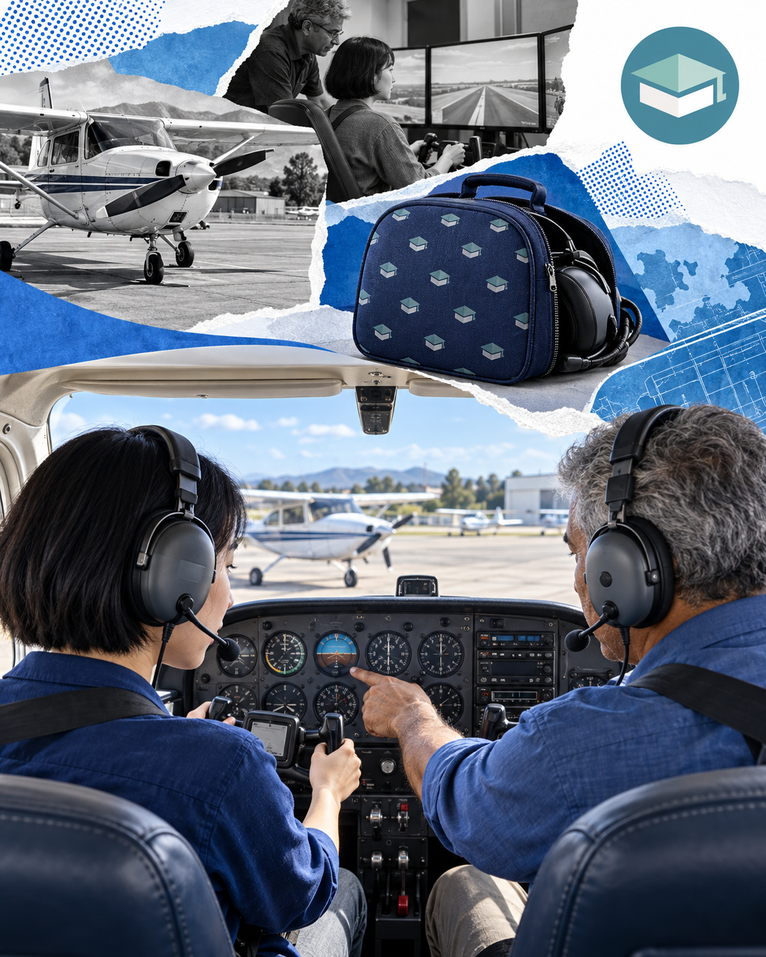
How to Become an Airline Pilot?
The path depends on the country where you train and the applicable licensing system. It includes theoretical training, flight experience, exams, medical assessment and the corresponding ratings. To work for an airline you will also have to meet the operator's selection and training requirements.
It is useful to distinguish the private pilot license from professional training. In the United States, for example, the FAA distinguishes the privileges of private and professional pilots: the private license has restrictions on carrying out paid flights. The commercial certification and a company's hiring requirements are separate stages. Check the equivalent path in the country where you want to work.
In Argentina, ANAC publishes information on pilot licenses and ratings and the registry of certified centers. In Spain, AESA provides the list of approved training organisations. Check which courses each center is authorised to teach.
Psychophysical fitness is determined through the corresponding aeronautical medical examination. In Spain, AESA requires a Class 1 medical certificate for professional CPL and ATPL pilots. Check the assessment that corresponds to your goal before taking on the main training costs.
English is also part of the preparation for international operations. The OACI sets operational level 4 as the minimum reference for language proficiency. Practice should include comprehension and oral communication in aeronautical situations.
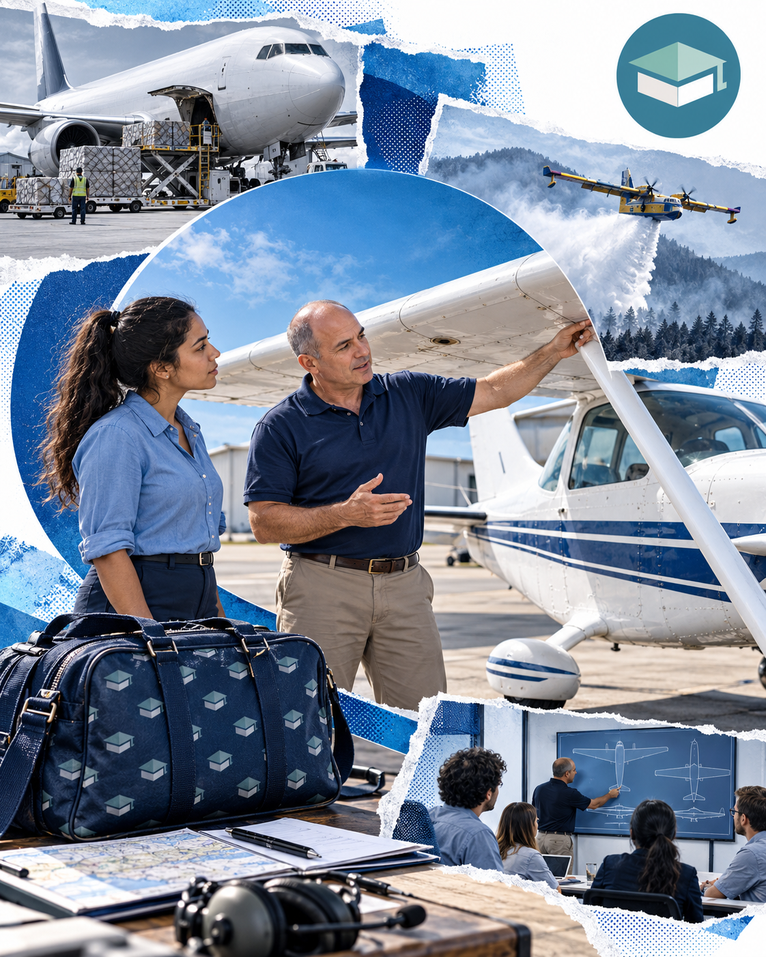
Pilot training in other countries
Comparing countries lets you discover different ways of organizing training. Review both the program and the authority that will issue the license, as well as the place where you want to work.
- Spain. AESA provides for modular and integrated training. In the modular path, professional preparation starts from a private pilot license; the integrated path organizes the course from the beginning. Ask the school for the schedule, the stages, and the licenses or ratings included to assess how the program fits your availability.
- United States. The FAA distinguishes instruction under Part 61 and schools certified under Part 141. The latter must use structured programs and curricula approved by the authority. When comparing options, ask which system each course follows, how progress is recorded, and what experience requirements apply to the certification you are seeking.
- Chile. The DGAC publishes the commercial pilot license requirements, which include theoretical knowledge, instruction, experience, and a flight proficiency exam. It also distinguishes between instruction centers, training centers, and flight instruction companies. Check which program each organization has approved and which practical training the authority recognizes.
- Mexico. AFAC organizes procedures by license type, including private, commercial, and airline transport pilot licenses. Before enrolling, identify the planned license upon completion, the privileges included in the course, and the documentation required to apply for it.
If you want to study in one country and work in another: first check the recognition, validation or conversion procedure that the destination authority will apply. For example, AESA publishes information on FAA license conversion. Ask them to clarify what training, exams and documents you will need. Add accommodation, travel and the relevant immigration procedures to your budget.
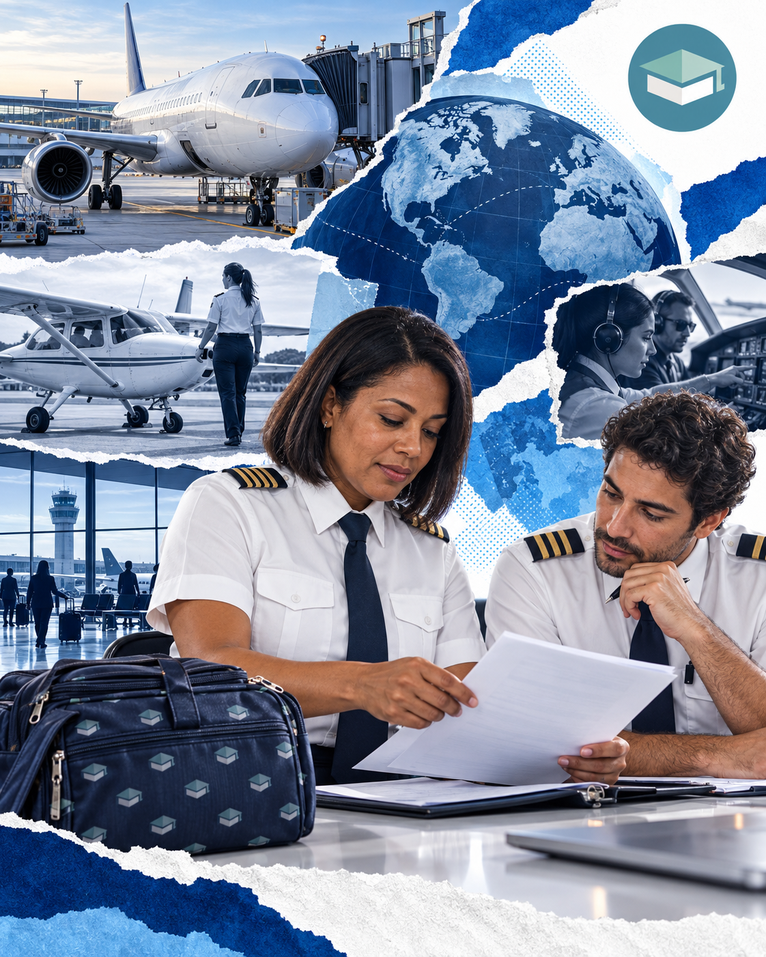
What is studied in aviation?
Pilot training covers how an aircraft flies, how its systems work, and how an operation is prepared and carried out. The FAA aeronautical knowledge manual brings together typical areas of this preparation:
- Principles of flight and aerodynamics: forces acting on the aircraft and behavior during flight.
- Systems and instruments: controls, equipment and reading flight information.
- Meteorology: atmospheric conditions and use of meteorological information.
- Navigation and airspace: route planning, guidance and organization of the flight environment.
- Performance, weight and balance: relationship between load, weight distribution and aircraft capabilities.
- Human factors: effects of fatigue, attention, communication and risk assessment.
In Argentina you can check the Private Pilot - Airplane theory content published by ANAC to learn about part of the initial study.
The mathematics, physics and geography help you understand calculations, movement and guidance. To explore the design and technical development of aircraft, check out the approach of Aeronautical Engineering, which has its own objectives and content.
Duration and budget. Ask for a written breakdown of tuition, classes, flight hours, simulator, exams, materials and paperwork. Ask how additional practice sessions and rescheduling are charged. Compare proposals that include the same stages and details; a single figure alone may leave out an important part of the process.
How theory and practice are connected
Theory is applied to specific tasks: interpreting the forecast weather, calculating weight and its distribution, reading the instruments or preparing a route. When you compare courses, ask for examples of how this content is taught and how its application is assessed during practice sessions.
Also ask what training takes place in an aircraft and what part uses simulators or training devices. In Chile, the DGAC specifies that synthetic trainers must be certified and that the credits for each device require approval. The name “simulator” alone provides little information: ask which device is used and which hours count toward your course.
The risk management is also part of learning. To understand a school’s approach, ask how it teaches students to assess the conditions of an operation, recognize limits and review what happened after a practice session.
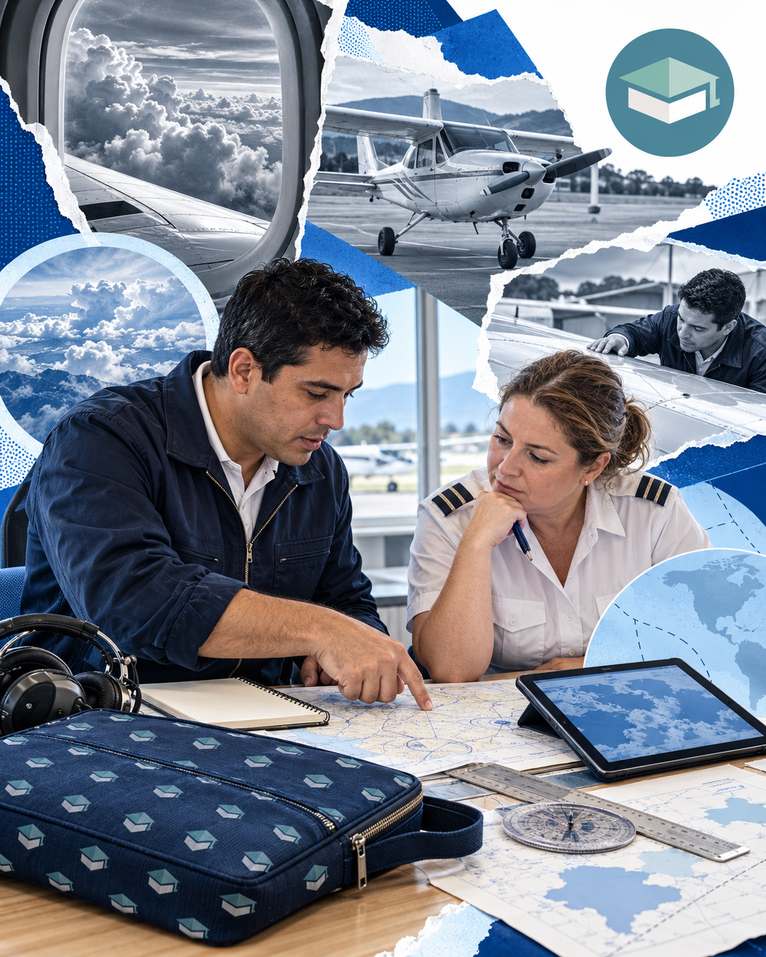
What does an aviator do?
A pilot prepares and operates an aircraft within the privileges of their license. Before the flight they analyze the available information, check the operating conditions and coordinate with the people involved. During the flight they monitor the systems and the environment, follow procedures and communicate with air traffic services when appropriate.
Preparation can focus on passenger or cargo transport, instruction and specialized aerial work. ANAC distinguishes, among others, training and assessment for commercial pilot, instructor, crop-duster and forest-firefighting pilot. Each activity requires the corresponding preparation and authorizations.
Air traffic control, maintenance and airport operations are other areas of the sector. They have their own training paths: ANAC publishes separate categories of aeronautical personnel. If you are drawn to working in aviation, compare the tasks of each career before choosing a course.
Aviators who trained to fly
These paths show different learning and specialization journeys: flight instruction, military training, university studies and advanced training.
- Chesley “Sully” Sullenberger — United States. He learned to fly at age 16 and continued his training at the Academia de la Fuerza Aérea de Estados Unidos. He was a military pilot and later an airline pilot. His background includes instruction, accident investigation and air safety work; he participated in developing US Airways crew resource management training.
- Shaesta Waiz — Born in Afghanistan and trained in the United States. She studied Aeronautics at Embry-Riddle Aeronautical University, where she earned undergraduate and master's degrees. In 2017 she made a solo around-the-world flight with the Dreams Soar project, which combined aviation and educational activities. Her journey connects university studies, flight and promotion of science education.
- Zara Rutherford — Belgium and United Kingdom. Her site documents United States and United Kingdom private pilot licenses, as well as ultralight licenses from France and Slovakia. The FlyZolo team identifies instructor Will Robson, who took part in her preparation. In January 2022 she completed a solo around-the-world flight in an ultralight.
- Patty Wagstaff — United States. She began taking flying lessons in Alaska and later trained in aerobatics, according to the biography from the Museo del Aire y del Espacio de San Diego. She was a three-time United States national aerobatics champion. Her work includes airshows and specialized instruction, a career focused on advanced training.
- Jessica Cox — United States. She earned her sport pilot certificate in 2008, after three years of preparation. Born without arms, she learned to operate an Ercoupe with her feet. Her training required finding an instructor, a suitable aircraft and completing the corresponding evaluation process. Her case offers insight into a specific accessibility journey in sport aviation.
Knowing about these experiences helps you explore different activities within aviation: carrying passengers, teaching, competing, preparing expeditions, or developing educational projects. To choose your own path, connect those tasks with the license and training they require.
To get started, define what activity you want to do, check its official requirements, and compare authorized centers. Then, organize your study time, practice, and budget according to that path.