How to become an airline pilot?
Para ser pilot for an airline you need to complete aeronautical training, obtain the corresponding licenses and ratings, build experience and pass a company's selection and training process. The path varies depending on the country where you study and where you want to work.
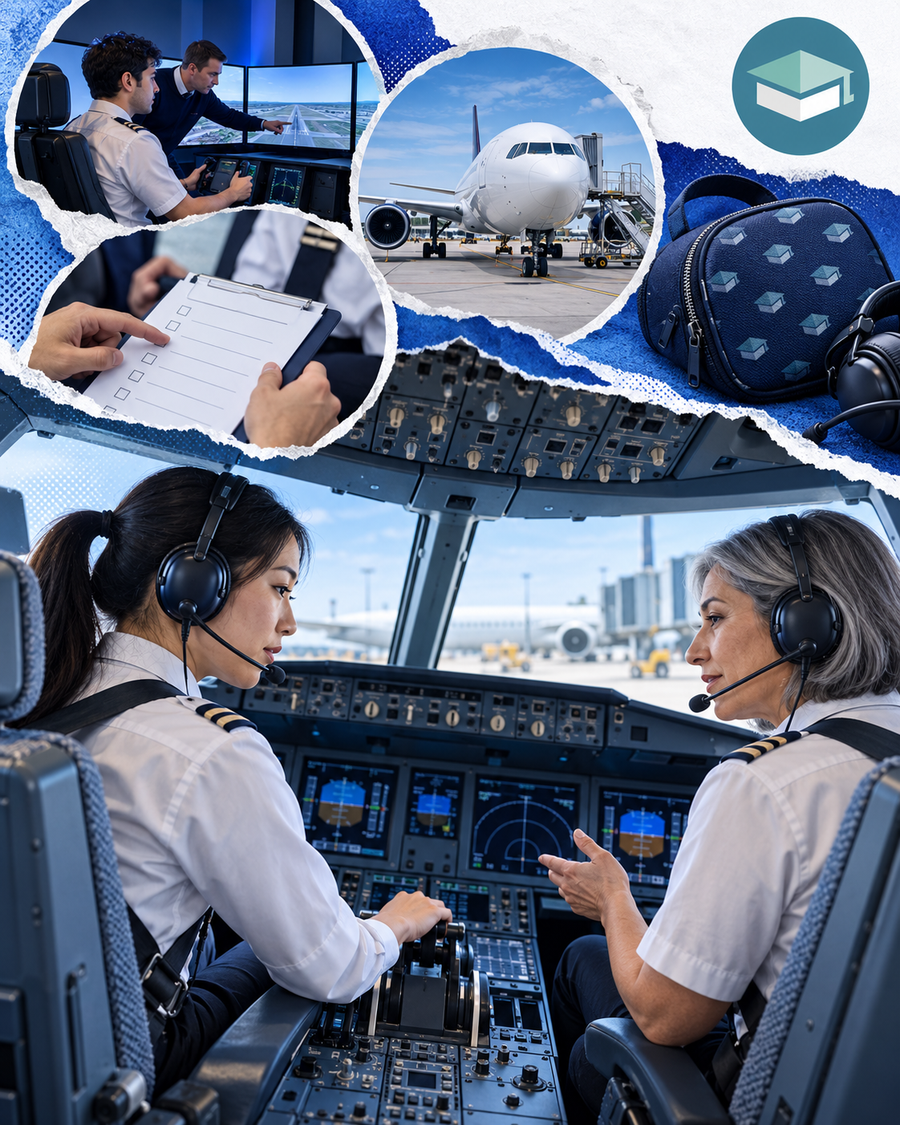
Becoming an airline pilot
Training involves much more than handling the controls: interpreting the weather, planning an operation, monitoring systems, coordinating with the crew and responding to changes or emergencies. Automation requires pilots to understand the equipment and supervise how it works.
Before enrolling, define three things: which authority will issue your license, what stages the program includes and what the requirements are of the airlines you want to apply to. That information lets you organize your studies, practice and budget from the start.

Learning to fly
You can train at a school, an academy, a university program or a military institution. Compare the content and authorizations of each option. The term “airline pilot course” can cover different stages depending on the institution.
The main training paths
- Flight schools and flying clubs. They let you organize training in stages. Check which courses are authorized, what availability instructors and aircraft have, and how progress is assessed. If you need to combine your studies with other activities, ask for the actual schedule of theory and practical sessions.
- Academies with integrated programs. They bring together several stages in a planned pathway. Review what tuition includes: theory, practical training, simulator, exams, and ratings. If there is an agreement with an airline, read its conditions and distinguish between access to a selection process, an interview, and a job offer.
- University programs in Aviation. They can combine academic studies and flight training. Ask separately for information about the degree and about the planned licenses. Duration, content, and recognition depend on the program.
- Military training. It is part of a service career, with its own selection, responsibilities, and obligations. If you are interested in this path, check the official admission channels or those of your country's air force. Later entry into civil aviation requires reviewing the applicable equivalences and requirements.

What to sort out before paying for the course
Medical certificate. Check the assessment required for the career goal you are pursuing. In Spain, AESA establishes the Class 1 medical certificate for CPL and ATPL pilots. In other countries, categories and procedures vary. Making this inquiry at the start lets you know the requirements before facing the main expenses.
Language. Aeronautical English requires understanding and conveying spoken information in flight contexts. OACI sets operational level 4 as the minimum benchmark. Check when it is assessed and what certification the authority that will issue your license accepts.
Budget. Ask for a breakdown of enrollment, theory, flight hours, training devices, exams, fees, and materials. Add transportation and accommodation if you have to relocate. Ask how additional practice sessions are charged, what happens with rescheduling, and what conditions apply to advance payments.
The stages you need to identify
- Initial training. Aeronautical knowledge and supervised practice. The FAA knowledge manual includes aerodynamics, systems, instruments, navigation, meteorology, weight and balance, and human factors.
- Professional license and ratings. Identify the commercial license and the privileges needed for the planned operation. The acronym CPL designates a commercial license; IR refers to instrument flying. Each system sets its own requirements.
- Experience. Document the required flight times and types. How they are distributed and logged matters: pilot-in-command time, cross-country, night or instrument flight, among other categories.
- Preparation for team operations. Check what crew coordination training and what aircraft-specific preparation you will need. The type rating is linked to a model or group of aircraft defined by the regulations.
- Operator selection and training. Review the specific opening, its assessments, and the onboarding program. Separate the legal licensing requirements from those requested by the company.
How the path changes by country
Argentina. ANAC publishes the register of certified centers. Resolution 651/2025 eliminated the First Class Airplane Commercial Pilot category, and Resolution 65/2026 approved a new edition of Part 61. When comparing schools, ask for the pathway based on those regulations and verify the licenses and ratings it leads to.
Spain. AESA provides for modular and integrated training. The modular pathway starts from a PPL, private pilot license; the integrated one organizes learning from the outset. Check the center's authorization in the list of approved training organisations. Ask for the program to detail which license is obtained, which theoretical exams are completed and what training remains pending before joining an airline operation.
Within the European framework, the privileges of the CPL include acting as co-pilot in commercial air transport, subject to the applicable requirements and restrictions. The ATPL is the airline transport pilot license. Passing its theoretical exams is one stage of the process: ask the school to distinguish between the theoretical course, the license to be issued by the authority and the training required for the position you are aiming for.
United States. The FAA distinguishes training under Part 61 and schools certified under Part 141, which use approved structured programs. For the airplane ATP certificate, the general experience rule requires 1,500 hours, with the regulatory distribution and conditions. There are restricted-privileges ATP pathways, including certain university and military training programs. The FAA also distinguishes the ATP CTP program and authorized university programs. Check whether the option you are considering meets the specific conditions for your chosen pathway.
Chile. The DGAC publishes the commercial pilot requirements, covering knowledge, instruction, experience, and a skill test. Its information distinguishes the general path from training at instruction centers. Check the types of authorized centers and companies and verify what training the program you plan to take covers.
Mexico. The AFAC distinguishes the procedures for private, commercial, and airline transport pilot licenses. Ask the school to identify the graduation license, the ratings included, and the documents you will need to submit for its issuance. Compare that preparation with the requirements published by the companies where you want to apply.
Canada. Transport Canada publishes the conditions for commercial and airline transport licences. For those arriving with a foreign licence, it details the medical certification, experience, knowledge and skill requirements in its licences for foreign pilots guide. Documentation of hours and ratings is part of the process to be reviewed.
Studying and working in different countries. Check the recognition, validation or conversion of the licence in the destination country before choosing a training centre. Confirm separately the immigration requirements for studying and working. Include in your planning the exams, practical training and additional procedures required by the receiving authority.
How to compare schools and academies
In addition to checking the centre's authorization, ask for specific answers about how the course is run:
- What licences, ratings and exams the price includes.
- How many aircraft and instructors are available for the group.
- How practical sessions are assigned and cancelled sessions are made up.
- What simulators are used and what credits the authority recognizes.
- How hours are logged and documents are delivered to the student.
- What conditions the contract has in case of interruptions or a change of centre.
Education and instruction can also be part of a pilot's path. If you are interested in teaching flying, check the instructor rating or certificate and the training required by your licensing system.
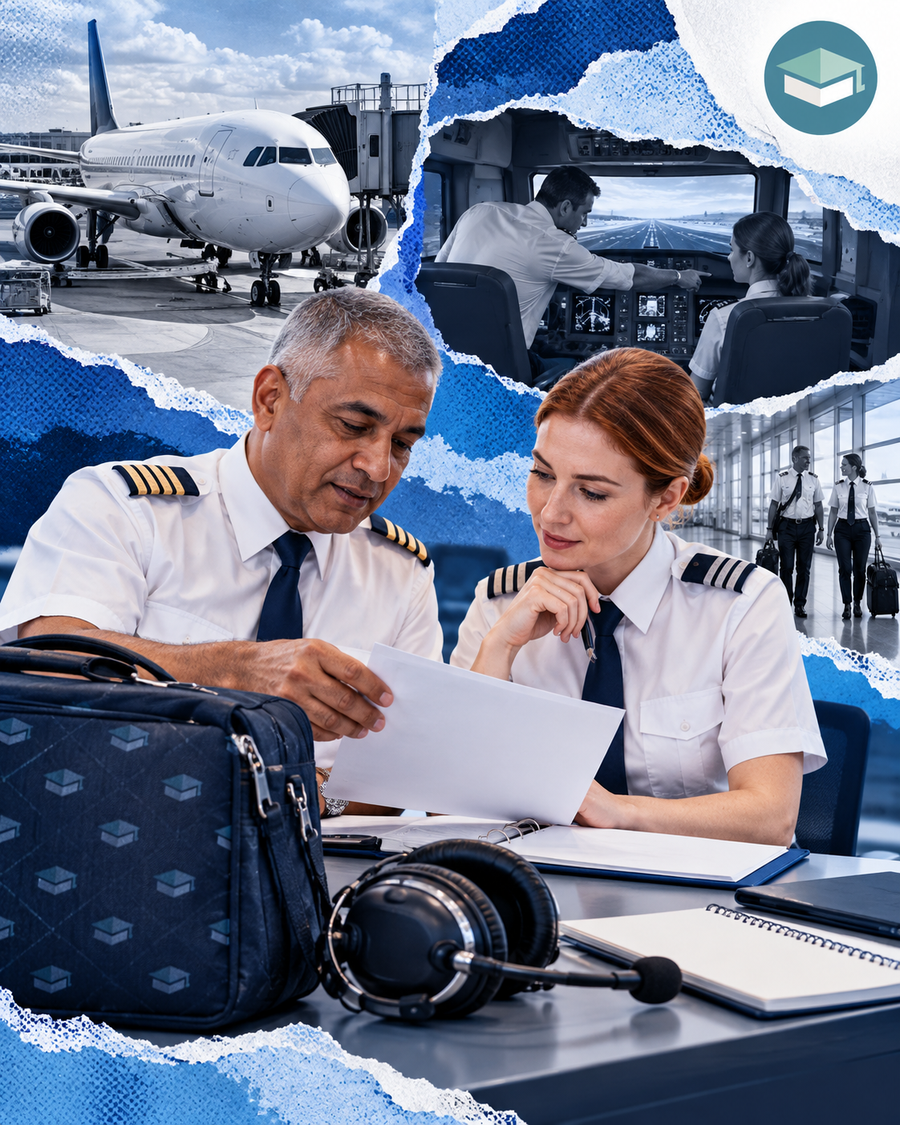
Gaining Seniority
Joining an airline opens another stage of learning: company procedures, aircraft training and adaptation to operations. The first officer shares flight duties with the captain. Accumulated experience must be accompanied by evaluations and preparation to take on new responsibilities.
The promotion to captain depends on licensing requirements, performance, internal processes, and vacancies. Seniority can influence base, fleet, and schedule assignments, according to each company's rules.
When reviewing a job offer, ask how progression is organized: what evaluations are carried out, what experience is required, what training the company offers, and how promotion opportunities are assigned. It is also useful to know what happens if you change airlines or fleets.
How much money airline pilots really earn
To interpret a salary you need to know the country, the year, the currency, the position, and the items included. A figure for an experienced captain provides different information than an offer for a first officer joining the company.
As a reference for the United States, the Bureau of Labor Statistics reports an annual median of 232,140 US dollars in May 2025 for airline pilots, copilots, and flight engineers. It is a measure of that occupational category as a whole: half earn more and half earn less. The median brings together different levels of experience.
For Argentina, Spain, Chile, Mexico, or Canada, compare offers and scales for the local market. Note whether the amount is gross or net, whether it is monthly or annual, and which part corresponds to fixed salary, activity, per diems, or benefits.

State of the Industry
Air transport connects markets and supports activities such as tourism and logistics. Its evolution is related to the economy, fuel costs, aircraft availability, and operating conditions.
An example of these changes is the IATA forecast published in June 2026, which reduced expected airline profitability due to higher fuel prices and disruptions in the Middle East. The report differentiates the effects by region.
In the United States, the BLS projects 7% employment growth for commercial and airline pilots between 2025 and 2035. That projection refers to a specific market and period. To plan your entry, follow the job openings, requirements, and fleet plans of the companies that interest you.
Factors affecting airline pilot salaries
When comparing positions, review both pay and work organization. Conditions are better understood when analyzed together:
- Role and responsibility. Identify whether the position is first officer, captain, or instructor, and what additional duties it includes.
- Airline, base, and fleet. Review the expected place of residence, routes, and aircraft you are being hired for.
- Seniority and progression. Check how the pay scale changes over time and what conditions are required to move to the next level.
- Pay calculation. Distinguish base salary from activity-related items and check what minimums the contract sets.
- On-call duty and availability. Ask how reserve works, how far in advance assignments are communicated, and where you must remain available.
- Rest and travel. Consider days off, nights away from home, transfers, and time spent at base.
- Benefits and training. Review health coverage, vacation, accommodation during assignments, and the conditions of company-funded training.
Prepare a written comparison of offers using these same criteria. To start the journey, choose the country and target license, check the medical certification, and ask authorized centers for a complete program with stages, schedule, and costs. That way you can organize your training and know what you will need to demonstrate to apply to an airline.