
Paleontology
A fossil does not tell its story on its own. To interpret what organism it was, when it lived and how it related to its environment, you have to study its anatomy, the rocks that contain it and the evidence left by other living beings. That is the work of Paleontology: reconstructing the history of life from a record that is always incomplete.
Paleontology: what to study, where to study it and what a paleontologist does
If you are thinking about studying Paleontology, it is worth learning about both its discoveries and its day-to-day work. The career includes excavations, but also hours of observation, sample preparation, comparison of collections, data analysis and scientific writing. It can lead you to research dinosaurs, but also plants, mollusks, microorganisms, footprints or ancient ecosystems.
What is Paleontology and what does it study?
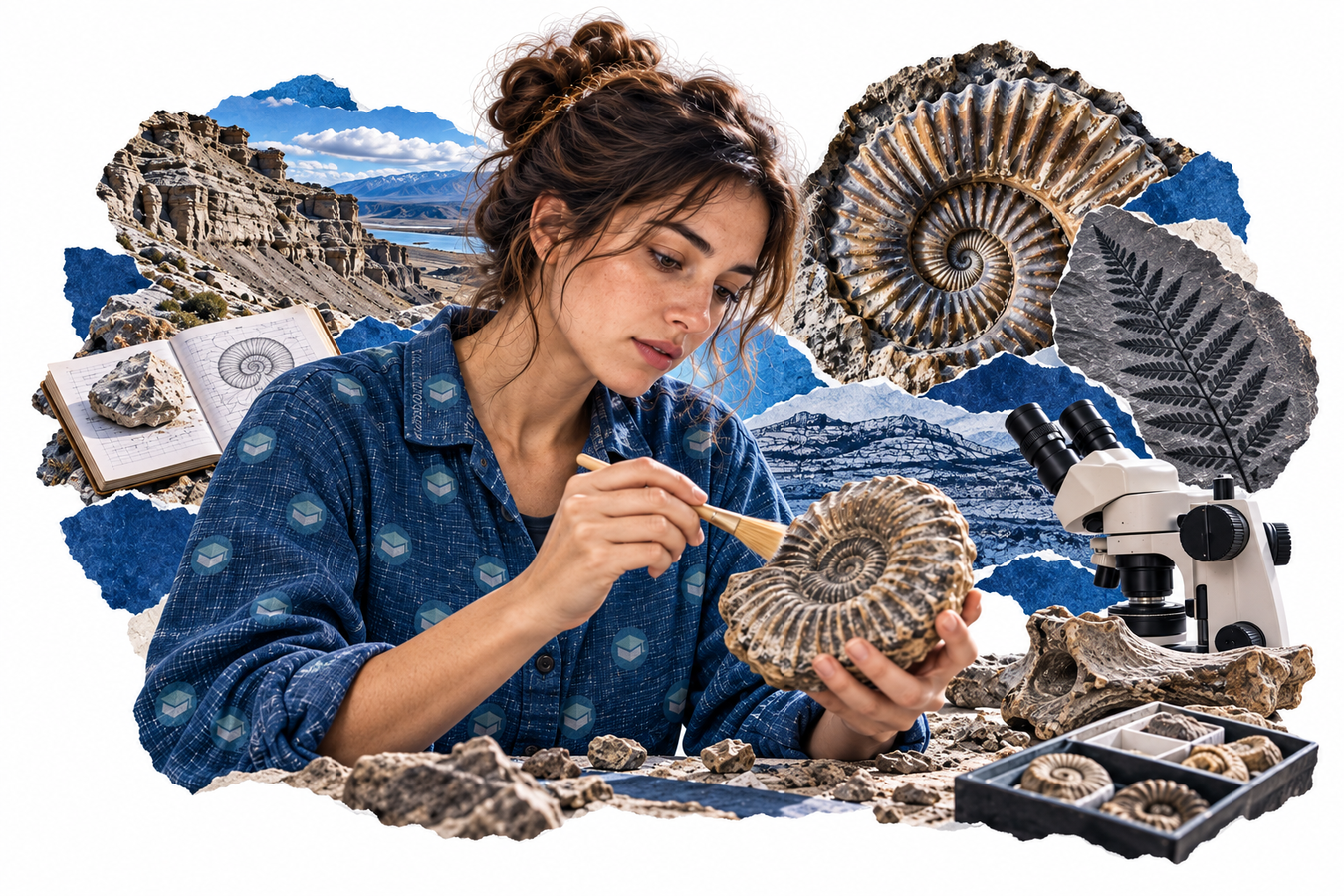
Paleontology is the science that studies past life through fossils and their geological context. It combines tools from Biology and Geology to investigate evolution, extinctions, the diversity of organisms and changes in environments over time.
A fossil can be a bone, a shell, a leaf preserved in rock, a mold or a sign of activity, such as a footprint or a burrow. That is why the discipline is not limited to studying skeletons. The Natural History Museum's explanation of fossil types helps to understand the variety of evidence used in this work.
Its main specialties include:
- Vertebrate Paleontology: studies animals with backbones, such as fish, reptiles, birds and fossil mammals.
- Invertebrate Paleontology: investigates organisms such as mollusks, arthropods, corals and other groups without backbones.
- Paleobotany: analyzes fossil plants and the history of vegetation.
- Micropaleontology: studies fossils that require microscopic observation.
- Palynology: works with pollen, spores and other microscopic organic particles, both modern and fossil.
- Ichnology: interprets footprints, traces, borings and other signs of organism activity.
- Paleoecology: reconstructs the relationships between living beings and their ancient environments.
- Taphonomy: investigates what happened to remains from the death of the organism to their preservation and discovery.
Is it the same as Archaeology?
No. Archaeology studies human societies through their material evidence; Paleontology investigates the history of life. Their fields may meet in research on human evolution or the animals that lived alongside ancient populations, but they have their own questions and methods.
When was Paleontology born?
Interest in fossils is much older than the career. However, modern Paleontology was consolidated between the late 18th century and the 19th century, when comparative anatomy and the study of strata made it possible to interpret remains as evidence of past organisms and environments.
Georges Cuvier was a decisive figure in that process: he compared fossil animals with living species and helped establish that some species had disappeared. In 1822, Henri-Marie Ducrotay de Blainville proposed the term “paleontology”, as explained by the Centro de Investigación en Paleontología de París on the birth of the discipline's name.
Science and the university degree were not born at the same time. There is no single creation date for the Paleontology degree for all countries. Its teaching developed within the natural sciences, Biology and Geology; specific guidance, bachelor's degrees and postgraduate programs later emerged. That is why, today you can find different qualifications that lead to this activity.
What should you study to become a paleontologist?
There are three main paths: pursuing a specific degree in Paleontology, studying Biology with paleontological guidance or specialization, or training in Geology and later specializing in the fossil record.
The choice depends on the type you want to research. If you are interested in the anatomy, kinship and evolution of organisms, a biological foundation can be especially useful. If you are drawn to rocks, sediments, environmental reconstruction and correlation between sites, geological training provides fundamental tools. A specific degree seeks to integrate both approaches.
What subjects and skills do you need?
Content varies by institution, but training usually combines:
- Biology and evolution: diversity of organisms, comparative anatomy, classification and kinship relationships.
- Geology: minerals, rocks, sedimentology, stratigraphy and Earth's changes.
- Paleontology: fossil identification, taphonomy, paleoecology and study methods.
- Quantitative tools: statistics, measurement, data organization and reproducible analysis.
- Practical work: field recording, material preparation and collection management.
- Scientific communication: reading literature, writing reports and presenting results.
English is especially useful for consulting publications and participating in international projects. Programming, geographic information systems, scientific photography and three-dimensional modeling can also broaden your profile. Their importance depends on the specialty: not all paleontologists use the same techniques.
How long does the degree take? Is a doctorate necessary?
The duration depends on the qualification and the country. For example, the Bachelor's Degree in Paleontology at the Universidad Nacional de Río Negro has an expected duration of five years, while the BSc in Paleontology and Evolution at Bristol is organized in three years.
To build an academic research path, the usual route is to continue with a doctorate. This involves carrying out original research, analyzing its results and defending a thesis. The requirements for technical, educational or management positions are different and should be checked in each call for applications.
The Natural History Museum career guide, based on the experience of paleontologist Susie Maidment explains the importance of solid scientific training and postgraduate studies for research.
Where is it best to study Paleontology and why?
The best option for you should meet three conditions: training suited to your interests, real opportunities for hands-on practice and a total cost you can sustain. The reputation of an institution does not replace analyzing its program, its collections, its research teams and its admission requirements.
Universidad Nacional de Río Negro, Argentina: a specific degree
The Bachelor's in Paleontology from the Universidad Nacional de Río Negro is a relevant option if you want to enter training dedicated directly to the discipline.
Its planned length is five years and it includes an intermediate qualification of University Technician in Paleontological Methodology and Practice upon completing the first three years. The university reports professional fieldwork in fossil sites and a profile that includes research and heritage protection.
Why consider it? For its specific training and the chance to gain paleontological experience during the degree. Before choosing it, check how the practical training is organized, its costs and the conditions for student participation.
Universidad Nacional de La Plata, Argentina: Paleontology through Biology
The Bachelor's in Biology with guidance Paleontology from the Universidad Nacional de La Plata offers a path that connects the study of organisms with the fossil record.
Why consider it? It may be suitable if you are especially interested in biological diversity and evolution. In addition, the Museo de La Plata has specialized areas, such as its División Paleobotánica.
The existence of these collections provides a valuable scientific environment, but it does not guarantee an internship: check which activities are actually available to students.
Universidad de Zaragoza, Spain: specialization after the degree
The Máster Universitario en Paleontología de la Universidad de Zaragoza is a postgraduate option, so it requires prior university education.
Why consider it? It allows you to deepen your knowledge of the discipline after a related degree. It is a relevant path for those who have already studied science and want to steer their education toward Paleontology. Check the admission requirements and the lines available for the final project; it should not be confused with a degree to start immediately after high school.
What to ask before enrolling
- What do you actually practice? Ask for examples of field, laboratory and collection activities included in the subjects.
- Which specialties have active faculty? Look for recent research, in addition to the names of the subjects.
- How do you access projects and final papers? Ask about requirements, places and forms of support.
- What resources can students use? Distinguish between existing equipment and equipment available during training.
- How much does it cost to complete the degree? Include accommodation, travel, materials and field trips.
- What paths do its graduates follow? Request information about research, technical jobs and other professional placements.
What tasks does a paleontologist perform?
Work begins with a question: what group does an organism belong to?, how did a community change?, what relative age do certain sediments have?, what evidence supports a reconstruction? Finding a fossil may be part of the process, but the goal is to produce a well-founded interpretation.
- Plan the research: review background, select materials and define methods.
- Record the context: document the location, strata and conditions of the find.
- Prepare and preserve samples: work with specialists to allow their study without losing information.
- Compare materials: use collections, bibliography, images and measurements.
- Analyze hypotheses: evaluate possible explanations and their limitations.
- Communicate results: write articles and reports, present papers and participate in educational activities.
Not all of these tasks correspond to a single person. Teams may include researchers, preparators, collection managers, imaging specialists and professionals from other sciences.
Where does a paleontologist work? Examples of places and roles
Research institutes and universities
In these settings you can study evolution, anatomy, extinctions or ancient environments; lead projects, train students and publish results. An Argentine example is the Instituto de Investigación en Paleobiología y Geología, linked to CONICET and UNRN, with research on the fossil record and the geological history of Patagonia.
To build a research career, in addition to the undergraduate degree, the doctorate, methodological experience and scientific output usually matter. Access depends on scholarships, competitive calls and funding.
Museums and scientific collections
The work includes identifying, cataloging, preserving and studying fossils; documenting their provenance and facilitating consultation. A collection serves to verify previous research and formulate new questions.
In Trelew, Chubut, the collection of the Museo Paleontológico Egidio Feruglio shows the importance of field numbers, cataloging and conservation.
There are scientific positions and technical roles with different requirements. Preparing a specimen, managing a collection and leading research are related activities, but require specific competencies.
Preparation and digital research laboratories
Some people specialize in removing the rock that surrounds a fossil, stabilizing materials or documenting its condition. Others work with CT scans, photographs, three-dimensional models and measurements to study structures that are difficult to observe directly.
In Cataluña, Spain, the Institut Català de Paleontologia Miquel Crusafont describes work that connects excavation, preparation, conservation, research and outreach. It is an example of how different roles contribute to the study of the same material.
Geological consulting and subsurface-related industries
Micropaleontology and biostratigraphy can help correlate sediment layers and reconstruct depositional environments. These tools have applications in geological research and in subsurface-related activities.
The description of the UNLP career scope includes applications in hydrocarbons and minerals. This is a field that requires specialization: training focused on large vertebrates does not automatically mean being prepared to interpret microfossils from boreholes.
Heritage management and public agencies
They may also take part in inventories, site assessment, conservation advice and projects to protect paleontological heritage. These roles can be carried out in provincial or municipal agencies or institutions responsible for collections and sites.
The career profile includes heritage advisory and management tasks. To apply for a specific position, you need to review its requirements and the competencies required in the relevant jurisdiction.
Education and science communication
Paleontology can be part of teaching, exhibitions, educational materials and outreach. For example, the Museo de La Plata develops educational programs about the fossil record and geologic time.
To teach, the requirements depend on the educational level and local regulations. To communicate science, in addition to knowledge of the discipline, you need to adapt the content to the audience and distinguish evidence, hypothesis, and artistic reconstruction.
These places are examples of professional activity, not job vacancy announcements.
Paleontology role models and what they contributed
Learning about their paths lets you discover questions and specialties that might interest you.
- Georges Cuvier: a leading figure in comparative anatomy and the study of fossil animals. His work was important in recognizing extinction as part of the history of life.
- Mary Anning: made fundamental discoveries of marine reptiles on the coast of Dorset, England. Her story also helps us understand the barriers women faced in 19th-century science. You can learn about her contributions in the Mary Anning biography from the Natural History Museum.
- Florentino y Carlos Ameghino: were important figures in the development of Argentine paleontology. The interpretation and publication of materials relied on explorations and collections, including those carried out by Carlos. The profile of Florentino Ameghino published by the UNLP explains that collaboration.
- Zulma Gasparini: a pioneer in the study of marine reptiles in Argentina. Her career shows that researching fossil vertebrates encompasses much more than land dinosaurs. A study shared by CONICET on Patagonian ichthyosaurs recognizes her contribution.
- Juliana Sterli: a researcher dedicated to the origin and evolution of turtles. Her scientific profile at the Museo Paleontológico Egidio Feruglio offers a look at a contemporary line of research.
These careers do not represent a single professional model. The discipline advances through teams, new techniques, and the critical review of earlier interpretations.
Advantages of studying Paleontology
- Working with deep scientific questions: investigating how life changed and what evidence allows us to reconstruct its history.
- Combining different methods: observation, fieldwork, laboratory work and quantitative analysis.
- Developing transferable skills: interpreting data, documenting procedures and communicating results is also useful in other scientific and technical fields.
- Contributing to heritage conservation: protecting materials and their context allows other people to study them in the future.
- Choosing from diverse specialties: from plants and microfossils to vertebrates, footprints and ecosystems.
Disadvantages and difficulties of the degree
- A specialized job market: there are fewer employers directly linked to the discipline than in careers with wider application.
- Extended training for research: the doctorate and other training stages can add several years after the degree.
- Dependence on funding: campaigns, equipment, scholarships and projects require resources whose continuity may vary.
- Possible need to move: some teams, collections and opportunities are concentrated in specific cities or regions.
- Slow and uncertain results: a campaign may not yield the expected materials and an interpretation may change with new evidence.
- Demanding and repetitive tasks: measuring, cataloging, preparing samples and revising manuscripts takes up an important part of the work.
Fieldwork can also involve difficult weather conditions and travel. Its frequency varies between specialties and positions. It is worth knowing these conditions before idealizing the career as a succession of expeditions.