
Why study Biochemistry?
Biochemistry has established itself as a fundamental discipline for solving both current and future diseases and problems.
Biochemistry is the science that examines the chemical structure of living organisms, especially carbohydrates, lipids, nucleic acids and proteins, including other tiny particles found in cells and the chemical reactions these compounds undergo (metabolism) that allow them to obtain energy (catabolism) and produce their corresponding biomolecules (anabolism). The concept of biochemistry is based on the fact that every living being contains carbon and that biological molecules are generally composed mainly of hydrogen, carbon, nitrogen, oxygen, sulfur and phosphorus. Biochemistry is a science that approaches the study of biosystems and biomolecules. It is a scientific discipline that encompasses physicochemical laws and the biological transformation that affects biosystems and their components.
What type of people might be interested in this degree?
People with a scientific spirit and an interest in learning the functions of biological systems, who study on their own, seek information and are passionate about researching topics of interest to them.
What type of work does a biochemist do? What scope does the degree have?
Biochemistry is the basis of biomedicine and biotechnology and it is an experimental science with a promising present and future. Biochemistry is necessary for the creation of food and transgenic organisms, gene therapy or bioremediation, and stands as a promise for current and future challenges.
The purpose of this degree is to train a competent professional for the design, implementation, clinical analyses and other specifications related to the diagnosis, prevention and treatment of human diseases; to design and interpret toxicological, food science, forensic and legal chemistry, or molecular biology tests; to technically direct laboratories that handle biological material, to act in regulation and in the development of standardization guidelines for reagents, raw materials and the approval of methods used in performing analyses; to contribute to scientific knowledge efficiently and ethically.
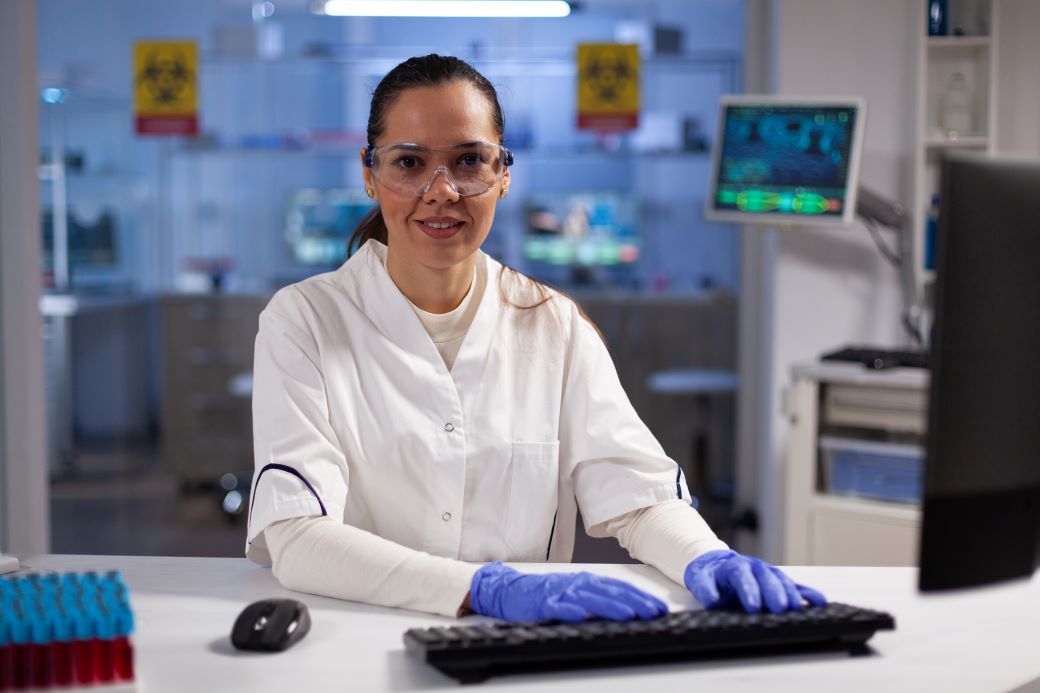
In which sectors are biochemists needed?
Through this degree, graduates are trained to perform and interpret clinical analyses and others related to human health, as well as to work in the technical direction of laboratories where clinical analyses are performed. There are many activities for which the biochemist is prepared: to perform toxicological, bromatological and legal chemistry examinations; to act as a consultant, advisor or expert in Biochemistry matters; to research or be a professor at both university level and other levels of teaching; to work together with other disciplines in the study, detection and/or resolution of biological issues, etc.
In summary, a biochemist can be in charge of the technical direction of a clinical analysis laboratory, can act as a consultant, expert or advisor, and participate in building patterns and standards for standardization and quality of raw materials and reagents used in performing bromatological, clinical, toxicological analyses, etc. They can also work in teaching, both basic as well as technical and scientific knowledge, of the subjects included in the degree.

Where to study Biochemistry?
Argentina: The Bachelor's degree in Biochemistry at the Universidad Nacional de La Plata lasts 6 years. At UBA the same degree lasts 5 and a half years, including mandatory professional internships. This university also offers you specialization degrees in Clinical Bacteriology; Cytology, Endocrinology; Hematology and Clinical Chemistry, all 2 years long. On the other hand you can do master's degrees in: Biotechnology, Bromatology and Food Industrialization Technology, Policy and Management of Science and Technology, and Medical Molecular Biology, all lasting 2 years, while the Master's in Public Health lasts 1 and a half years. The Instituto Superior de Ciencias de la Salud offers the Biochemistry Assistant Technician course, which lasts 2 years.
Chile: The Universidad de Chile has a Bachelor's degree in Biochemistry lasting 6 years. Among other postgraduate programs they offer a Master's in Biochemistry and a Master's in Cellular and Molecular Biomedicine, of 120 credits each.
Spain: At the Universitat Autónoma de Barcelona you can do the Bachelor's degree in Biochemistry, which lasts 4 years. It also offers you the Master's in Biochemistry, Molecular Biology and Biomedicine; as well as the Master's in Advanced Biotechnology, both 1 year long. The Bachelor's Degree in Biochemistry from the Universidad Complutense de Madrid also lasts 4 years, a university that will offer you the same master's degree as the one in Barcelona, also 1 year long. The Universidad Autónoma de Madrid offers the Bachelor's Degree in Biochemistry, as well as the Master's in Biotechnology and the Doctorate in Biochemistry, Molecular Biology and Biomedicine. In Granada: Universidad de Granada, Málaga: Universidad de Málaga, Córdoba: Universidad de Córdoba, Sevilla: Universidad de Sevilla, Islas Baleares Universidad de las Islas Baleares (UIB) , Albacete: Universidad de Castilla la Mancha (UCLM), Badajoz: Universidad de Extremadura, Barcelona: Universitat Autónoma de Barcelona (UAB), Universitat de Barcelona (UB), Tarragona: Universitat Rovira i Virgili (URV), Madrid: Universidad Autónoma de Madrid (UAM),Universidad Complutense de Madrid (UCM), Murcia: Universidad de Murcia (UM), País Vasco: Universidad del País Vasco, Navarra Universidad de Navarra (UNAV) Valencia: Universitat de Valencia (UV).
Mexico: UNAM has in its curriculum the Bachelor's Degree in Diagnostic Biochemistry, lasting 4 years. You can also do the Master's and/or Doctorate in Biochemical Sciences, which last 2 and 4 years, respectively. At the Instituto Politécnico Nacional you have the opportunity to study Biochemical Engineering, for 4 and a half years, as well as a master's and doctorate in Biomedicine and Molecular Biotechnology or Chemicobiological Sciences.
Uruguay: The Universidad de la República allows you to study the degree in Clinical Biochemistry, which lasts 5 years.