Energy Operations Engineer
An energy operations engineer is the professional who supervises, analyzes and improves the operation of plants, networks, facilities or systems where energy is produced, transformed, transported or managed.
They can work in power plants, industrial plants, gas companies, oil and gas, refineries, renewable generation facilities, control centers, treatment plants, energy infrastructure projects or utility companies.
Their work sits between engineering, operations, safety and management. They are not limited to watching equipment or following instructions: they analyze data, coordinate teams, solve technical problems, take part in operational decisions and seek to keep the plant running with continuity, efficiency and safety.
It is an important career because an energy facility must operate every day under controlled conditions. When there are failures, outages, alarms, production deviations or safety risks, the operations engineer helps understand what is happening and what decision to make.

What problem it solves
The energy operations engineer solves a central problem: how to make an energy facility work well every day, even when failures, demand changes, emergencies or technical problems arise.
In energy, operations cannot stop without consequences. An electric power plant, a network, a gas facility or an industrial plant needs to operate with stable technical parameters. If there is a serious failure, a wrong maneuver or a late decision, outages, economic losses, accidents or environmental impacts can occur.
This professional helps prevent these problems, coordinate responses and improve operations with a technical and strategic outlook.
Main tasks
An energy operations engineer can perform tasks such as:
- Supervise the daily operation of a plant, network, or energy facility.
- Analyze production, efficiency, safety, and availability indicators.
- Investigate failures, defects, shutdowns, or service outages.
- Coordinate with operators, maintenance technicians, supervisors, and managers.
- Participate in major operational maneuvers.
- Review historical performance data for equipment or processes.
- Propose improvements to reduce failures and increase efficiency.
- Coordinate first-line maintenance together with the technical team.
- Plan operational tasks and support maintenance scheduling.
- Supervise work permits and safety procedures.
- Participate in emergency or incident management.
- Prepare technical reports on operation, failures, or performance.
- Train or mentor operators and technicians.
- Work with monitoring systems, data dashboards, or process control.
- Verify that operations comply with technical, environmental, and safety standards.
It is a role where decisions are made that can affect an entire plant or energy system.
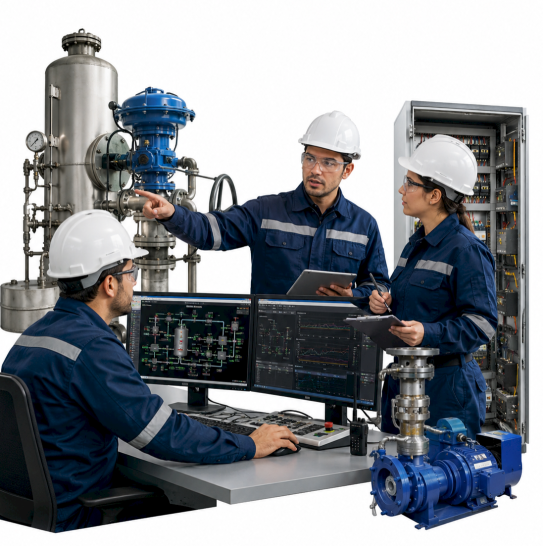
The day-to-day life of an energy operations engineer
The day-to-day life of an energy operations engineer usually combines meetings, data analysis, plant walkthroughs, and coordination with different teams.
It may start by reviewing reports from the previous shift: which equipment was active, whether there were alarms, what failures appeared, which maintenance jobs are pending, or which operating conditions must be monitored during the day.
Then they may meet with operators, maintenance technicians, safety staff, and supervisors to define priorities. For example: which equipment should be checked first, which failure could affect production, which intervention should wait for a scheduled shutdown, or which operational risk needs immediate attention.
During the day, they may walk through the plant or facility to observe equipment, talk with operators, check panels, inspect critical areas, or verify the status of a maneuver. They may also work from a control room or a technical office analyzing information from sensors, SCADA systems, maintenance reports, or operation indicators.
SCADA stands for Supervisory Control and Data Acquisition, in Spanish, supervision, control and data acquisition. These systems make it possible to monitor and control industrial processes, plants, networks, or energy facilities.
When a failure occurs, the operations engineer must quickly understand the problem. They can review data, listen to the operator, consult maintenance, assess risks and decide whether to keep operating, reduce load, isolate equipment, activate a procedure or initiate an emergency response.
They also spend part of their time improving processes. They don't just respond to problems: they work to keep them from happening again.
Tools, equipment and technologies they use
An energy operations engineer may work with:
- SCADA systems.
- Data dashboards and operational indicators.
- Operations management software.
- Maintenance management systems.
- Pressure, temperature, level, flow or vibration sensors.
- Control panels.
- Measuring equipment.
- Failure, incident and performance reports.
- Electrical, mechanical or process drawings.
- Operating procedures.
- Work permits.
- Internal communication systems.
- Tablets, computers and technical software.
- Data analysis tools.
- Remote monitoring platforms.
- Personal protective equipment.
In more digitalized environments, they may also work with industrial IoT, automation, predictive maintenance, artificial intelligence applied to operations, OT cybersecurity and process optimization models.
OT stands for Operational Technology, in Spanish, tecnología operacional. It refers to the systems that control physical equipment and processes, such as sensors, valves, panels, plants, networks or industrial systems.

Areas where they can specialize
An energy operations engineer can specialize in different areas of the sector.
Power plant operation
They supervise electricity generation processes, main equipment, auxiliary systems, operational safety, performance and service continuity.
Industrial plant operation
They work in industries that use a lot of energy and need to efficiently control thermal, electrical, mechanical or chemical processes.
Gas and oil operation
They may participate in treatment plants, production facilities, pumping, pipelines, separation, compression or upstream processes.
Renewable energy operation
They may work in solar farms, wind farms, hybrid systems, distributed generation or energy storage facilities.
Process control
They focus on technical variables, automation, control systems, remote monitoring and operational stability.
Continuous improvement and operational efficiency
Analyze data, failures, costs, energy consumption and performance to propose improvements.
Safety and emergency response
Take part in safety procedures, risk analysis, work permits, incidents and emergency plans.
Useful additional training
In addition to the degree, courses or certifications in the following can be useful:
- Plant operation.
- Process control.
- SCADA systems.
- Industrial instrumentation.
- Automation.
- Industrial safety.
- Work permits.
- Emergency management.
- Failure analysis.
- First-line maintenance.
- Operations management.
- Energy efficiency.
- Data analysis.
- Industrial IoT.
- OT cybersecurity.
- Project management.
- Oil and gas.
- Renewable energies.
- Technical English.
In large companies, part of the training also takes place inside the plant, with internal training, procedures training and learning alongside experienced operators and supervisors.
Important skills
This career requires technical, analytical and leadership skills.
Some of the most important are:
- Understanding of energy processes.
- Ability to analyze operational data.
- Technical problem solving.
- Decision-making under pressure.
- Team leadership.
- Communication with operators, technicians and managers.
- Operational planning.
- Industrial safety.
- Interpretation of alarms, reports and indicators.
- First-line maintenance knowledge.
- Logical thinking.
- Attention to detail.
- Ability to prioritize.
- Risk management.
- Adaptation to shifts, emergencies or operational changes.
- Continuous learning.
It is a career for people who enjoy understanding how a complete system works and not just an isolated part.
Where they work
An energy operations engineer can work in:
- Power plants.
- Industrial plants.
- Electric power generation companies.
- Energy transmission and distribution companies.
- Gas companies.
- Gas processing plants.
- Oil and gas companies.
- Refineries.
- Hydrocarbon production facilities.
- Oil services companies.
- Solar farms.
- Wind farms.
- Energy storage companies.
- Control centers.
- Utility companies.
- Energy efficiency companies.
- Chemical industries.
- Mining companies.
- Plants with on-site generation.
- Energy infrastructure projects.
- Automation and control companies.
Requirements companies usually ask for
Companies may ask for:
- Related engineering degree.
- Experience in plant operation, energy, industry, gas or oil.
- Knowledge of industrial safety.
- Handling of operational indicators.
- Ability to analyze failures or incidents.
- Experience with plant equipment.
- Knowledge of SCADA systems or monitoring platforms.
- Ability to coordinate operators, technicians or contractors.
- Handling of technical reports.
- Availability to work in plants, in the field or on shifts.
- Knowledge of work permits and safe procedures.
- Technical English, especially in international companies.
- Ability to respond to emergencies or service interruptions.
In sectors such as oil, gas, mining or electric power generation, they may also ask for experience in high operational demand environments and strict compliance with safety standards.
Difference between energy plant operator and energy operations engineer
The energy plant operator is closer to daily operation. They control equipment, check indicators, record data, execute procedures and detect deviations.
The energy operations engineer has a broader role. They analyze the operation, coordinate teams, evaluate failures, propose improvements, supervise procedures and make technical decisions so the plant runs better.
The operator knows very well what happens in the field or control room. The engineer uses that information to improve the complete system.
Difference between energy operations engineer and energy maintenance engineer
The energy operations engineer focuses on making the plant run correctly day to day: production, processes, continuity, safety and failure response.
The energy maintenance engineer focuses on preserving and repairing equipment: maintenance plans, spare parts, mechanical or electrical failures, reliability and useful life of assets.
In practice, both work very closely together. Operations detects problems and maintenance steps in to solve them. Good communication between these areas is key to avoiding shutdowns and accidents.
The energy operations engineer is usually one of the people who best understands how a complete facility works.
They don't just look at a pump, a valve, a screen or a panel. They must understand how equipment, people, data, risks, procedures and production are connected.
That is why it is a profile that can grow toward supervision, plant leadership, operations management or operations direction. It is an ideal career for those who want to combine engineering, action, leadership and decision-making in real systems.