
What is oil and gas reservoir simulation?
The reservoir simulation is an engineering discipline that allows studying and predicting the behavior of the fluids present in the subsurface geological formations.
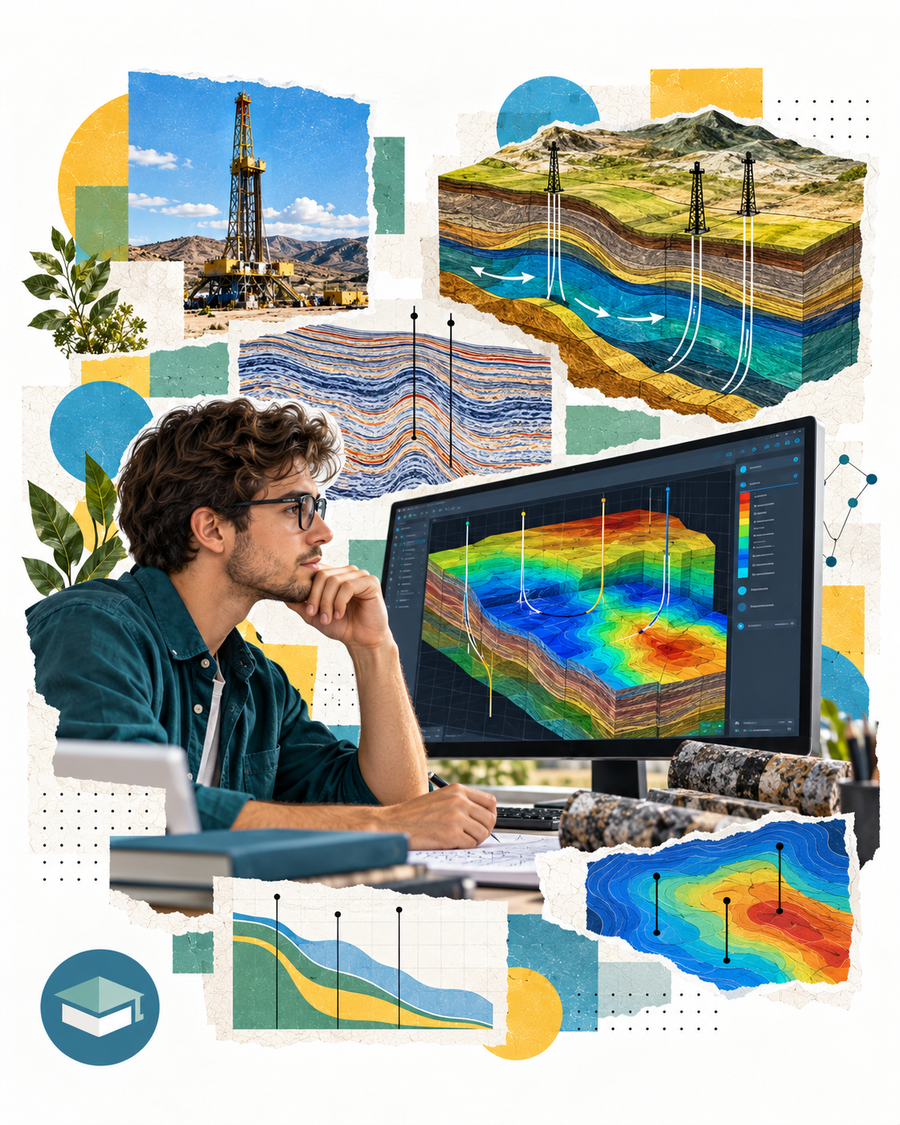
Oil and gas reservoir simulation
It is mainly used in the oil and gas industry to analyze how a reservoir changes during its exploitation and to evaluate different production strategies.
It is a specialty that combines geology, mathematics, physics, engineering and computational tools.
What does reservoir simulation consist of?
A hydrocarbon reservoir is a geological formation whose rocks can store and transmit fluids such as oil, gas and water.
When production begins, the pressure and the distribution of fluids inside the reservoir change.
Simulation makes it possible to represent these processes through numerical models.
The goal is not to reproduce reality perfectly, but to build a sufficiently reliable representation to analyze alternatives and support technical decisions. The Society of Petroleum Engineers explains how a reservoir simulator is built and what its basic components are.
How does a simulation work?
Geological information and fluid properties
The first step is to collect data on the structure and properties of the reservoir.
Important parameters include porosity and permeability, initial pressure and the characteristics of oil, gas and water.
Well logs, seismic information and production data are also used.
With these elements, a model is built that represents the main characteristics of the reservoir. Tools such as Petrel from SLB allow geological information to be integrated and three-dimensional representations to be built.
Mathematical models and scenarios
The simulator uses equations that describe fluid movement and mass conservation.
Depending on the problem, it can incorporate thermal phenomena, compositional changes, and other physical processes.
Engineers establish production or injection conditions and perform calculations to estimate the reservoir response.
They then compare scenarios and analyze the results. The article How to Build Your Own Reservoir Simulator, published by SPE, describes the mathematical and computational foundations of this process.
What software is used to simulate reservoirs?
Specialized tools include ECLIPSE from SLB, tNavigator from Rock Flow Dynamics and CMG (Computer Modelling Group) simulators.
ECLIPSE allows dynamic reservoir simulations to be performed using different numerical formulations.
tNavigator integrates simulation with geological modeling and production engineering tools.
CMG has applications such as IMEX, GEM and STARS, aimed at different recovery processes and fluid behavior.
For its part, Petrel Reservoir Engineering lets you work with geological models and take part in reservoir simulation preparation and analysis workflows.
Which professionals work in this specialty?
Reservoir simulation is a common specialization within Petroleum Engineering, a degree that combines knowledge of geology, fluid mechanics, drilling and hydrocarbon production.
Also participating are professionals in Geology, Geophysics, Chemical Engineering, Mathematics and Computer Science, depending on the project functions.
Reservoir engineers usually focus on interpreting the results and relating them to development and production decisions.
Why is simulation important?
Drilling wells, modifying production systems or implementing recovery methods can require significant investments.
Simulation makes it possible to evaluate different alternatives in advance and study their possible outcomes.
It also helps to understand the risks arising from geological uncertainty and the available information. tNavigator uncertainty analysis tools are an example of how different development scenarios can be studied.
Reservoir simulation is one of the main applications of scientific software in the oil industry. For those who enjoy mathematics, programming and engineering, it represents a field of specialization that connects technical knowledge with digital technology.