
What to study if I like geology, maps and discovering what's underground?
I like maps, geology and discovering what's underground
If you are interested in observing landscapes, understanding how mountains were formed, interpreting maps or discovering what lies beneath the Earth's surface, there are several degrees that may be related to your interests.
Studying the subsurface combines natural sciences, mathematics and technology. It also has applications in the search for water, minerals, oil, gas and geothermal resources.
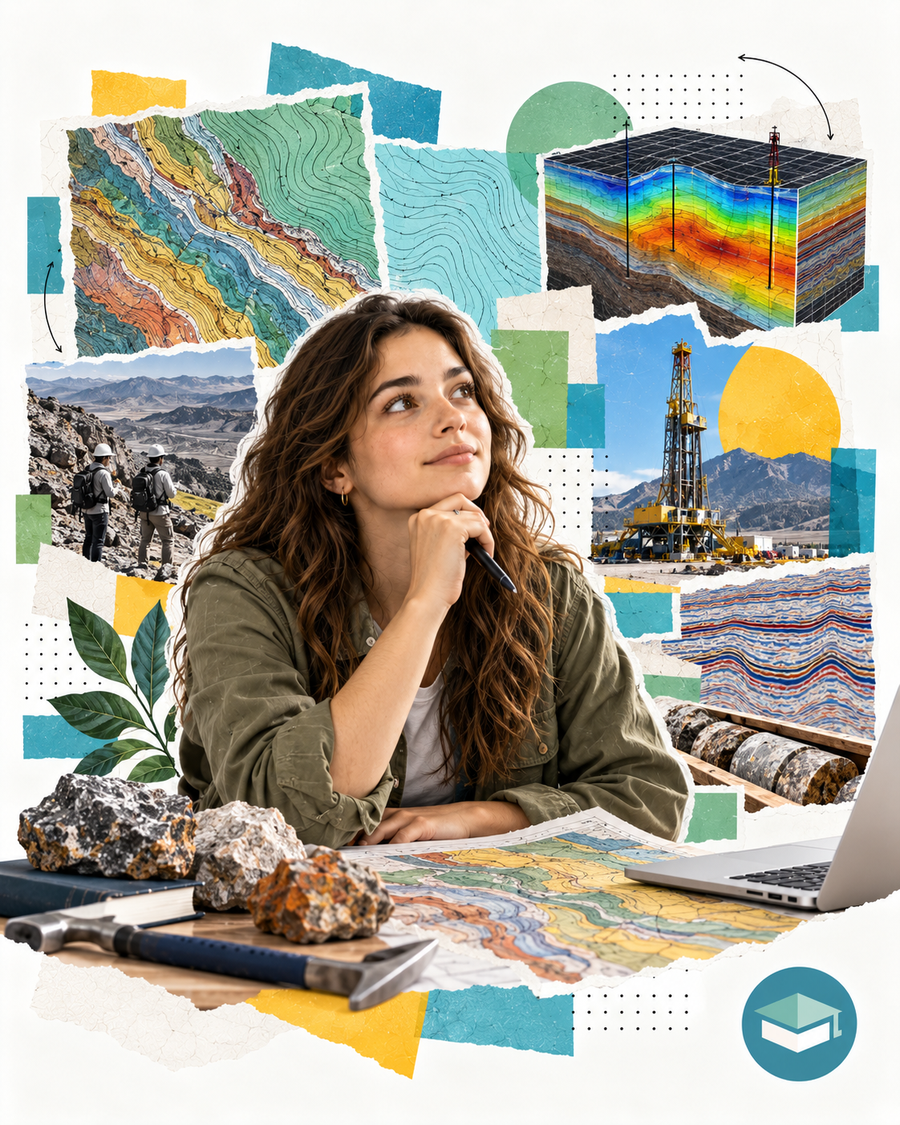
Degrees for those who are interested in the subsurface
Geology
The Geology degree studies the composition, structure, history and evolution of the Earth.
The geologists investigate rocks, minerals, faults, sediments and processes that modify the planet.
This degree can be especially interesting for people who enjoy fieldwork, the observation and interpretation of natural phenomena.
Its applications include exploration of natural resources, environmental studies, geotechnics and scientific research.
Geophysics
The Geophysics degree uses physical principles and mathematical tools to study the properties and structures of the Earth.
Professionals can analyze seismic, gravitational, magnetic information and other data that make it possible to investigate areas of the subsurface without observing them directly.
It is an attractive alternative for those who combine an interest in Earth sciences with an aptitude for mathematics and physics.
Petroleum Engineering
The Petroleum Engineering degree is focused on the development and production of hydrocarbon reservoirs.
Although it uses geological knowledge, it also incorporates fluid engineering, drilling, production and simulation.
It can be a good option for those who want to apply knowledge of the subsurface to industrial and energy projects.
How the subsurface is studied with technology
Currently, subsurface analysis does not depend only on rock samples and traditional maps.
Professionals use seismic data, well logs, mathematical models and three-dimensional representations.
For example, Petrel, SLB's geology and modeling software, allows integrating geological and geophysical information to build digital models of underground formations.
These models can help identify structures, analyze rock properties and assess uncertainties.
Technology makes it possible to connect scientific knowledge with advanced computing tools.
What jobs can these professionals do?
Geologists can work in exploration, formation characterization, geotechnics and environmental studies.
Geophysicists take part in the acquisition, processing and interpretation of physical subsurface data.
Petroleum engineers can work in reservoir engineering, drilling, production and field development.
In complex projects, these careers work together to understand ground characteristics and make technical decisions. To learn about a different application from exploration, the geothermal energy guide explains the energy use of subsurface heat.
How to choose the most suitable degree
If you enjoy observing rocks, landscapes and natural processes, Geology can be an excellent alternative.
If you are especially drawn to physics, mathematics and measurement methods, you should look into Geophysics.
If you want to study the subsurface and apply that knowledge to designing extraction systems and energy production, you might consider Petroleum Engineering.
Your interest in discovering what happens beneath the Earth can become a scientific or technological degree. The important thing is to identify whether you prefer to investigate natural phenomena, interpret data, or design engineering solutions.