
I Want to Be a Film Critic
Cinema is one of the most important and popular creative industries of our time, as well as being an extraordinary mass communication medium.
As its name suggests, the film critic is the person who dedicates himself to the study, analysis and appreciation of films, either from an academic point of view or journalistically.
The work of a film critic consists mainly of giving an opinion and, in this way, defining the characteristics and nature of film discourse.
As if that were not enough, the film critic must have artistic sensitivity and excellent communication skills in order to reveal what films really want to tell us.
To be a film critic in Argentina you must complete studies in "Image and Sound Design" or the bachelor's degree in "Audiovisual Arts"; in Brazil the bachelor's degree in "Visual Arts"; in Colombia you also need to study the bachelor's degree in "Audiovisual Arts"; in Spain "Audiovisual Communication" and in Mexico the bachelor's degree in "Cinematography".
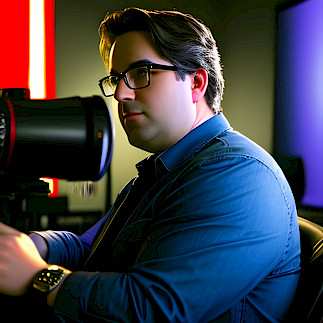
What does a film critic do?
A film critic is a professional who has specific training that allows him to study, analyze, appreciate and fully understand film discourse and everything related to it. In this way, a film critic has the possibility of seeing what is behind a film, thereby distinguishing himself from the ordinary viewer.
Likewise, a film critic must be able to capture the message that a film wants to convey and make it understandable to other viewers. In fact, he also has the ability to be part of the creative team that makes a film, so he can work in different places.

What do you study to become a film critic?
To become a film critic you mainly study everything that has to do with the production of cinematic discourse. That is why subjects are generally taken on film language, directing, cinematography, editing, sound, production, film history, montage, screenwriting, post-production, visual communication and aesthetics, image and perception, as well as film criticism and theory.
Why study to become a film critic?
For many, cinema is actually an art that requires serious knowledge and technical skills that help convey a specific message and, above all, a specific aesthetic. Therefore, cinematography in general is a very popular and efficient means of communication today.
In this way, the film critic is a person who can play a very important role in deciphering the message that films or a director want to convey to us. In addition, they help us understand what cinema is and why it is important for our lives.
Finally, the film critic can influence the creation of a particular cinematic discourse, thus producing certain kinds of feelings and opinions.
Advantages of studying to become a film critic
The film student has the advantage of getting to know countless cultures different from their own, which are expressed through films and film language. They also have the opportunity to develop a set of technical skills that help them create a discourse and convey a specific message.
Also, film critics possess extensive knowledge of other topics that affect the understanding of a film, such as the historical context or the life of a director.
Disadvantages of studying to become a film critic
Among the main disadvantages of studying to become a film critic, we find that very few universities or higher education institutions offer courses or studies of this type. To this we must add that the degree has grown in demand, that is, more and more people are interested in pursuing these studies, but this increase in students eager to begin training does not match the number of options in terms of institutions offering the degree.

In Argentina: The Universidad de Buenos Aires offers the undergraduate degree in "Diseño de imagen y sonido", which lasts four years. The Universidad Nacional de La Plata, through its Facultad de Bellas Artes, offers the bachelor's degree in "Artes Audiovisuales" with guidance in theory and criticism, which lasts five years. At the Instituto Universitario Nacional de Arte you can study the bachelor's degree in "Artes Audiovisuales", with a total duration of four years.
In Brazil: The Universidad Estatal de Río de Janeiro is the best institution to study the bachelor's degree in "Artes Visuales" which lasts four years.
In Colombia: The Universidad Nacional has the option to study the bachelor's degree in "Artes Audiovisuales with a total duration of four years divided into eight semesters. UNITEC offers bachelor's-level studies in "Artes Audiovisuales" that last four and a half years.
In Spain: At the Universidad complutenses there are undergraduate studies in "Comunicación Audiovisual" lasting two years. At the Universidad Pompeu Fabra you can study the bachelor's degree in "Comunicación Audiovisual" over four years.
In Mexico: The Universidad Nacional Autónoma de México, through its Centro Universitario de Estudios Cinematográficos, offers the bachelor's degree in "Cinematografía", which lasts five years. The Centro de Capacitación Cinematográfica has a Licenciatura en Cinematografía that lasts nine semesters, that is, four and a half years.
Being a film critic involves much more than simply giving opinions about films; it is a role that demands a high degree of specialization and knowledge of both the technique and the art of film.
The role of the critic is, indeed, crucial for connecting audiences with the multiple dimensions of a film, from its technique and aesthetics to its cultural and social implications.
The work of the film critic goes beyond simply passing judgment on films; in fact, it is a career that requires deep technical and artistic knowledge of the cinematic medium. With specific training in areas such as directing, screenwriting, editing, and film theory, critics can offer insights that the average viewer might overlook. They help to decode the language of film, making films more accessible and enriching for the general public.
In addition, the film critic does not only operate from an academic or journalistic ivory tower; he has the ability to influence popular culture, social discourse and, in some cases, even the trajectory of films and filmmakers. His role is especially relevant in a world where cinema is one of the most powerful and accessible media, with the ability to cross cultural and linguistic borders.
The required academic training varies by country, but the goal is the same: to train professionals with the necessary tools to analyze and evaluate cinema from multiple angles.
This becomes an advantage as it allows the critic to approach works from different cultures and thus enrich his perspective and analysis.
However, despite the growing demand for this type of specialized training, few institutions offer programs dedicated specifically to film criticism, which could be considered a disadvantage or a challenge for those interested in pursuing this degree.