
Carolyn Mair
On this occasion, Facundo Strizzi, co-founder of NoSeQueEstudiar, interviews Carolyn Mair, psychologist, university professor and author of "The Psychology of Fashion". In this conversation, Carolyn shares her professional background and her reflections on the intersection between psychology and the world of fashion.
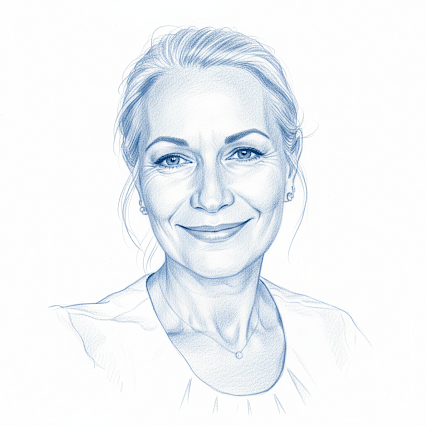
Carolyn Mair is a Cognitive Psychologist who supports organizations in using psychology to create meaningful, responsible and impactful practices in their businesses. She is an award-winning educator and leadership consultant.
Carolyn Mair is a leading voice in applying psychology to solve problems in the fashion industry. Since 2017, she has advised a wide range of global businesses in areas such as sustainability, customer insight, mental health and well-being, AI ethics, and organizational culture. Her work focuses on building ethical and human-centered, psychologically informed practices, spanning from leadership and culture to customer experience in the fashion ecosystem.
Her multidisciplinary approach allows her to offer unique perspectives, making her a popular choice for media interested in the intersection and impact of fashion and psychology.
Location: Londres, United Kingdom
On social media: Instagram and Linkedin
Featured experience:
- Behavioral Consultant and Psychologist (2017 - Present): Specialized in applying psychology to solve problems in the fashion industry, working with some of the largest fashion companies in the world.
- Full Professor of Fashion Psychology at UAL (2012-2017): Created the world's first master's programs to apply psychology in the context of fashion and established Fashion Psychology as an important area of applied research.
- Best-Selling Author: Her book 'The Psychology of Fashion' was published in 2018 by Routledge and is available in 6 languages.
- She has published more than 70 peer-reviewed articles on various topics, including Psychology, Neuroscience, Computer Science, Metacognition and Pedagogy.
Academic Background:
- PhD in Cognitive Neuroscience.
- MSc in Research Methods.
- BSc in Applied Psychology and Computing.
Key skills:
- Human behavior, cognitive and social psychology, cognitive neuroscience.
- Ethics, consumer behavior, well-being, motivation.
- UX, L&D, research, strategic planning, leadership and management.
Interview with Carolyn Mair
Facundo Strizzi, co-founder of NoSeQueEstudiar, virtual interview with Carolyn Mair.
1: Why did I study psychology?
Carolyn Mair explains that her interest in psychology arose from a very young age, fascinated by human behavior: what motivates people, how they interpret the world, how they form their beliefs and memories. Her desire to understand these aspects from a scientific perspective led her to study a bachelor's degree in psychology and computing in her hometown.
2: What inspired you to combine fashion with psychology?
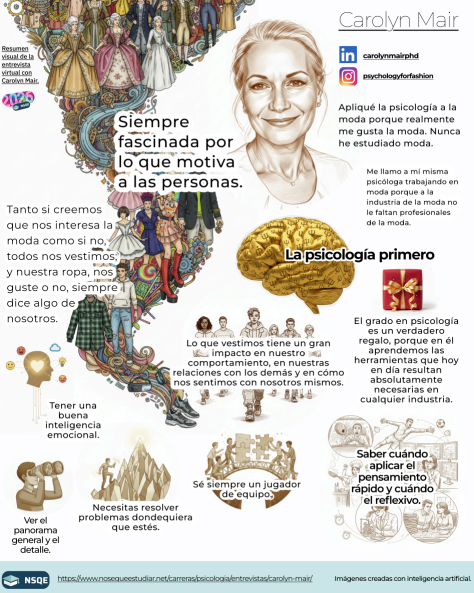
Carolyn's inspiration for bringing fashion and psychology together comes from her concern about the industry's unethical and psychologically problematic practices, such as the setback in the representation of diverse bodies in models. She highlights that clothing, intentionally or not, always communicates something about us, and fashion can be a powerful tool for projecting a desired image (like professionalism with a jacket) and for improving psychological and physical well-being through comfortable garments that reflect our personality.
3: How do fashion, consumer behavior and psychology connect, especially in career choices?
Carolyn prefers to introduce herself as a "psychologist working in the fashion industry" rather than a "fashion psychologist", since the latter is not a recognized professional title. She stresses that psychologists bring essential skills such as data analysis, ethics and understanding of human behavior, valuable in areas such as human resources, display and merchandising. She advises students to prioritize the study of psychology, since the skills they gain are fundamental in any sector.
4: What do you think are the skills needed to succeed not only in psychology but also in fashion?
To thrive in the competitive fashion industry, Carolyn emphasizes that a psychologist must go beyond academic knowledge and focus on problem solving and strategic thinking. Skills inherent to psychology, such as critical thinking, problem solving, teamwork, emotional intelligence and self-awareness, are crucial tools for any industry, both now and in the future. Psychology, at its core, seeks to improve situations and solve problems, which makes it an invaluable discipline.
5: Can psychological principles be applied to various industries, not just fashion?
Carolyn states that the psychological skills are applicable in any context where there is human interaction, thus covering practically all industries. Even in the field of Artificial Intelligence, psychologists can contribute to problem-solving, as well as analyzing and interpreting data, thanks to their solid training in these areas.
6: Will AI completely change degree options in 20 years?
Carolyn addresses the impact of AI on fashion, used in design, store design and user interfaces. Psychologists have an advantage in collaborating on AI training, since creating an intuitive user experience is a psychological process. She also highlights the important ethical issues raised by AI, such as consumer data security in technologies like virtual fitting rooms, where trust is key. Finally, she emphasizes that cognitive skills such as communication and the sense of aesthetics, which develop in the brain, are fundamental for future professionals looking to stand out.
7: Any advice for undecided students?
Carolyn advises undecided students to try to get into the best possible university with good resources. She recommends studying a pure and accredited psychology degree, since accreditation guarantees a quality standard and is crucial for professional certification in many countries. For the final degree project, she suggests finding a university supervisor who is interested in applying psychology within the context of fashion, which would allow integrating personal interests with the academic field.
8: Why do we buy what we buy?
Carolyn reflects on the universality of psychology, focused on human behavior present in all industries. She herself applied psychology to fashion out of personal interest, having previously worked as a window dresser. She highlights that fashion influences mood, behavior and social interactions. She also points out that psychological principles can extend to other fields, such as interior design, where former students from her program have found job opportunities.
9: Anything else?
In this final part, Carolyn reiterates her deep love for psychology and her constant fascination with human behavior. She is excited to stay up to date with the latest research and see how even old studies are reevaluated. She emphasizes the progressive and constantly changing nature of psychology, as well as the wonder of understanding the human brain.