Evangelina Luján Aloe
The Virtual Interview with Evangelina Luján Aloe
The interview was conducted asynchronously and later edited by the NoSeQueEstudiar team. It explored in depth the degree and achievements of the Dr. Evangelina Luján Aloe, a renowned psychologist and academic with an outstanding career in clinical psychotherapy and research in psychological well-being.
During the conversation, Dr. Aloe shared her focus on the holistic approach to the human being, integrating different therapeutic models based on scientific evidence, as well as her research on spirituality and well-being in patients with terminal illnesses.
Visual summary of the conversation with Dr. Evangelina Luján Aloe
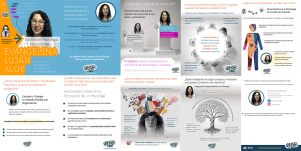
Profile of Dr. Evangelina Luján Aloe
 The Dr. Evangelina Luján Aloe is a psychologist and university professor with extensive experience in clinical psychology and the training of future psychology professionals. She has specialized in the integrative approach of different therapeutic currents and has developed a research line focused on the relationship between spirituality and psychological well-being in terminal patients. She is currently Director of the Psychology Degree at the University of Flores (UFLO) where she also works as a professor in undergraduate and postgraduate programs.
At the UFLO, Dr. Aloe coordinates the academic training of new psychologists and leads projects that promote the teaching of evidence-based psychotherapies.
Education and Advanced Training
✔ PhD in Psychology, Universidad de Flores, Argentina
✔ Bachelor's Degree in Psychology, Universidad de Buenos Aires, Argentina
Areas of Specialization
Integrative Clinical Psychotherapy
Since 1998, Dr. Aloe has worked in the clinical field integrating various psychological approaches, such as humanistic therapies, cognitive-behavioral, narrative and contextual. Her holistic approach includes knowledge of psychoneuroendocrinology for a more comprehensive treatment of human well-being.
Academic Psychology and Professional Training
As a university professor, she has held different roles at the Universidad de Flores, including academic coordination and teaching courses key to the training of psychologists. She has taught at undergraduate and graduate levels, teaching courses on effective evidence-based psychotherapies, new behavioral sciences and child and adolescent psychotherapy.
Research on Spirituality and Psychological Well-being
Her work has focused on the relationship between spirituality and psychological well-being in patients with terminal illnesses. Her goal is to contribute new perspectives and tools for psychotherapy in palliative care contexts.
Contributions and Current Projects
Dr. Aloe has developed multiple research studies and has participated in academic settings as a guest speaker at various institutions. Currently, she continues her teaching work and her clinical practice, in addition to continuing to explore new forms of psychological intervention based on scientific evidence for supporting patients at critical stages of life.
Virtual Interview with Evangelina Luján Aloe
Evangelina: It is a pleasure to tell you about the bachelor's degree in psychology, which is the career I studied.
I first studied the Bachelor's Degree in Psychology and then the Doctorate in Psychology, and my career is dedicated to studying, understanding and preventing, right? The behaviors, emotions and relationships of human beings trying to support human beings from birth to the end of their lives in the different areas where their life unfolds, in the family, at school, in relationships, in bonds, at work, trying to support people through the challenges that arise, supporting them if there are psychological and emotional ailments, and from there helping people to have a better life and to be able to develop in a healthier way in life.
Evangelina: I knew from a very young age that I wanted to do or dedicate myself to something that would allow me to help and support people in pain and suffering.
First I started studying medicine and then I realized that there was another type of pain that was not only in the body, and there I understood that people also suffered emotionally and from there I started to explore and I discovered that psychology was a degree that could precisely help me to support, learn how to support and how to manage to help people go through emotional pain in a different way and also so that they can have a learning of new behaviors that allow them to be happier and have greater well-being in their lives.
Evangelina: During the first years, I think it is important for academic challenges to study in a group, to have a group that helps you keep going, to have questions, to be able to ask them, to have someone to share the discouragement that often comes from tiredness. The group helps precisely to keep going, to give you motivation.
One of the things that also always motivated me is being very clear about why I was making the effort I was making, because studying precisely involves effort.
And on a personal level, a lot of work is with myself, on getting to know myself and on knowing what things I also needed to ask for help with, and it is important to be able to ask teachers, classmates, family, other students who are also more advanced for help.
That helps a lot to be able to find new ways of doing it that sometimes you don't know how to do.
Evangelina: Well, as I mentioned, I started out studying medicine and then I realized that there really were other areas of health, like mental health, that were just as important for people's health. So, that's when I understood that what drew me most was psychological and emotional health, and that it is also very closely linked to the body, but that there were other ways to approach it, right? Health and supporting people's well-being, which wasn't necessarily through medicine.
And well, it was quite a challenge to bring it up, to bring it up with my family, to admit it to myself, to accept that I already saw myself as a doctor and that really, although I was interested in people's health, it had more to do with their psychological health and not just their physical health.
And later I also understood, through studying and working, that precisely physical health is affected by mental and emotional health, and vice versa as well.
So it was also about that, daring to be honest with myself and understanding that I could pursue what I wanted. And I also had my family's support, I was able to tell them, and they accepted that I studied what truly made me happier.
And that also helped a lot to accept it, because it is still sometimes a grieving process for the idea you had formed of what you were going to do, but also doing what you truly believe interests you most is also what helps you do all those tasks.
Evangelina: I studied in Buenos Aires, at the Universidad de Buenos Aires, here in Argentina. It's free and, in that sense, it made it easier for me not to have to pay a monthly fee, but I did have to pay for course materials and transportation. What I did was work.
I worked in a shop, my parents had businesses, so I worked in businesses with them, and I also had another job at a school. Two or three times a week I went to a school to do some tasks.
So, well, I worked and that involves a challenge, being able to work. It takes a lot of organization, and it's possible to do it if you organize your study time, your work time well and, of course, accepting that there are times when, well, there are weekends when you have to stay home to study.
That's why I insist that motivation is key, being clear about the goal, why you are doing this and what you want to achieve later on, right? When you graduate.
Evangelina: I think the degree allows us to develop skills that we are going to need, fundamentally, later as professional psychologists, as we are mental health professionals.
To be a mental health professional, in addition to knowledge, you need to develop other skills that have to do with empathy, assertive communication, emotion regulation, regulation of one's own behavior.
Well, all those skills that will be needed and required for the development of the career also need to be learned and developed while you study.
The tolerance for frustration is also fundamental. Knowing that, even if I made a mistake or it didn't work out for me, I can keep going, I can learn, learn what I need to change so that next time I do better, so it goes well for me.
So, they are skills, there are competencies that are indispensable in the psychologist's career. The degree is a good opportunity to keep developing those competencies.
I think it is essential to be very clear about that, right? Everything you develop as competencies and skills: order, organization for thinking, for conveying. All of that is something that helps in the degree and that will also be fundamental when you have to develop as psychology professionals.
Evangelina: If I could give you some recommendations, it would be discipline, being orderly, organized, knowing that there will be times when we will become exhausted, we will get tired. Respecting ourselves, understanding that, supporting ourselves in order to, somehow, cope with that tiredness.
I believe that discipline for those who study is necessary, getting organized, having established schedules for studying, resting as well.
I think those things are important and always keeping the goal clear. The goal is motivation, it helps, right? Always being clear about why you are doing that.
So, seeing further ahead that you are going to achieve what you want is motivation to keep going.
Evangelina: I was telling you that I completed my doctorate and, for my doctoral thesis, I researched spirituality and psychological well-being in terminally ill patients.
It matters a great deal to me to be able to study and integrate the different human dimensions in clinical practice. Now I am doing another research study that is also about spirituality and psychological flexibility, a very current concept in psychology, in palliative care.
I am writing a book about incorporating spirituality into clinical practice and also understanding how human beings are multidimensional.
It has connections, behaviors, emotions and it has a spirituality, and we need to be able to work across all those human dimensions in order to support people in their challenges of living.
Right now, an important project I have is research, on the one hand, and on the other hand, also writing about this.
Moreover, I continue heading the degree, training new professionals, future professionals who can have this comprehensive and integrative view of what it means to be human. Because each human being is unique, unrepeatable, distinct. Having comprehensive training also allows us to support each person in what they need and want to improve or overcome, especially so we can also work on the skills needed for life today.