Degrees that no longer exist
Before turning on a lamp with a switch, someone had to make the candle, transport the fuel or walk the streets to light the street lamps. Before keeping food in a refrigerator, there were workers who cut ice in winter, stored it and delivered it during the warm months. And before a computer solved thousands of operations, people with mathematical training performed those calculations as part of their workday.

Degrees that no longer exist: history of the trades, careers and studies that disappeared or were transformed
The degrees that no longer exist tell the story of needs that changed, technologies that spread and societies that reorganized work. However, not all of them ended in the same way: some disappeared as common occupations; others kept a small market; and many were integrated into new careers.
The candles offer an especially clear example. Electricity reduced their importance for lighting homes every day, but their manufacturing continues. Today they are also used in celebrations, religious practices, decoration and relaxation or beauty settings. The product survived while the main reason many people bought it changed.

Candles and electricity: an ancient activity that found other functions
Candle makers and chandlers: from producing light to creating ceremonial and decorative objects
The candle manufacturing has ancient origins. Different societies developed techniques and used raw materials available in their environment.
In medieval Europe, production was organized as a specialized trade. Beeswax and tallow had different costs and characteristics. In France, candle manufacturing was already part of guild activity in the 13th century. During the 19th century, new raw materials and industrial processes expanded production.
The electric lighting began to displace that market in the late 19th century, but its expansion was uneven. Candles remained necessary where there was no supply or during outages. Their religious uses, present since earlier times, retained their importance.
Candlemaking turned toward new markets. Demand shifted: from everyday lighting toward ceremonial, decorative and aromatic uses. The National Candle Association documents this evolution.
Lamplighters: street lighting became an automated task
The lamplighter served a different need than the candlemaker: maintaining public lighting. Depending on the city and era, he had to light lamps, turn off lights, clean components or tend the fuel. The expansion of urban lighting made necessary a work organization that kept pace with the growth of lit streets.
In París, the replacement of traditional lighting spread over decades. Throughout the 19th century different lighting systems coexisted. The historical research The difficult conquest of a capital: electric energy in París between 1878 and 1907 studies that competition between systems.
As electric lighting and automatic mechanisms spread, it was no longer necessary for one person to individually light each light point. The daily task diminished, while the installation, maintenance and repair of networks gained importance.
The lamplighter lost his usual role in electrified cities, but public lighting work continued. Each locality changed its system according to the development of its electrical grid.
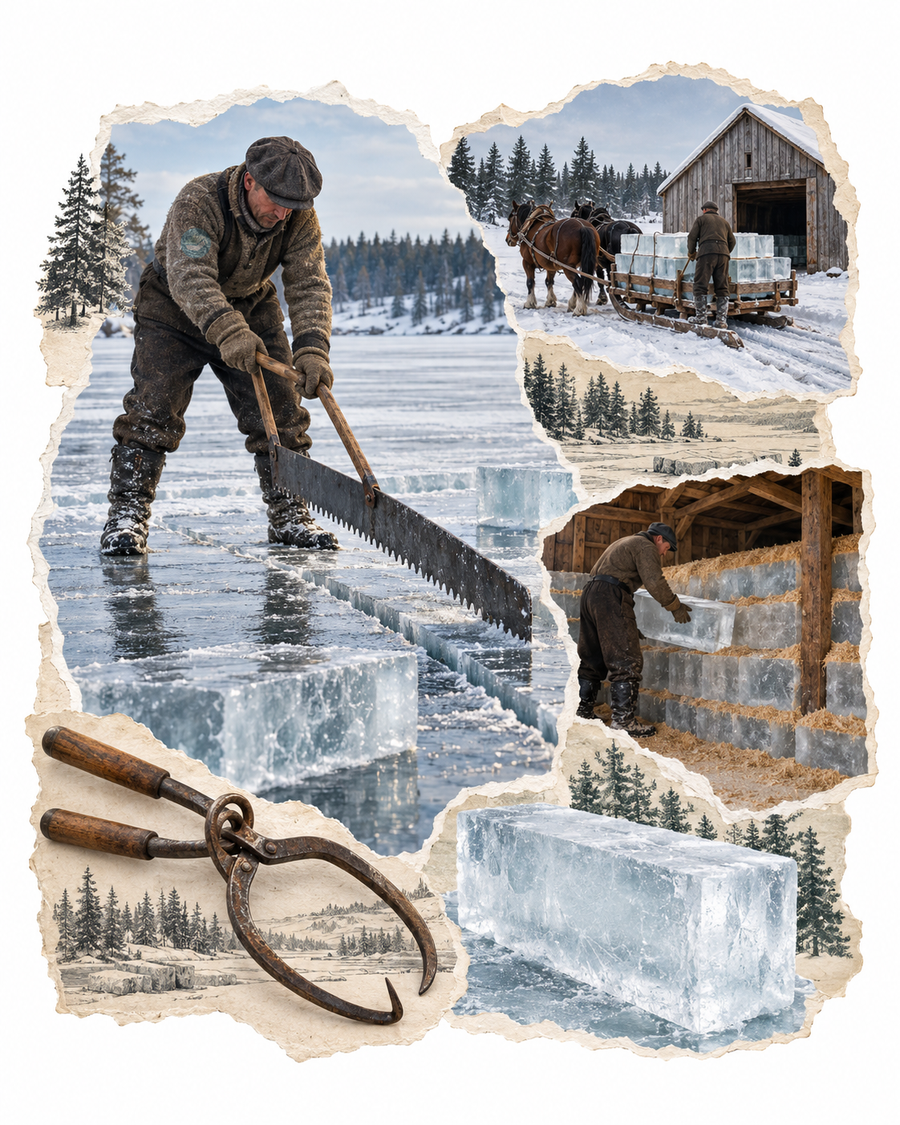
Preserving food before refrigeration: Canada and other ice markets
Ice cutters: harvesting winter to sell cold in summer
Before mechanical refrigeration, cold could be stored in the form of ice. In Canada, domestic demand had sustained a major industry at the beginning of the 20th century. Workers cut blocks on frozen surfaces, moved them and stored them in insulated warehouses.
The workers had to calculate how much ice could be kept until summer and organize its distribution. A warm winter could harm supply and employment. The HVACR Heritage Centre de Canadá explains that chain of work.
The artificial manufacture of ice and the spread of refrigerators reduced dependence on natural harvesting during the 20th century. Natural harvesting lost much of its everyday market. Refrigeration created other technical and commercial tasks.
Ice deliverers: a regular visit that the icebox made unnecessary
In homes with an icebox, the block was consumed as it melted and had to be replaced. The delivery person brought the supply to the kitchen. It was a recurring service, tied to equipment that could not produce cold by itself.
The introduction of electric refrigeration into American homes since the late 1920s illustrates how that demand began to change. The Smithsonian National Museum of American History describes that period.
Replacement depended on the cost of the appliance and the availability of electricity. Delivery continued during the transition in homes that still relied on iceboxes.
Recording and managing before current systems: Africa and the Andes
Scribes of ancient Egypt: a career tied to an administrative culture
In Egypt, writing developed in the late fourth millennium BCE. Scribes took part in administration, the preparation of documents and the transmission of knowledge. The preserved papyri show specific tasks: letters, accounts and records of goods.
The Metropolitan Museum of Art explains training and writing systems; its Heqanakht documents show how they were applied to economic matters.
Scribes were trained within the educational and administrative organization of their time. Their transformation was linked to the political, linguistic and religious changes of Antiquity and to the reorganization of the institutions that employed this knowledge.
The changes in languages and in administrative institutions modified the training and tasks of those who produced documents and accounts.
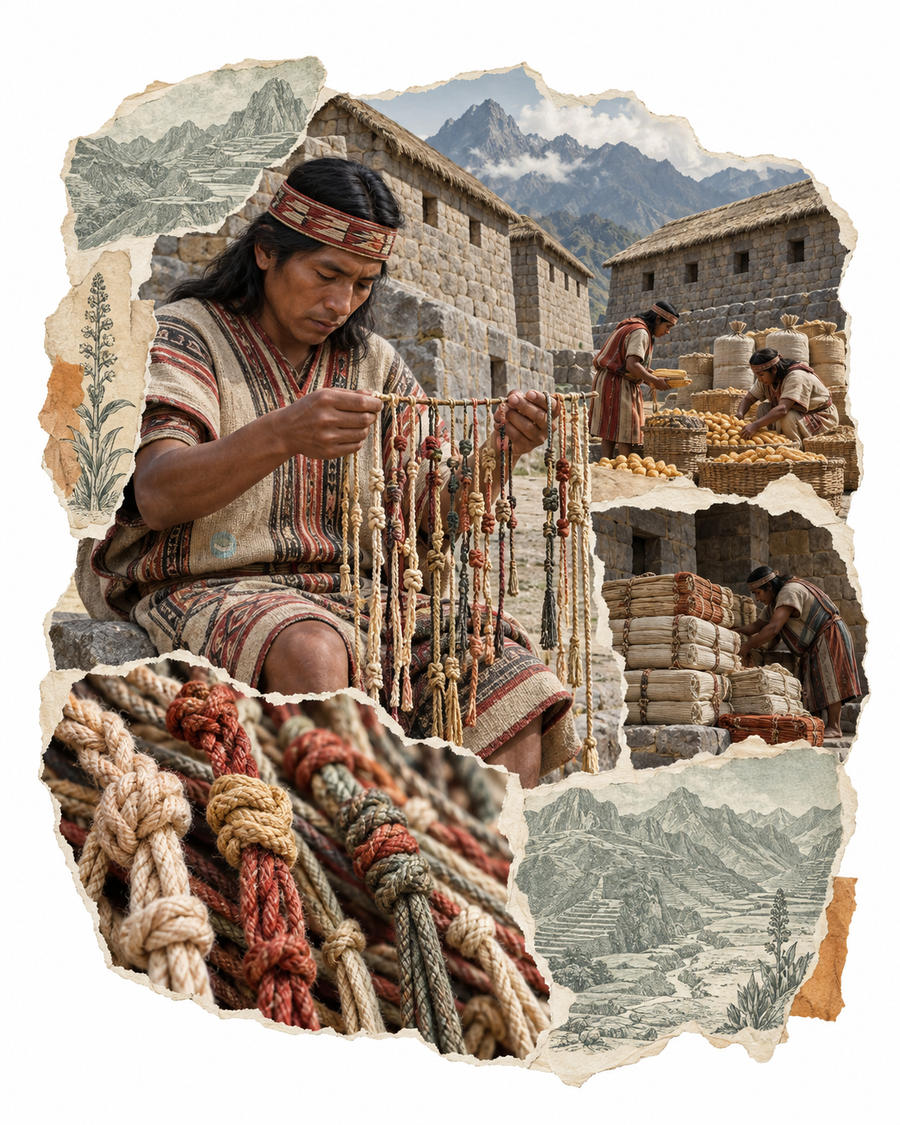
Quipucamayoc: specialists in Inca State records
In the Andes, the quipucamayoc were officials specialized in the use of quipus. The Museo Chileno de Arte Precolombino presents them as part of the Inca administration. UNESCO documents the importance of these instruments for keeping records.
During the expansion of the Inca State in the 15th and 16th centuries, these officials were part of its administrative organization. The reorganization of the 16th century dismantled the State that sustained the position.
Communicating at a distance: jobs that emerged and disappeared amid new networks
Pony Express riders: a service that lasted about eighteen months
The Pony Express began operating in April 1860 in the United States. Its relay system made it possible to carry mail on horseback between stations. It needed riders and an infrastructure to sustain the changing of animals and the continuity of the route.
In October 1861, the connection of the transcontinental telegraph made its advantage for transmitting urgent information obsolete. The service ended that same month, although the last deliveries were completed later. The National Pony Express Association preserves its timeline.
Telegraph operators in India: a 19th-century infrastructure that lasted until 2013
The Indian telegraph network dates back to 1851. For generations, sending a telegram involved receiving a message, processing it within a specialized network and delivering it to its recipient. The work combined technical procedures and service organization.
The telephony and, later, digital communications reduced its use. The telegram service operated by BSNL closed at the end of July 14, 2013, with effective discontinuation from the 15th. Contemporary coverage by ABC Australia reports that closure and the fall in demand.
Australia: fast communications also created new jobs before replacing them
The Australian overland telegraph line was completed in 1872. The National Museum of Australia explains how that infrastructure transformed the country's communications.
Its construction and operation required stations, operators and maintenance. The telegraph, which displaced certain forms of messaging, also created new occupations. Later, other networks reduced the need to handle messages in the traditional way.
Manual switchboard operators: connecting calls was human work
The first telephone networks needed people to establish connections through manual switchboards. The expansion of the telephone from the late 19th century turned that task into an important occupation.
In Spain, the first automatic exchange of the Telefónica network was inaugurated in Santander in August 1926. Manual service continued for decades: the company's last manual exchange, in Polopos, was automated in December 1988. The company documents both the start of automation as well as its culmination in manual exchanges.
Between 1926 and 1988, automation spread through the Spanish network until it replaced manual connection of calls.
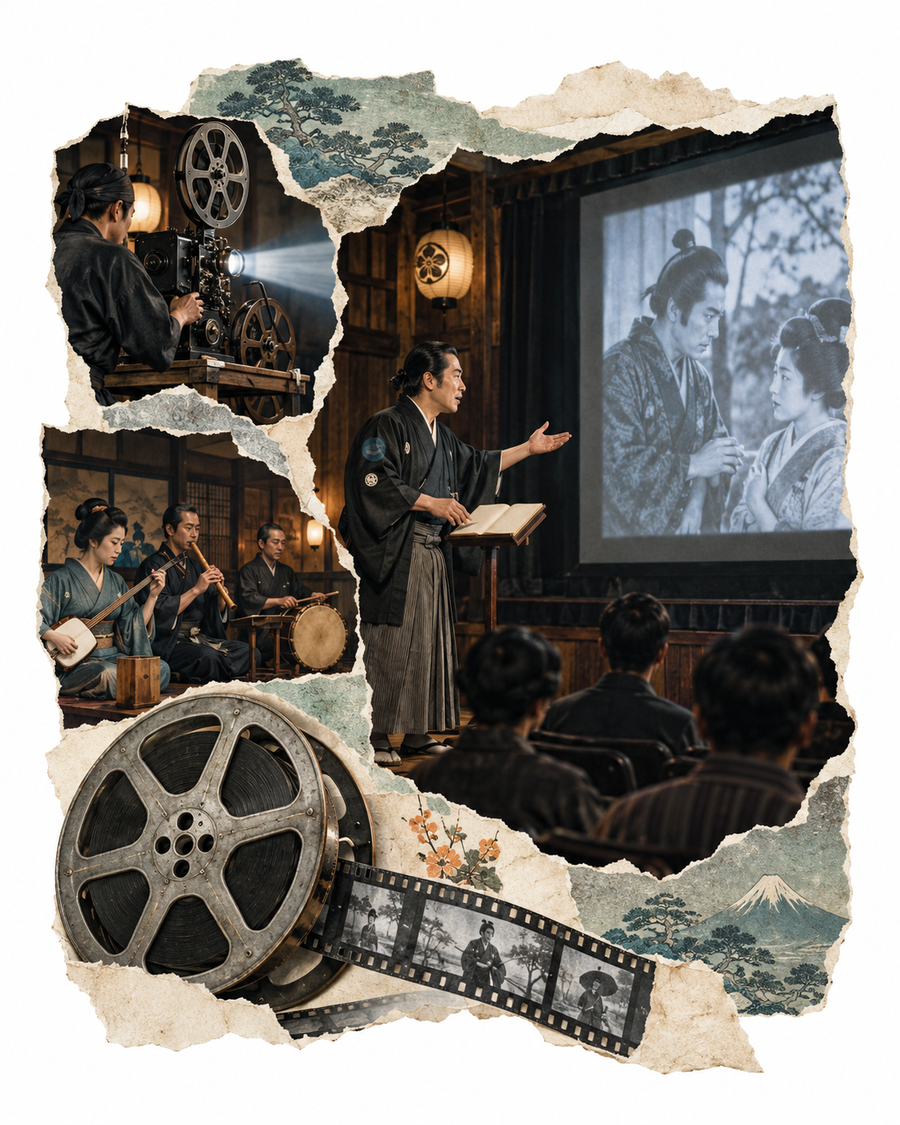
Shows and culture: when a trade survived as heritage
Benshi in Japan: giving voice to cinema before recorded sound
The benshi accompanied Japanese silent film screenings. They explained the action and verbally performed the characters. Their work had an artistic dimension: they could turn a screening into a unique experience.
The Japan Society de Nueva York places that tradition from the first Japanese film exhibitions in 1896 to the end of the silent era in 1939.
Sound cinema reduced their usual market and pushed the benshi toward specialized shows. The career of Sawato Midori shows its continuity in specialized shows.
Benshi stopped being a necessary figure for much of commercial exhibition, but survived as an art. Special screenings preserved a space for its performers.
Industries that lost their centrality: the case of saltpetre in Chile
Workers in the salitre offices: a crisis that transformed entire communities
The salitre exploitation in northern Chile developed during the 19th century and was of enormous economic importance between 1880 and 1930. The offices brought together extraction, processing, maintenance, transport and supply tasks.
The competition from synthetic products and market crises weakened that economy. The Great Depression worsened the decline: between 1930 and 1932, the collapse of exports hit the country hard. Memoria Chilena, from the Biblioteca Nacional de Chile, documents the industry and the impact of the economic crisis.
The closure of plants eliminated jobs and disrupted communities. The crisis of the thirties reduced the scale of the industry and accelerated the reorganization of its production centers.
Calculating before electronic computers
Human computers: a specialized occupation that was integrated into new roles
Before “computer” primarily designated a machine, it could also refer to a person in charge of performing calculations. In research and aeronautics, those workers processed data and verified results.
In Langley, United States, the NACA formed a first group of five women for that work in 1935. NASA describes the work of these teams from the mid-1930s to the 1970s.
The electronic machines changed the distribution of tasks. Some of the women workers learned programming or took on new scientific roles.
The need to organize computing as a separate manual occupation was reduced; mathematics, interpretation, and verification remained essential.
Other trades and occupations that are no longer part of everyday work
Linotype operators: turning a manuscript into lines of metal
Linotype, developed by Ottmar Mergenthaler, had a decisive demonstration at the New York Tribune on July 3, 1886. The operator typed on a keyboard and the machine composed lines of text cast in metal. The Universidad Complutense collection preserves one of these machines.
The linotype operator prepared the text for printing, oversaw composition and corrected the lines that needed to be replaced. Their work combined reading, keyboard skill and knowledge of the machine. Newsrooms and workshops depended on that stage to turn written originals into printed pages.
During the sixties and seventies, phototypesetting and computer systems changed text preparation. The study Early steps in computer typesetting in the 1960s describes that transition. The trade lost its place in regular production when metal lines were no longer needed. The preserved machines became associated with demonstrations, collections and specialized workshops.
Card punch operators: entering data with holes in cardboard
Punched-card systems created a specific occupation within offices and computing centers. The punch operator transcribed information using a keyboard that produced holes in specific positions. The reading equipment interpreted those perforations as data or instructions.
A workday could consist of transferring forms onto cards, correcting errors and keeping batches organized. The separation between preparing data and processing it organized the work of entire departments. The Computer History Museum documents the role of the operators, mostly women, in this system.
Cards continued to be a central input and storage medium until the seventies. The expansion of terminals and other electronic media reduced the need to punch them. The history of their coding traces that evolution. The position dedicated to producing cards lost its function within the computerized office.
Water vendors in Buenos Aires: selling water before it arrived through pipes
In Buenos Aires before running water, the supply combined wells, cisterns and street vending. The water vendors carried water in carts and sold it to neighbors. For many families, buying it was part of the daily organization of the household.
The Bernasconi Museum guide published by the Government of Buenos Aires describes how the water carriers loaded their barrels in the Río de la Plata and transported the water in ox-drawn carts to sell it in the city.
The running water service began in 1869, according to the history of the La Cisterna archaeological site. The expansion of connections progressively reduced the water carrier's clientele. Home distribution went from cart routes to a permanent pipe infrastructure.
París pneumatic mail operators: sending messages under the streets
Since 1866, París developed a network of pneumatic tubes to carry messages. Documents traveled inside containers propelled by pressure differences. The system connected points of the city through its own infrastructure.
Stations needed staff to receive documents, place them in the containers, dispatch them and collect arrivals. Postal work thus included a technical stage of circulation through tubes, in addition to delivery to the recipient. The Comité para la Historia de La Poste holds research on the network.
The service closed on March 30, 1984. Electronic communications and express delivery services took its place. The Lyon Municipal Library records the date and the alternatives. With the closure, the daily operation of that urban postal network ended.
Rickshaw pullers in Singapur: an occupation withdrawn by administrative decision
The rickshaw was a two-wheeled passenger vehicle that a person pulled on foot. In Singapur, its expansion since the late 19th century provided work for Chinese immigrants and made it part of urban transport.
The worker provided the physical strength to move the vehicle and carry the passenger. The activity placed considerable strain on the body. In 1947, the authorities abolished rickshaws and many pullers switched to driving trishaws, pedal-powered vehicles.
The Biblioteca Nacional de Singapur documents that transition. Motorized transport and later restrictions also reduced the trishaw market, which by the late seventies was increasingly linked to tourism. In this case, an administrative decision put an end to the work of pulling the vehicle on foot in the city.
University degrees that stopped being taught and qualifications that were replaced
Home Science at the Universidad de Otago, New Zealand: from domestic training to several specialties
The Universidad de Otago opened its Escuela de Home Science in 1911. The training brought together knowledge that was then studied within a single field: applied chemistry, food, nutrition, hygiene, textiles, clothing and teaching. The home and community life were at the center of a program with scientific and practical content.
The institutional history of Otago records a three-year diploma taught from 1921 until the early nineties and a four-year degree from 1922. In 1986, its main areas were brought together in Consumer and Applied Sciences. In 2012, this program merged with Applied Science.
The former joint program gave way to a more specialized organization. Food, nutrition and textiles gained their own spaces. The Departamento de Food Science preserves that academic lineage. The transition reflects the growth of disciplines that previously shared the same training.
Home Economics at the Universidad de Columbia Británica, Canada: suspension, reopening and closure of the school
The Universidad de Columbia Británica, en Vancouver, established a university course in Home Economics in 1931. The following year, budget cuts forced its suspension. An organization of families and teachers helped eight students complete their training at another university.
In 1943 the restoration of teaching was approved. The Escuela de Home Economics was established in 1951 and was renamed School of Family and Nutritional Sciences in 1984. In 1992 it offered, among other programs, the Bachelor of Home Economics, dietetics studies, nutritional sciences and family sciences.
The school closed in 1999. Dietetics and nutrition remained in the Facultad de Ciencias Agrícolas; family studies moved to Social Work. The UBC archives preserve the sequence. Funding and academic reorganization marked its interruptions.
Albeitería in Spain: from traditional apprenticeship to institutional veterinary medicine
The albéitares practiced a tradition of animal care predating modern veterinary schools, especially linked to horse care. Their training combined practical apprenticeship and accreditation before the institutions of the time.
The Real Colegio-Escuela de Veterinaria de Madrid opened in 1793. For more than half a century the new teaching and the institutions of albeitería coexisted. The Real Tribunal del Protoalbeiterato was officially abolished in 1847, with transitional examinations continuing afterwards. The Universidad Complutense de Madrid and its Biblioteca de Veterinaria explain that transition.
Veterinary teaching gradually incorporated animal care into a regulated scientific training. The abolition of the tribunal in 1847 and the subsequent transitional examinations accompanied that professional reorganization.
Licenciaturas and diplomaturas in Spain: the reorganization of university degrees
The Spanish university reorganization linked to the European Higher Education Area progressively replaced the previous structure with bachelor's degrees, master's degrees and doctorates.
The Royal Decree 1393/2007, in its historical wording, set 30 September 2015 as the deadline for the phasing-out of the teachings under previous regulations covered by its transitional provision.
The new bachelor's degrees reorganized training in areas such as nursing, engineering and teaching. Graduates of the previous study plans kept their qualifications under the corresponding recognition scheme.
China: the end of the imperial examinations in 1905
For centuries, the Chinese imperial examinations organized a route into the administration and an important part of elite education. Preparation was linked to the study of classical texts and to specific forms of written assessment.
In 1905, the court abolished the system. The Government of Hong Kong documents that ending. The contemporary diplomatic record of the decree makes it possible to consult the scope of the decision.
The reform replaced a traditional path for training and selecting civil servants.
Why do some activities disappear while others survive?
Technical substitution explains part of the change: automatically connecting a call reduces the need for a manual connection. But for a technology to reorder employment it must spread, become accessible and have infrastructure. Adoption could extend over decades.
Institutional reorganization can be just as decisive. The disappearance of a State, the reform of examinations or the modification of qualifications changes who can practise and what knowledge receives recognition. The quipucamayoc, albeitería and the imperial examinations show mechanisms different from automation.
The transformation of consumption allows certain activities to survive. A candle can be bought for its scent or its ceremonial meaning even though it is no longer needed to read at night. A cinematic narration can survive as a spectacle even though most films have sound.
Finally, economic crises can accelerate a decline that was already underway. Their consequences affect workers, families, and localities. Closures caused job displacement and forced people to seek other sources of income.
Frequently asked questions about degrees that no longer exist
Did electricity make candle manufacturing disappear?
No. It reduced its importance for daily lighting in electrified places. The activity continued with religious, decorative, scented, ceremonial, and emergency uses.
Were all old jobs replaced by machines?
No. They also changed due to educational reforms, political upheavals, economic crises, and new preferences. Some tasks survived as craftsmanship, heritage, or specialized services.
Did everything those workers had learned stop being useful?
Not necessarily. Part of that knowledge could be incorporated into other roles. Calculation, record management, and animal care continued, although their organization changed. The real possibility of transferring those skills depended on each context.
The history of work continues in today's careers
The degrees that no longer exist explain how fundamental activities were transformed: producing light, preserving food, recording resources, communicating messages, calculating, and teaching.
A candle, a phone call, or a computer reveal layers of that history. Behind each current solution were workers who met the same need with other materials, institutions, and knowledge. Understanding these transitions helps to look at a degree for what it allows you to do and for its capacity to evolve, as well as for the name of its title.