I don't know what to study but I like drawing
Liking drawing can be a very good clue for choosing what to study, but drawing doesn't lead to a single career.
Think of two people who spend hours with a pencil. One draws buildings. Another invents characters. Another imagines furniture, sneakers or cars. Another enjoys creating posters and visual compositions.
All four draw, but they are probably interested in very different professional problems.
"What degree fits if I like drawing?", try a more specific question: What do you like to create when you draw?

Discover what's behind your interest
Maybe you don't have it clear yet. You may simply know that you enjoy drawing, creating things or thinking visually.
If you're at that point, the NoSeQueEstudiar Career Test can help you identify what other interests and skills that creative side combines with: technology, communication, spaces, stories, objects, people, business or problem-solving.
The test cannot help you find clues and paths you can research later.
And to make it even more concrete, look at what usually shows up in your drawings.

If you like drawing objects
Do you invent furniture, products, vehicles, tools or things that could be manufactured?
Then it's worth exploring Industrial Design.
Industrial design combines creativity with technical and practical aspects. It's not just about making a pretty object: you have to think about how it works, who will use it, how it could be manufactured and what problems it needs to solve. Descriptions place it precisely at the intersection of art, business and engineering.
It may interest you especially if, in addition to drawing, you enjoy asking yourself: "How could this object work better?"

If you draw buildings, rooms or spaces
If you fill notebooks with houses, rooms, buildings or space layouts, you can look into Architecture.
Here drawing is a tool for representing ideas, but professional work includes much more: developing plans, using specialized software, understanding client needs, working with technical constraints and participating in construction projects.
So, liking to draw buildings is a good sign, but it's also worth asking yourself if you are drawn to spaces, construction, planning and the technical side.
If you like communicating ideas visually
Perhaps what you enjoy most is combining images, shapes, colors and compositions to convey something.
There you can explore Graphic Design and other visual communication fields.
The graphic designers develop visual concepts to communicate ideas and work both by hand and with digital tools. In professional practice, meetings with clients, revisions, typography, composition and adapting pieces to different formats also come up.
That matters because working as a designer does not mean spending eight hours drawing freely. An important part of the job consists of solving communication problems.
Try real design tools
You can also explore some tools used in creative and technical fields:
- Figma Design → digital design, interfaces and prototypes.
- Adobe Fresco → drawing and digital illustration.
- Adobe Illustrator → vector illustration and graphic design.
- SketchUp → 3D modeling for architecture, spaces and objects.
- BlopHome → 3D interior design and decoration.
You don't need to learn them all. Choose one related to what attracts you and see if you enjoy creating, modifying and solving problems with it.
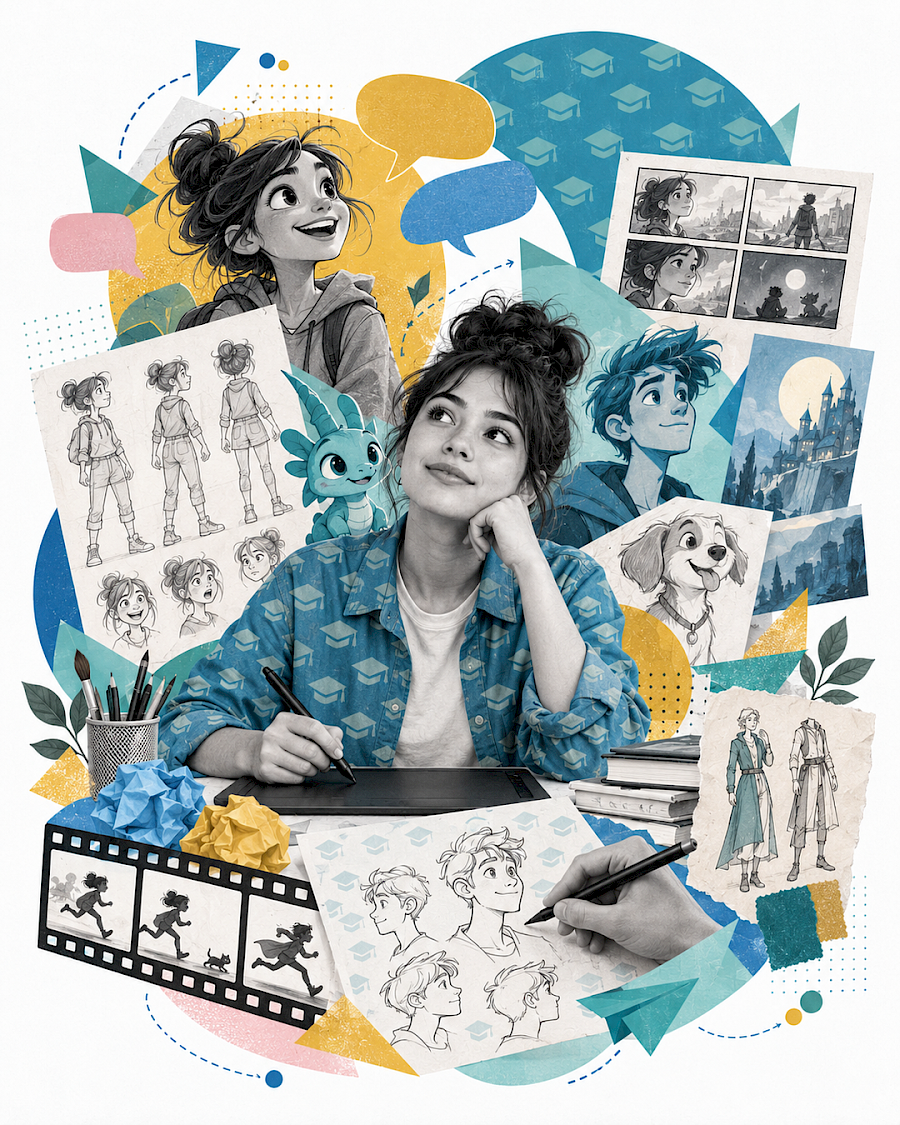
If you invent characters
If what you love is faces, creatures, characters, imaginary worlds or different expressions and poses, you can explore paths like Illustration and Animation.
In animation, for example, drawing can be combined with software, modeling, movement, storytelling and teamwork. Professionals in the field create characters, settings, moving images and effects for film, video games and other media. There's also an important reality: in these fields your portfolio usually carries a lot of weight, that is, what you are able to show you can do, in addition to your education.
If you draw to tell stories
Maybe you're not so interested in a single image as in imagining what happens before and after.
Scenes, framing, characters, sequences, settings.
That interest can bring you closer to Animation, Film, Audiovisual, storyboard, narrative illustration and related fields.
“Do I like telling stories visually?” That difference can help you a lot to narrow down your options.
If you're drawn to clothing and appearance
If you draw dresses, outfits, accessories, silhouettes or garment details, you can explore Apparel Design or Fashion Design.
But it's also worth looking beyond the sketch.
Are you interested in materials? In trends? How a garment is constructed? Visual identity? The business side? Drawing can be the entry point, but professional work involves many other skills.
If you enjoy precise, technical drawing
There are people who don't enjoy free artistic drawing as much, but do enjoy depicting objects with proportions, perspective, measurements and details.
That profile can be found in areas such as Architecture, Industrial Design and various engineering fields.
Here drawing works more as a way to think, plan and communicate solutions than as an artistic work.
Don't choose a degree just because you draw well
This is probably the most important part.
Being good at drawing and enjoying drawing are useful signs, but they don't mean you have to turn drawing into a career.
An activity can delight you as a hobby and lose part of its appeal when clients, deliverables, revisions, constraints, software, budgets, and deadlines appear.
And you don't need to be “the best at drawing” to explore a creative degree. Many techniques are learned and developed.
The important thing is to discover what part of the process interests you enough to want to learn more.
Try this exercise
Look at your last ten drawings —or think about what you would draw if no one told you what to do— and look for a pattern.
Objects → Industrial Design.
Buildings and spaces → Architecture.
Posters, brands, and composition → Graphic Design.
Characters → Illustration or Animation.
Scenes and stories → Film, Animation or Audiovisual.
Clothing → Fashion Design.
Blueprints and technical drawing → Architecture, Industrial Design or some engineering degrees.
You don't have to choose one of those degrees now.
Choose two or three that spark your curiosity, look at their study plans, look at jobs, professionals, and find out what part of the day they spend drawing and what other tasks they do.
Because maybe the clue isn't simply that you like drawing.
Maybe it's that you like creating objects, imagining spaces, communicating ideas, or telling stories.
And discovering that difference can bring you much closer to a degree that really makes sense for you.