
Degrees related to cosmetology
The Degree in Cosmetology is a much broader professional field than it seems. It is not limited to makeup, facials, or salon work: it is also related to chemistry, biology, dermatology, research, technology, product design, and business.
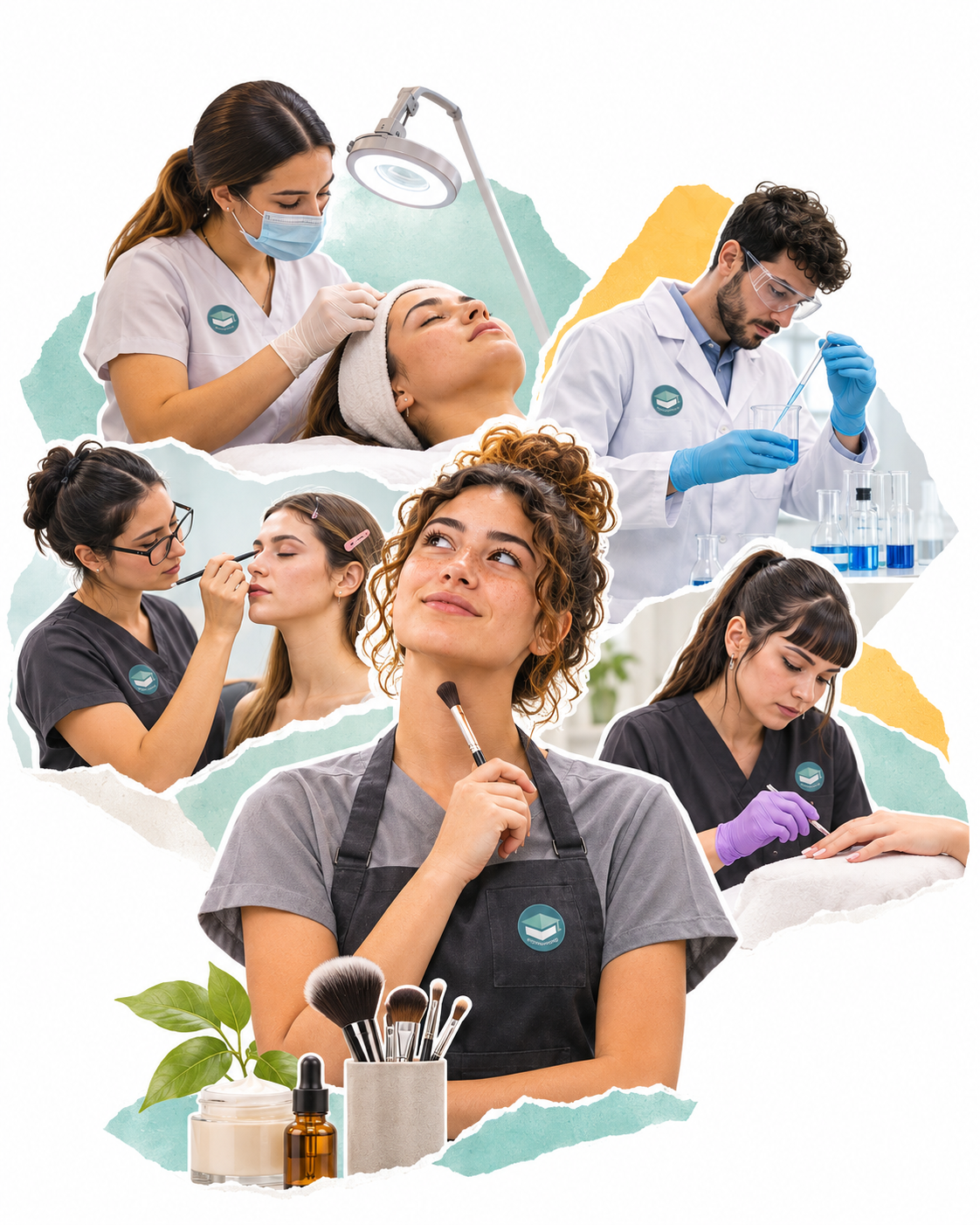
Degrees related to cosmetology: careers, training, and opportunities around the world
The degrees linked to this field offer two main paths: working directly with people in the aesthetic care of skin, hair, or nails; or participating in the research, manufacturing, and marketing of cosmetic products. According to the McKinsey State of Beauty report, global beauty market growth of nearly 5% per year is expected through 2030, although opportunities and challenges differ across regions.
Cosmetology, cosmetic science, and dermatology: how do they differ?
Cosmetology studies and applies aesthetic care techniques, products, and non-medical procedures. Its profile is mainly technical and practical, although it requires scientific foundations and safety protocols.
Cosmetic science researches ingredients, develops formulations, and evaluates the stability, safety, and efficacy of products such as cleansers, creams, makeup, perfumes, and shampoos. It requires scientific and industrial training.
Dermatology is a medical specialty dedicated to preventing, diagnosing, and treating diseases of the skin, hair, and nails. It can collaborate with cosmetology and the cosmetics industry, but studying cosmetology does not grant medical licensure.
Degrees in aesthetic care: roles, studies, and challenges
Cosmetologist or esthetician
They perform aesthetic skin assessments, facials, hydration, superficial treatments, and care recommendations within their scope of practice. They can work in treatment rooms, beauty centers, spas, and independent services.
What they study: skin anatomy and physiology, skin types and characteristics, basic formulations, hygiene, biosafety, authorized equipment and client communication. Challenges: avoiding irritation, recognizing contraindications, referring to the dermatologist when appropriate, staying up to date and building a stable clientele.
Hairdressing, hair styling and colorimetry
These professionals perform cuts, hairstyles, coloring, bleaching and cosmetic hair treatments. They work in salons, creative productions, training and advising brands.
What they study: hair structure, pigments, colorimetry, dye chemistry, cutting techniques, hair textures and safety. Challenges: limiting damage to the hair fiber, working with different hair types and reducing occupational exposure to chemicals. Diagnosing scalp diseases is not part of hairdressing work.
Professional makeup
A person dedicated to makeup can work in events, fashion, photography, advertising, film, television, theater or brand training. The work requires adapting to lighting, production schedules and the characteristics of each face.
What they study: color theory, facial morphology, makeup techniques, hygiene, lighting and history of aesthetics. Challenges: developing a competitive portfolio, maintaining consistent quality and working correctly with different skin tones and characteristics.
Manicure, pedicure and nail techniques
They specialize in cosmetic care, nail polish, extensions and artistic nail designs. They can work in salons, specialized studios or their own businesses.
What they study: nail anatomy, disinfection, acrylic materials, gels, decorative techniques and infection prevention. Challenges: controlling exposure to dust and chemicals, avoiding repetitive motion injuries and competing without neglecting hygiene and quality.
Body aesthetics and spa services
They perform exfoliations, cosmetic body treatments, manual techniques and wellness services within the scope of their training. They work in specialized centers, hotels and spa establishments.
What they study: basic anatomy, hygiene, body products, manual techniques, contraindications and customer service. Challenges: physical effort, the additional training needed for some equipment and expectations of results that should not be confused with medical effects.
Eyelashes, eyebrows and micropigmentation
Includes eyebrow design, eyelash extensions, laminations and, when regulations allow and the required authorization is held, permanent pigmentation procedures.
What it covers: anatomy of the eye area, properties of adhesives and pigments, facial symmetry, application techniques and biosafety. Challenges: preventing allergies, infections and injuries in sensitive areas; training and authorization requirements may vary depending on the procedure and the country.
Scientific, industrial and medical degrees related to cosmetics
Cosmetic chemistry and formulation
Role: designing and improving creams, serums, cleansers, shampoos, makeup and other formulas. Typical studies: chemistry, chemical engineering, pharmacy or cosmetic science; with in-depth study of emulsions, preservatives, stability and testing methods. Challenge: obtaining products that are safe, stable, functional, pleasant to use and viable to manufacture.
Pharmacy specialized in cosmetic products
Role: collaborating in the development of formulations, ingredient selection and quality evaluation. Typical studies: pharmacy and specializations in dermopharmacy or cosmetic technology. Challenge: balancing the properties of substances with safety and regulatory requirements, without attributing medical indications to a cosmetic.
Cosmetic biotechnology
Role: researching peptides, fermentation, enzymes and biological processes to obtain ingredients. Typical studies: biotechnology, biochemistry, molecular biology and microbiology. Challenge: turning research findings into reproducible, safe and economically viable raw materials.
Toxicology and safety assessment
Role: studying risks of ingredients and products considering exposure and conditions of use. Typical studies: toxicology, chemistry, pharmacy or other related sciences. Challenge: supporting decisions with sufficient evidence and meeting different safety requirements.
Cosmetic process engineering
Role: organizing, designing and improving industrial manufacturing, from mixing equipment to packaging. Typical studies: chemical, industrial or process engineering. Challenge: scaling up production without losing stability, uniformity and quality.
Microbiology and quality control
Function: check raw materials, monitor microbial contamination, investigate changes in products and verify specifications. Common studies: microbiology, biology, chemistry or pharmacy. Challenge: maintain manufacturing conditions that prevent contamination and ensure consistent results across batches.
Dermatology
Function: diagnose and treat skin, hair and nail diseases; some dermatologists also take part in clinical research on care products. Studies: medicine and specialization in dermatology. Challenge: clinically evaluate patients and differentiate medical needs from aesthetic preferences; it is not a specialization you can enter with only cosmetology courses.
Clinical research and efficacy evaluation
Function: design studies to measure product effects and analyze results. Common studies: health sciences, biology, pharmacy, statistics and research methodology. Challenge: produce reliable data, use appropriate measurements and avoid advertising messages that exaggerate results.
Creative, commercial and business degrees
Beauty marketing
Function: research consumers, design campaigns and build strategies for brands. Studies: marketing, communication, market research and e-commerce. Challenges: differentiate products in competitive markets and communicate benefits without misleading claims.
Product development
Function: coordinate the creation of new lines between the laboratory, factory, design and sales. Studies: project management, business, innovation and technical knowledge of cosmetics. Challenges: turn a consumer need into a feasible, safe and profitable product.
Packaging design and user experience
Function: create containers, applicators and presentation systems. Studies: industrial and graphic design, materials and production processes. Challenges: reduce waste and use materials compatible with formulas without compromising protection and functionality.
Cosmetic education and training
Function: teach techniques, train professionals and train sales or service teams. Studies: cosmetology or another base discipline, pedagogy and technical specialization. Challenges: update content, evaluate learning and distinguish scientific evidence from commercial trends.
Cosmetic entrepreneurship
Function: create and manage salons, studios, brands or distribution businesses. Studies: administration, finance, marketing and fundamentals of the product or service offered. Challenges: initial investment, costs, hiring, customer loyalty, profitability and compliance with obligations.
Regulatory affairs
Function: review ingredients, documentation, labels and requirements to launch products in different markets. Studies: pharmacy, chemistry, related sciences and specialized training in regulation. Challenges: interpreting regulations that are not identical across countries and keeping technical documentation up to date.
These careers usually collaborate. To launch a sunscreen, for example, formulators, microbiologists, toxicologists, efficacy evaluators, engineers, designers, marketing professionals and documentation specialists may be involved; the specific requirements depend on the legal classification of the product in each market.
What you study to work in cosmetology and cosmetic science
Technical training: subjects and applications
In technical training, theory and supervised practice are combined. Anatomy and physiology provide an understanding of the structure and function of skin, hair and nails. Skin biology covers the epidermis, dermis, glands and protective barrier. Basic cosmetic chemistry introduces pH, emulsions, preservatives and ingredient compatibility.
Coursework in facial and body cosmetology develops techniques for cleansing, hydration, exfoliation and aesthetic care. Biosafety teaches disinfection, infection prevention and protection during work. Aesthetic equipment covers how devices work, their indications and legal limits. Aesthetic assessment helps recognize contraindications; customer service and administration incorporate ethics, budgets, inventories and organization of a service.
These subjects come to life in practice: before a facial exfoliation you need to assess the condition of the skin; when applying hair color you need to understand pigments and reactions; and in a nail salon you must prevent infections and control exposure to materials. Training internships should not be confused with automatic authorization to perform any procedure.
University education: from ingredient to finished product
In the scientific degrees, the following are studied in greater depth: organic and inorganic chemistry, biochemistry, biology, microbiology, toxicology, instrumental analysis and process engineering. A person developing a serum must verify that the formula keeps its properties, that its packaging is compatible, and that the advertised benefits have sufficient support.
Large-scale manufacturing adds tasks such as raw-material control, production protocols and batch-to-batch testing. Some specializations require a prior university degree and may include laboratory practice or industrial internships.
Which path matches each professional interest
To work directly with skin in a treatment room, the usual path is training in cosmetology or professional aesthetics. For hair, hairdressing and colorimetry. For makeup in fashion or audiovisual productions, professional makeup artistry with practice and a portfolio. To create creams, chemistry, pharmacy or cosmetic science. To research new ingredients, biochemistry or biotechnology. For quality and safety, chemistry, microbiology or toxicology. To diagnose dermatological diseases, medicine and the corresponding specialty. To manage a company or factory, combine technical training with business administration, finance or engineering depending on the role.
A course, a skills certification, a technical diploma, a university degree and a professional license are not equivalent. It is worth checking the hands-on training, educational recognition and the requirements to practice in your chosen location.
Real examples of degrees, diplomas and certifications by country
The following examples show what educational options exist. They include technical programs, higher education degrees, graduate programs and skills certifications. Admission requirements, campuses, application periods and authorizations may change: check directly with each institution.
North America
Canada: the postgraduate certificate in Cosmetic Science from Seneca Polytechnic lasts two semesters, about eight months. It includes product formulation, raw materials, laboratory equipment, quality, safety assessment and business aspects. It is a specialization path after previous studies, not a qualification to perform medical procedures.
Mexico: the EC0859 «Professional Makeup Design» competency standard, published in the Diario Oficial, is an example of assessment of specific skills, such as preparing the work area and applying makeup techniques. Competency-based certification is not equivalent to a bachelor's degree nor does it automatically cover all cosmetology activities.
South America
Brazil: the Técnico em Estética de Senac São Paulo combines training in aesthetic assessment, facial and body techniques, customer service and professional practice. It shows the importance of technical training in aesthetic services within a market that also has a significant manufacturing industry.
Colombia: the Occupational Technician in Comprehensive Cosmetology and Aesthetics from INCATEC offers competency-oriented training, facial and body techniques and care practices. It is an occupational training credential, distinct from a university degree.
Chile: the AIEP Cosmetology Technician degree combines foundations of aesthetic care, work with products and professional practice. It is an example of how technical training integrates hands-on skills with knowledge of skin and procedures.
Peru: the CETPRO CREAR Cosmetology specialty features modules in hairdressing and aesthetic care. Its modular structure makes it possible to see differences between partial certificates and a complete training pathway, whose validity must be checked in each call for applications.
Argentina: the University Technician Degree in Cosmetology, Cosmiatry and Aesthetics from the Universidad de Morón reports a duration of two years, with content in cosmetic chemistry, anatomy, equipment-based treatments and practical training. It is an undergraduate program; the activities that may be performed depend on the applicable regulations.
Europe
Spain: the Advanced Technician in Comprehensive Aesthetics and Wellness is a 2,000-hour Vocational Training qualification that includes aesthetic treatments, service organization and practical training. Its official status sets it apart from short private courses.
France: the BTS in Aesthetics, Cosmetics and Perfumery, Cosmetology option, described by Onisep, is a higher education program focused on formulation, testing and technical work. It is a different path from makeup or salon aesthetics services.
Italy: the master's degree in Industrial Cosmetic Science from the Universidad de Milán includes organic and inorganic ingredients, skin biochemistry, microbiology, toxicology, formulation, makeup development and production. It is an advanced program aimed at people who meet prior university requirements.
Asia
South Korea: the Korean Beauty Arts bachelor's degree from Wonkwang Digital University combines content on aesthetics, hair, makeup, color, and nails. Its academic information also distinguishes the university degree from the professional certifications that can be obtained through other routes.
China: the Cosmetic Technology and Engineering degree from Beijing Technology and Business University covers natural sciences, biotechnology, ingredients, formulation, and engineering, an example of the scientific side of the sector.
India: the master's in Cosmetic Science from JSS Academy of Higher Education & Research is an example of specialization in products, formulation, and scientific evaluation for people with appropriate prior training.
Africa
Nigeria: the National Innovation Diploma in Cosmetology and Beauty Therapy curriculum published by the National Board for Technical Education includes theoretical and practical training and supervised experience. The document consulted is a reference curriculum; its existence does not guarantee that any particular center currently offers it.
Kenya: the Hairdressing and Beauty Therapy technical qualification, listed by the TVET authority, shows a training pathway in hairdressing and beauty services. The authority also lets you check associated centers, which must be verified before enrolling.
South Africa: the Diploma in Somatology from Cape Peninsula University of Technology covers facial and body aesthetic care and practical activities in training facilities. The term “somatology” shows that related fields can have different academic names.
Oceania
Australia: the Diploma of Beauty Therapy from TAFE NSW, identified as SHB50121, provides training in facial treatments, aesthetic assessment, makeup and other beauty services. It is a vocational qualification from an educational system distinct from master’s degrees in cosmetic science.
New Zealand: the New Zealand Certificate in Beauty Therapy, level 4, from Ara Institute of Canterbury brings together training in facial care, makeup, nails and other techniques with practice. It is useful for understanding how qualifications are organized by levels.
How artificial intelligence is transforming work in cosmetology
artificial intelligence is changing aesthetic advice and product choice. Facial analysis systems can examine photographs to estimate visible characteristics, such as spots, wrinkles or tone differences, and suggest care routines. In makeup and hair coloring, computer vision and augmented reality allow shades to be tried on virtually before applying them. The L’Oréal Paris virtual beauty tools show how these features are already part of the shopping experience. For estheticians, makeup artists and beauty advisors, the change means that part of the consultation can begin on a screen, but interpreting the results and responsibly selecting products still require professional knowledge.
In industrial development, AI makes it possible to analyze large ingredient datasets and explore formulations before moving on to physical testing. The predictive models studied in cosmetic science seek to estimate properties such as texture, stability, shelf life, and certain sensitization risks. In perfumery, commercial applications already exist: Symrise and IBM developed Philyra, a tool that analyzes formulas and suggests fragrance combinations; its results were used in O Boticário fragrances in Brazil. This expands the work of chemists, formulators, and perfumers: in addition to creating products, they need to interpret predictions, recognize model errors, and verify results through real testing.
The expansion of these tools also raises professional issues. Photographs taken with different cameras or lighting conditions can alter skin assessment, and systems trained on images with little diversity may perform worse on certain skin tones. A study on bias in AI applied to skincare examines precisely these limitations. For this reason, professionals must learn to assess the reliability of recommendations, protect their clients' images and data, and avoid presenting an aesthetic simulation as a medical diagnosis. AI changes the tools and skills needed, but it does not turn a beauty app into a healthcare professional.
The beauty sector and the cosmetics industry across different continents
Consumer preferences, purchasing power, distribution, professional services, and the requirements for manufacturing products vary from country to country. The figures cited below measure different categories —retail sales, exports, or specialized establishments— so they should not be compared as if they were a uniform ranking of continents.
North America: major brands, specialization, and e-commerce
United States, Canada and Mexico have cosmetic product companies, beauty chains, aesthetic centers and training services. In the United States, makeup, skin care, perfumery and hair stand out. According to the Circana sales results for 2025, the US prestige beauty segment reached about 36 billion dollars and the mass-market segment, about 72.7 billion dollars in the channels analyzed.
For professionals there are opportunities in specialized services, formulation, digital sales, brand creation and product safety. The challenges are strong competition, the costs of attracting clients, advertising without sufficient backing and differences between territorial requirements. Mexico adds production and distribution opportunities for the regional market, while Canada also has specialized training in cosmetic science laboratories.
South America: hair care, production and ventures
Brazil, Colombia, Argentina, Chile and Peru show activity in hair care, perfumery, makeup, aesthetic services, distribution and manufacturing. Brazil stands out for the scale of its market: according to the ABIHPEC export data, foreign sales of beauty and personal care reached 1.061 billion dollars in 2025.
The diversity of hair textures and care needs favors the development of hair formulations and specific services. Opportunities include ventures, professional aesthetics, botanical product development, formulation and trade. Challenges include economic volatility, differences in purchasing power, import costs and informality in some services.
Europe: perfumery, cosmetic science and specialized manufacturing
France, Germany, Italy, Spain and Poland are part of a market with a tradition in perfumery, research, ingredient manufacturing and finished products. According to Cosmetics Europe, retail sales of cosmetics and personal care in Europe reached approximately 110 billion euros in 2025; the organization also documents millions of jobs associated with the value chain.
Professional profiles include formulation, toxicology, quality control, fragrance development, packaging design and sustainability. Challenges include costly innovation, international competition and the need to adapt formulas and processes to strict safety and environmental protection standards.
Asia: technology, exports and market diversity
South Korea, Japan, China, India, Indonesia, Thailand and Vietnam represent markets with different scales, consumers and production systems. South Korea is a notable case of innovation and export: the official data released by Korea.net place its cosmetics exports at about 11.4 billion dollars in 2025, 11.8% above 2024.
Japan contributes experience in research and formulation technology; China and India offer both scientific and commercial paths. In Western Asia, Saudi Arabia and the United Arab Emirates have activity in perfumery and high-end beauty. Opportunities span ingredient research, manufacturing, export, brand creation and digital commerce. Challenges include accelerated launches, imitative products, price competition and differing national requirements.
Africa: regional products, training and local manufacturing
South Africa, Nigeria, Kenya, Egypt and Morocco show different consumption and production profiles. There are ventures linked to ingredients such as shea butter, marula oil and other plant extracts, as well as demand for products for diverse skin and hair types.
In Kenya, Euromonitor recorded for 2025 15% growth in value in beauty and personal care sales, to approximately 124.1 billion Kenyan shillings. Opportunities include botanical formulation, manufacturing, responsible sourcing and digital sales. Challenges include access to financing, logistics, ingredient traceability and control of counterfeit products.
Oceania: sun protection, quality and distribution
Australia and New Zealand have markets for cosmetics, skin care, sun products and aesthetic services. In Australia, IBISWorld estimated that specialized cosmetics and toiletry retailers earned about 6 billion Australian dollars in 2025. That figure refers to a retail channel, not to the national industry as a whole.
Opportunities include formulation, brand development, technical training, care product research and specialized retail. Challenges are logistics costs, competition from imported products and the need to meet technical and commercial requirements.
Shared challenges for careers in cosmetology and cosmetic science
Safety, stability and proven benefits
It is not enough for a product to appear to work. It is necessary to study ingredients, stability, contamination and the tests that support the claimed benefits. For those who offer services, the priority is to recognize contraindications, use appropriate techniques and refer clinical problems.
Sustainability and environmental management
Manufacturers must improve packaging, control waste and study the origin of raw materials. The challenge is to reduce environmental impact without sacrificing product protection, hygiene or safety.
Diversity and inclusion
Services and products must respond to different skin tones, hair textures, ages and use needs. This requires expanding testing, technical training and design criteria.
Social media and misleading information
Digital trends can drive new products and services, but they also spread claims without evidence. Professionals need to distinguish study results, advertising and individual testimonials.
Ongoing training and working conditions
New ingredients, equipment, and methods require ongoing training. In beauty centers and salons, ergonomics, exposure to chemical products, and client care must also be addressed. Responsibilities increase when running a business or working in industrial manufacturing.
What degrees offer professional development opportunities
Cosmetology and aesthetics: direct care, specializations, and entrepreneurial opportunities, with a strong reliance on practice and client relationships. Cosmetic chemistry: research, formula development, and industrial work, requiring scientific knowledge. Biotechnology: ingredient and process projects that require specific technical training.
Safety and regulation: evaluation, quality, and documentation positions. Makeup: creative projects, fashion, and audiovisual production, where portfolio and professional networks are important. Marketing and business: brands, e-commerce, products, and sales. Entrepreneurship: autonomy in decision-making, accompanied by costs, risk, and business responsibilities.
Before choosing where to study, you should review the curriculum, course load, internships, admission requirements, degree or certificate awarded, and real professional scope. Afterwards, it can be useful to compare work environments: public-facing service, laboratory, industrial plant, creative production, or business management.
The cosmetology and related careers combine technical, scientific, creative, and commercial dimensions. They do not lead to a single job nor do they require a single type of training: their variety allows for building different paths, as long as the skills, responsibilities, and conditions of each one are understood.