Interview with Carmen Espoz Larraín - Chile
Tell us about your journey
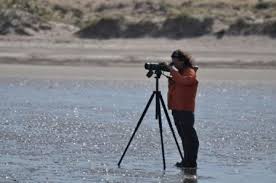
Marine Biologist from Universidad de Concepción, Chile, and PhD in Biological Sciences with a specialization in Ecology from Pontificia Universidad Católica de Chile. With experience in the management of economically important marine resources and in transferring knowledge to the artisanal fishing sector. In recent years she has led an ecological monitoring program developed at the Ramsar site Bahía Lomas (Tierra del Fuego, Chile), focusing on issues related to the conservation, management and administration of wetlands important for migratory birds. Currently, she is Dean of the Facultad de Ciencias at Universidad Santo Tomás, and she is President of Corporación Centro Bahía Lomas.
How did you discover you wanted to be a Marine Biologist?
All my memories lead me to marine biology. It was what I always wanted to study. It was something that came from the "factory".
At around 11 years old I received my grandfather's chemistry set (who was a civil mining engineer), and a collection of books about life at the bottom of the sea. Both things left their mark on me. 40 years later I still keep some of those books ...
While in the Marine Biology degree I "discovered" that what I liked most was Ecology. Then, I had the opportunity to join Dr. Juan Carlos Castilla's Marine Ecology group at P. Universidad Católica de Chile, and from there things fell into place to bring me to where I am today.
What were the challenges of studying Biological Sciences?
The degree was not offered in the city where I lived so at 17 I left home. I went to Universidad de Concepción. That was the first challenge. Studying away from the place where I had been born and raised.
The first years were difficult since I did not have the study habits the degree required. Also because living with family is not the same as living alone. I failed many courses. Chemistry and cell biology turned out to be particularly painful subjects. A "suffering" you had to go through if you wanted to become a Marine Biologist. Nothing to be done about it.
What do you think is most important to succeed as a Marine Biologist?
For me ecology (more than biology) is a way of life. I am happy with what I do, and to achieve it I think being creative, dreamy, and hardworking has helped; with some well-defined goals since the degree.
Would you say you chose a career that lets you travel the world?
Yes. Science involves learning, being part of study groups and sharing the knowledge that is generated, which translates into traveling to do research stays, participate in scientific meetings, working groups, among others.
Besides, there are the topics you choose to study. In my case, throughout my professional life, I have had the opportunity to study topics that have required traveling: geographic ranges of marine species during my doctorate, and migratory shorebirds at present.
Finally, I have always liked traveling so the topic of traveling is also related to your personal history.
Is learning other languages important to practice as a marine biologist?
Yes, preferably English. It makes life and communication with the rest of the scientific world easier. Most of the specialized literature is in English and it is a fairly universal language (at least in the West).
How do you think the Internet affected your career?
The Internet improved communication, enabled collaboration networks and changed the notion of time, among other things.
Does society benefit from the studies you carry out?
Yes. We work on topics related to the conservation of ecological systems (wetlands) and the species that inhabit them. If we succeed, current and future generations will be able to continue enjoying these ecosystems, in addition to the direct and indirect benefits they provide.
What advice could you give to a person who is thinking about studying Biological Sciences? Is it a degree with a future?
Everyone forges their own future. For that you have to work and believe that what you are doing is important, for you and society.
The million-dollar question: why choose a degree in the area of Biological Sciences?
The degree allows you to explore the world you live in, and in this process of exploration you become a contribution to the development of the country and people's well-being.
Young people ask us about job opportunities. Was it very hard for you to find work as a Marine Biologist?
Everything is relative. I joined JC Castilla's marine ecology group to develop my undergraduate thesis in 1 year. There I worked for about 5 years on research projects. Then, I entered a doctoral program. It took me 8 years to earn the degree. I finished on a Friday and by the following Monday I was hired at Universidad Santo Tomás, with the mission of developing a Research and Outreach Unit. I have just completed 14 years at this institution and I am dean of the Facultad de Ciencias. Answering the question, I do not feel it was very hard.