
What degree studies plants and what options are available?
If you are interested in learning how plants grow, identifying species or understanding their relationship with the environment, botany is the discipline you are looking for. It is part of biology and studies plant life, from its structures and functions to its diversity and evolution.
However, to choose what to study it is worth looking beyond the name of a discipline. You can approach the plant world from degrees like Biology, Agronomy, Forestry Engineering and Biotechnology, or through programs in horticulture and gardening. The choice depends on what you would like to do with that knowledge.
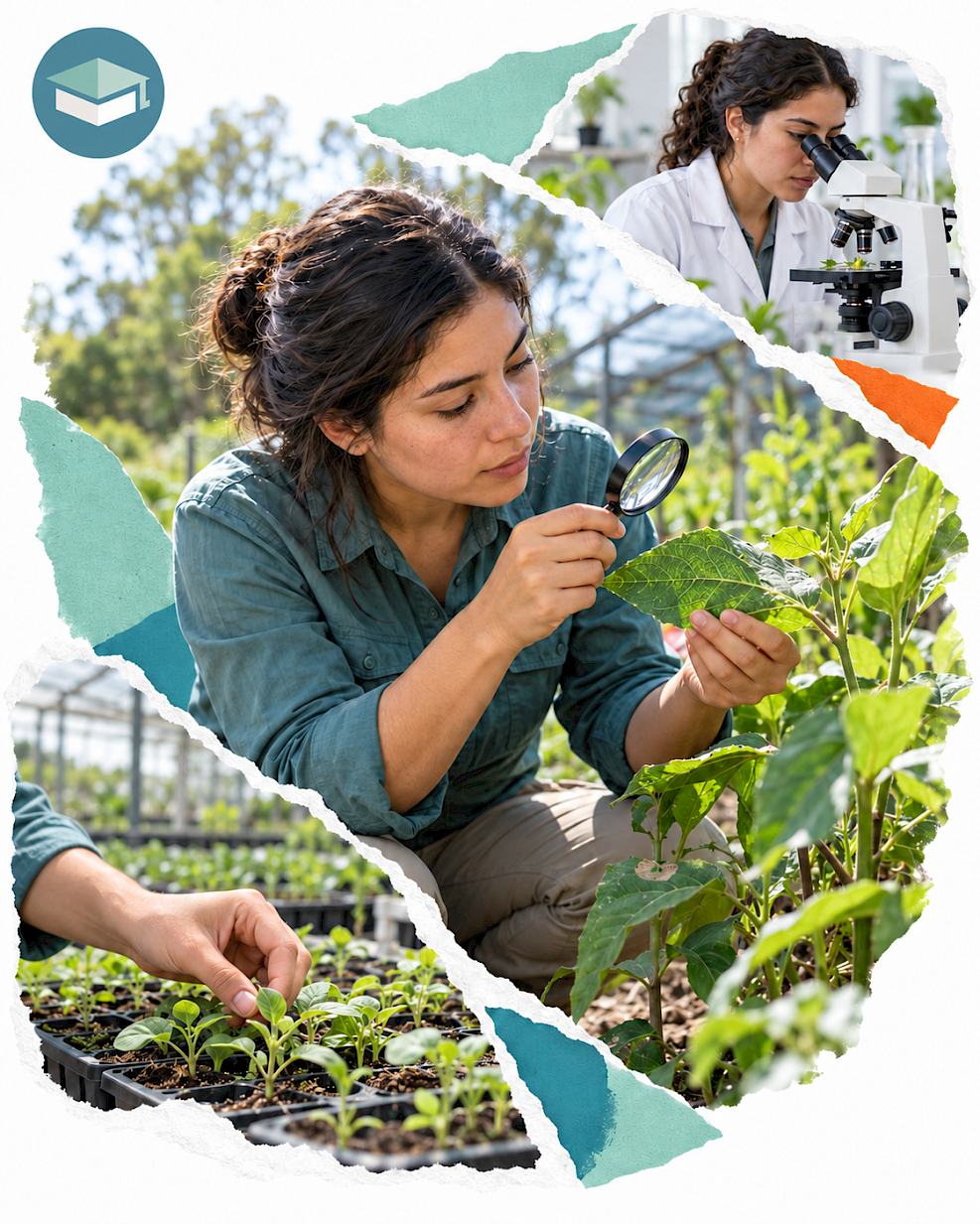
What botany is and how you can study it
Your initial interest can help you narrow down your search. If you want to explore what to study if you like nature, compare the tasks that are performed in natural environments, crops and green spaces. If you prefer to understand the processes of living beings, reviewing options related to biology can broaden your perspective.
Botany allows you to investigate questions such as why a species grows in certain environments, how it reproduces or what changes it undergoes when it has less water. It also helps to identify plants and understand their relationships with other living beings.
In many universities, training in botany takes place within Biology and is deepened through elective subjects, internships, research projects or postgraduate studies. Therefore, when looking for a degree that studies plants, review both the program title and its contents and specialization possibilities.
Degrees related to the study of plants
Biology to research plant life
Biology may interest you if you want to understand how living beings work and delve deeper into the study of plants. The training also covers other organisms, along with topics such as genetics, evolution and ecology.
A path focused on botany may include species identification, study of plant tissues, field observation, work with scientific collections and data analysis. The specific possibilities depend on the areas offered by each institution.
Knowing what a biologist does lets you connect those activities with professional work. When evaluating your interest in studying Biological Sciences, also consider the training in basic sciences and the study of organisms other than plants.
Agronomy to work with crops
Agronomy connects knowledge of plants with agricultural and livestock production. It studies how soil, water, climate, nutrition and health influence crop development, along with economic and management aspects.
It can be an option if you are interested in producing food, evaluating cropping systems or supporting producers. Check the full curriculum, because some degrees include significant training in animal production and other areas of the agricultural and livestock sector.
Forestry Engineering to study and manage forests
Forestry Engineering deals with forest ecosystems and their resources. It combines knowledge of vegetation, soils and ecology with tools for planning the management, conservation and use of forests.
Depending on the program's guidance, it may also include restoration, forest plantations, wood technology and organization management. It is an alternative for those who want to work with trees and forests from an environmental and productive perspective.
When exploring why study Forestry Engineering, consider whether you are interested in both ecological processes and resource planning and management. That combination helps you understand the focus of the degree.
Horticulture and floriculture to produce and care for plants
These areas are linked to the production of vegetables, flowers and ornamental plants. Their programs may cover propagation, substrates, irrigation, nutrition and crop management in nurseries, greenhouses or other systems.
Offerings vary by country: you can find technical degrees, engineering degrees and guidance within Agronomy. It is advisable to distinguish a formal degree from a training course and compare what practical training each option offers.
Biotechnology for studying cellular and molecular processes
Biotechnology can bring you closer to the study of plants through genetics, molecular biology and tissue culture tools. It is an option if you are drawn to the laboratory and the development of applications based on biological processes.
As it also covers industrial, medical and environmental applications, look for programs with subjects, laboratories or projects specific to plant biotechnology.
Before deciding whether studying Biotechnology fits your interests, consider the role of experimental work and molecular analysis. The presence of plants in some subjects does not imply that the entire degree is oriented toward the plant world.
Gardening and landscaping for working with green spaces
If you are interested in selecting plants for different environments, maintaining gardens or participating in the design of green spaces, you can explore these options. Gardening usually focuses on cultivation and maintenance; landscaping also incorporates decisions about the organization and use of space.
Degrees, educational levels and professional responsibilities vary by country. Check how much plant content and how much design training each program includes.
What subjects you can find
Content changes depending on the degree. These are some areas to look for in the study plans:
- Plant morphology and anatomy: shapes and structures of plants.
- Plant physiology: processes such as photosynthesis, growth, and response to the environment.
- Taxonomy and systematics: identification, classification, and relationships between species.
- Genetics: inheritance and variation of organisms.
- Ecology: relationships of living beings with their environment.
- Soil science: soil characteristics and their relationship with vegetation.
- Plant health: study of diseases and other problems that affect crops.
- Statistics and research methodology: tools for designing studies and interpreting results.
Biology may give more space to diversity and research; Agronomy, to crop management; and Forest Engineering, to forests and their resources. These are differences in focus that you should check in each curriculum.
Examples of universities where you can study
These programs show different ways of approaching the study of plants. The selection is for guidance only and does not constitute a ranking.
- Mexico — Universidad Nacional Autónoma de México: the Bachelor's Degree in Biology offers broad training on living organisms, with areas of specialization linked to diversity, ecology and molecular biology.
- Mexico — Universidad Autónoma Chapingo: the Agronomic Engineering in Protected Horticulture includes content on physiology, propagation and plant nutrition, irrigation and protected production systems.
- Costa Rica — Universidad de Costa Rica: its degree in Biology includes botany among its areas of training, along with ecology, genetics and other disciplines.
- Colombia — Universidad Nacional de Colombia, Bogotá campus: the undergraduate degree in Biology is a path for scientific training to explore the diversity of life. Check the campus's courses and plant research lines.
- Chile — Universidad de Chile: Agronomic Engineering is linked to food production, its quality, health and relationship with the environment.
- Chile — Universidad de Chile: Molecular Biotechnology Engineering includes a plant biotechnology workshop within training that covers different biological processes.
- Peru — Universidad Nacional Agraria La Molina: Forestry Engineering covers the management and conservation of natural forests, plantations and other forest ecosystems. You can also check its Forestry Engineering profile on NoSeQueEstudiar to continue comparing options.
How long a degree related to plants lasts
There is no single duration. It depends on the country, the qualification and the institution. As a concrete reference, the Facultad de Ciencias de la UNAM lists eight semesters for Biology, while the Universidad de Chile reports ten semesters for Agronomic Engineering.
When comparing options, also check whether the program requires internships, social service, a final project or other activities to obtain the degree.
What fields you could work in
Depending on your qualifications and experience, you could direct your path toward plant research, conservation of flora, agricultural production, nurseries, forest management, biotechnology or green spaces. Each area requires different knowledge and responsibilities.
To evaluate a specific career path, check the scope of the degree and the requirements of the place where you want to practice. Research and teaching positions may require additional training.
If you are interested in the technology path, exploring the areas of employment in Biotechnology can help you distinguish between plant applications and other sectors of this discipline. Then compare those fields with the subjects and practical training of the program you are considering.
How to choose what to study if you like plants
First think about the activities you would like to do:
- Identifying species and understanding their evolution: explore Biology and its botanical training options.
- Producing food and improving crops: compare Agronomy and Horticulture.
- Working with forests and restoration: review Forestry Engineering and its guidance options.
- Researching in the lab: look for Biology or Biotechnology paths with a plant focus.
- Growing ornamentals or working in gardens: look into Floriculture, Gardening and Landscaping.
Before deciding, read the first-year subjects, find out what the practical training is like and talk to students or graduates. That will allow you to connect your interest in plants with the day-to-day work of each career.
A career test can provide a starting point for exploring your preferences. Connect its results with concrete experiences, like visiting a laboratory, visiting a plant nursery, or participating in a plant identification activity.