
What does a biologist do?
A biologist studies living beings, their processes, and the relationships they maintain with the environment. Their work can help conserve species, assess water quality, investigate how a cell works, or develop processes that use microorganisms.
The career spans from genes and proteins to forests, oceans, and complete ecosystems. Therefore, a biologist's workday varies greatly depending on their specialty: it can take place in a laboratory, a nature reserve, a company, a research center, or in front of a computer analyzing data.
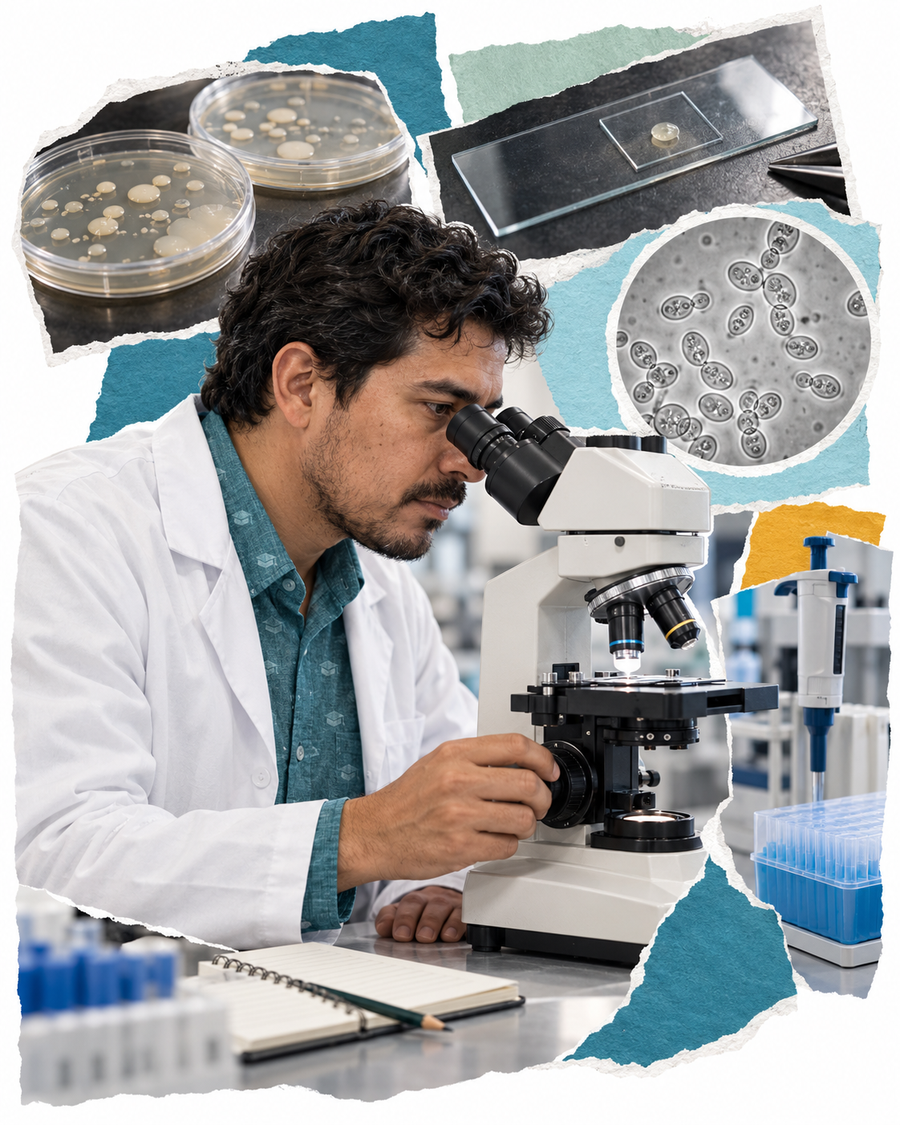
What a biologist does in their everyday work
Although activities vary, many projects follow a common sequence:
- Define a question: for example, how a fish population changes or what microorganisms appear in a sample.
- Design the study: choose sites, methods, controls, and the number of observations needed.
- Gather information: record species, collect authorized samples, conduct experiments, or consult databases.
- Analyze and interpret: compare results, assess uncertainty, and consider alternative explanations.
- Communicate: prepare reports, scientific articles, maps, recommendations, or educational materials.
In fauna studies, these tasks include monitoring populations and assessing the effects of human activities. In microbiology, they may include identifying microorganisms and studying their effects on other organisms or the environment.
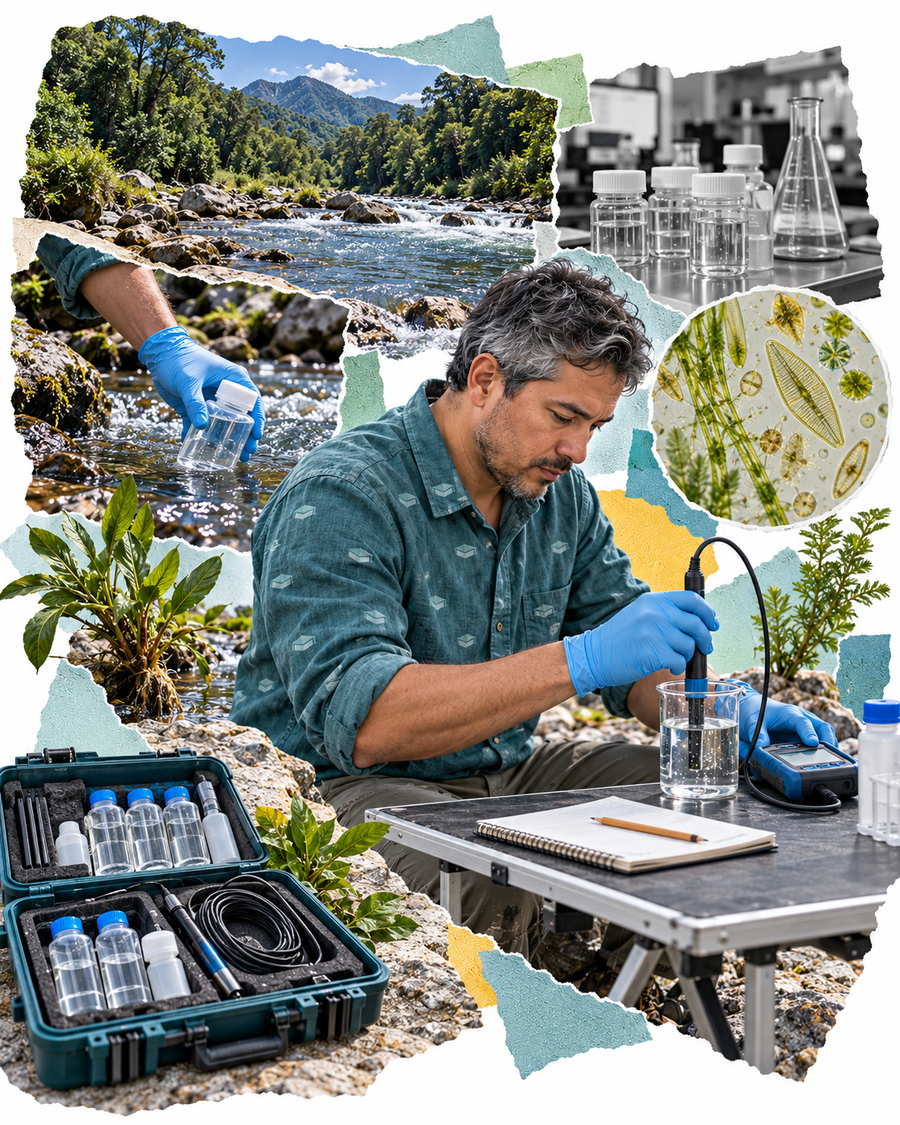
For example, in a river study, a team might record aquatic organisms, measure water conditions, and compare sites over time. The final product would be a report explaining what was observed, the limits of the sampling, and what new measurements are needed.
What tools a biologist uses in their day to day
Laboratory instruments
Depending on the project, they may work with microscopes and magnifying glasses, micropipettes, scales, centrifuges, incubators, or molecular analysis equipment. Each instrument meets a need: observing structures, measuring quantities, separating components, or studying genetic material.
They also use lab notebooks, sample records, and quality control procedures. Keeping samples identified and documenting what was done makes it possible to review the work and reproduce it.
Field equipment
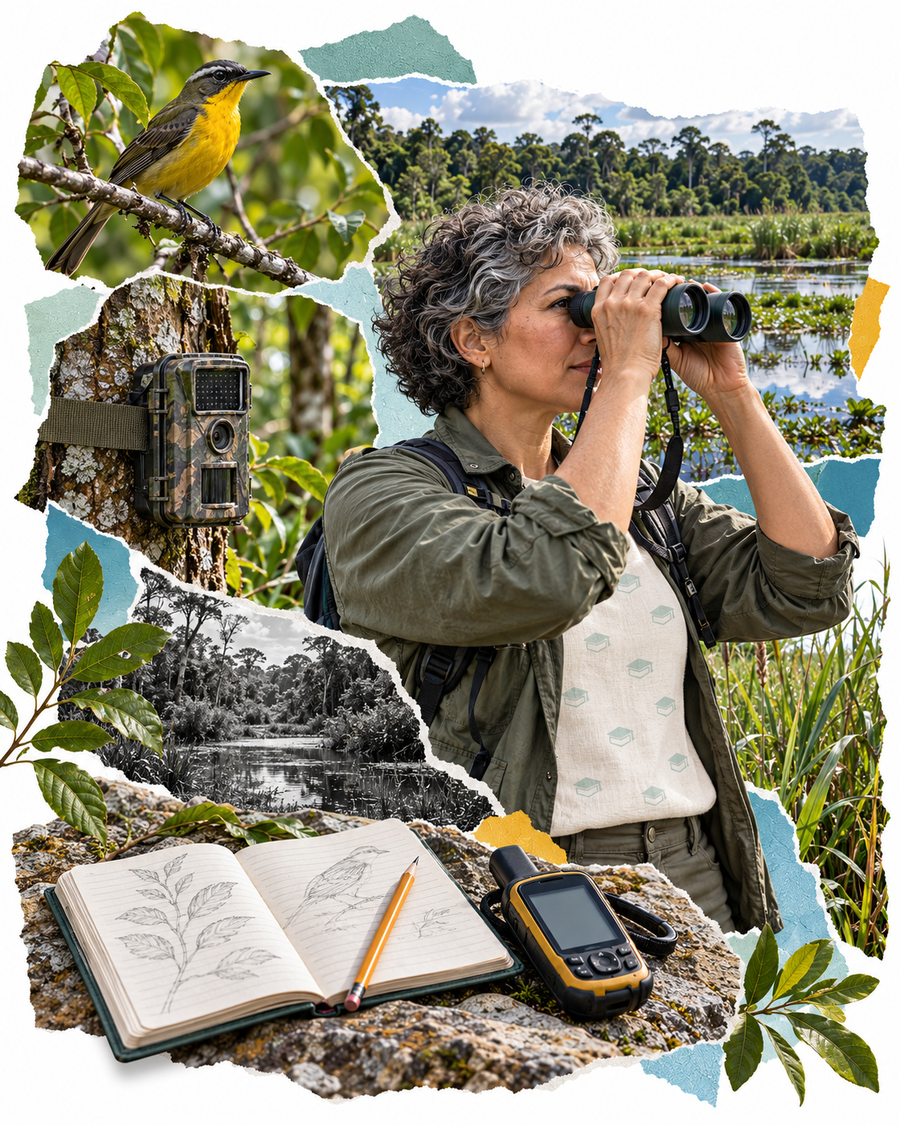
In biodiversity research, they may use GPS, binoculars, camera traps, sound recorders, and materials for delimiting sampling areas. In aquatic studies, they may need instruments to measure temperature, pH, or dissolved oxygen.
The choice depends on the organism and the environment. A recorder is useful for a bird study; a magnifying glass and a reference collection may be more relevant for identifying plants or invertebrates.
Software and digital resources
- R and Python: allow you to analyze data and automate tasks. R offers a statistics and graphics environment; Python lets you build analysis workflows using specialized libraries.
- QGIS: is used for working with geographic information, mapping sampling sites, and analyzing spatial data.
- Fiji, a distribution of ImageJ: makes it easier to analyze scientific images, for example to measure structures in microscopy photographs.
- BLAST, from the NCBI: compares ADN or protein sequences with databases and finds similarities that help investigate relationships between them.
- Zotero: helps you organize publications and manage bibliographic citations.
These tools are learned according to the job. An ecosystems specialist may spend more time on QGIS and statistics, while one in molecular biology may work with laboratory sequences and images.
How a biologist applies artificial intelligence
Artificial intelligence allows processing images, sounds and biological data to find patterns or generate predictions. Its usefulness depends on the research question, the quality of the data and the review of the result.
Identifying cells in images with Cellpose
In microscopy, a researcher may need to outline cells to measure them or compare samples. Cellpose uses AI models to perform that segmentation: assigning regions of an image to individual cells.
An accessible first test consists of opening a sample image from its site and running the analysis. The result lets you observe the regions the program proposes as cells.
The review task can be framed like this: “Compare the detected regions with the original image. Look for missed cells, two cells merged into a single region and one cell mistakenly split”. Manually reviewing an area with about twenty objects makes it possible to recognize errors, although it does not constitute sufficient validation for research. Before applying the model to an entire experiment, its performance must be checked with images representative of that work.
Recognizing bird sounds with BirdNET
BirdNET uses deep learning to recognize species from recordings. It can support biodiversity monitoring by processing audio files collected in the field.
The biologist must review uncertain detections, listen to the corresponding clips and consider location, date and quality of the recording. Moreover, detecting a song is not the same as counting individuals: the same animal may vocalize repeatedly. Interpretation depends on the sampling design.
What skills you need to work with AI
A biologist who uses these tools needs to understand statistics, data quality and error evaluation. They must also record which model they used, with what parameters and how they reviewed their results.
The change in these tasks consists of automating part of the detection or prediction and devoting more attention to checking its quality and biological meaning. A digital map, a spreadsheet or a conventional statistical analysis may be part of the same project without using AI.
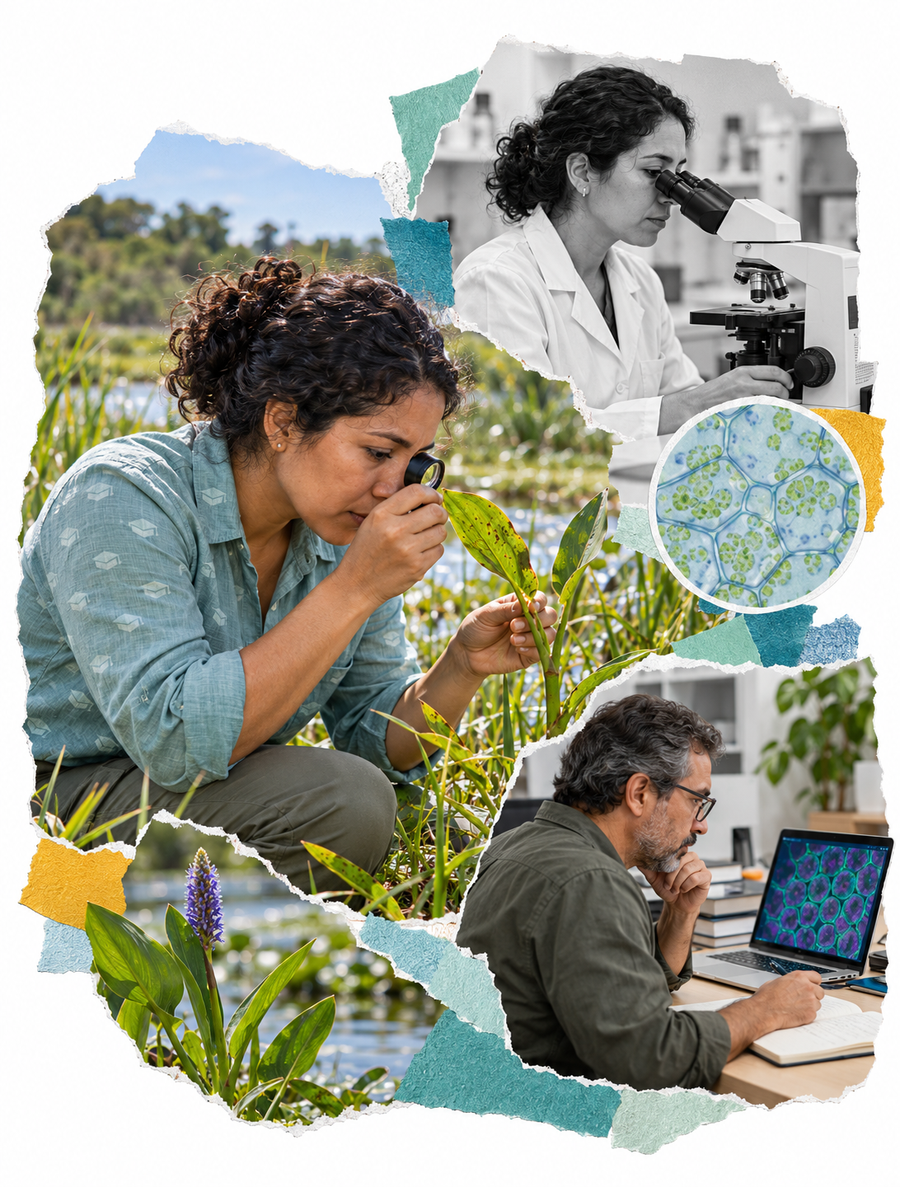
What are the different types of biologists
Specialties overlap. Some are defined by the organism studied, others by the scale of analysis or by the problem to be solved. They do not always correspond to independent undergraduate degrees.
Botanist
Studies plants: their diversity, structure, functioning and relationship with the environment. They can research native species, identify specimens or participate in vegetation conservation and restoration projects.
Zoologist
Studies animals, their behavior, evolution and diversity. They can specialize in birds —ornithology—, insects —entomology— or other groups, and work in fauna research or conservation.
Microbiologist
Researches microorganisms, such as bacteria, fungi and certain algae. Microbiology also includes the study of viruses. Its applications include fermentation processes, microbiological quality and analysis of interactions with plants, animals and environments.
Marine biologist or inland waters specialist
The marine biologist studies marine organisms and ecosystems. Those who specialize in inland waters can research rivers, lakes and wetlands. These areas contribute to knowledge of aquatic resources, conservation and environmental impact assessment.
Ecologist or conservation biologist
The ecologist studies the relationships between organisms and the environment. Conservation biology focuses on problems of biodiversity loss and on measures to protect it. Both approaches can participate in restoration and species monitoring projects.
Cellular, molecular biologist or geneticist
These specialties research cells, molecules and genetic material. Their questions may address how a gene is regulated, how a cell responds to certain conditions or how a trait is transmitted. Genetics also applies to populations and evolutionary processes.
Evolutionary biologist
Studies how organisms and populations change over generations. They can analyze adaptation, relatedness between species and processes that give rise to diversity, using observations, experiments and genetic data.
Biologist specialized in bioinformatics
Combines biological knowledge, programming and statistics to analyze data such as sequences or experiment results. They can develop analysis methods or evaluate AI models. Bioinformatics also brings together professionals from other backgrounds.
Biologist dedicated to biotechnology
Apply knowledge of organisms, cells, or molecules to the development of products and processes. May take part in research on enzymes, fermentation, bioinputs, or biological waste treatment, working with engineering, chemistry, and other professionals.
What to study to become a biologist
University education is usually found in degrees called Biology or Biological Sciences. Depending on the country, the program may grant a licenciatura, an academic degree and a professional title, or have a specific guidance.
Content includes cell biology, genetics, evolution, botany, zoology, microbiology, and ecology, along with chemistry, mathematics, and statistics. There is also practical training in laboratory, research and, depending on the program, fieldwork. The Biology curriculum of the FES Iztacala of the UNAM shows how these subjects are integrated throughout the degree.
To compare options, it is advisable to review the degree awarded, internships, elective subjects, research projects, and graduation requirements. An AI or programming course can complement this education, but it provides different skills than those of a full university degree.
Master's degrees and doctorates allow you to deepen your knowledge in a specialty and develop research. Whether they are needed depends on the position and level of responsibility; the path of a university researcher may require different training than that of someone starting on a technical team.
How biology is studied and applied in different Latin American countries
The following programs illustrate concrete differences in training. Their professional profiles describe possible areas of work, without indicating how many openings exist in each labor market.
Mexico: biodiversity, natural resources, and experimental biology
The Licenciatura en Biología of the FES Iztacala, UNAM, lists a duration of eight semesters. Its curriculum includes research laboratories and electives related to conservation, aquaculture, aquatic pollution, and molecular biology.
These areas allow training to be guided toward problems such as evaluating the biological quality of water, studying species or researching cellular processes. The time to obtain the degree also depends on completing the graduation requirements; eight semesters describe the curricular duration of that program.
Argentina: study of fauna and conservation
The Bachelor's Degree in Biology with Zoology Guidance from the Universidad Nacional de La Plata has a published duration of five years.
Its academic description and scope of the degree include field activities, study and classification of animals, fauna conservation and analysis of contamination problems affecting it. For example, this training can be applied to monitoring animal populations or to studying species that are declining in number.
Colombia: conservation, genetics and biotechnology
The undergraduate degree in Biology from the Universidad de Antioquia awards the title of Biologist and lists a duration of ten semesters.
Its profile includes genetics and cellular and molecular biology, biological diversity, ecology and biotechnology. It describes applications in research, conservation, consulting, bioinformatics and problems related to the environment and agricultural activity. Depending on the guidance chosen, a graduate can prepare to research biodiversity or participate in projects that study biological processes of productive interest.
Chile: a program focused on the environment
The degree in Biology with a mention in Environment at Universidad de Chile lists a duration of ten semesters. It confers the academic degree of Bachelor in Environmental Sciences with a mention in Biology and the professional title of Biologist with a mention in Environment.
Its training applies to conservation, effects of contaminants and management of aquatic resources. It also prepares students to generate environmental information and to participate in consulting and multidisciplinary teams. This case shows why it is useful to distinguish the academic degree from the professional title.
Peru: biodiversity, hydrobiology and laboratory specialties
The Facultad de Ciencias Biológicas at Universidad Nacional Mayor de San Marcos offers Biological Sciences, Genetics and Biotechnology, and Microbiology and Parasitology.
Biological Sciences develops mentions in botany, zoology and hydrobiology and fisheries. The latter connects the study of aquatic organisms with their management and use. The other degrees have their own focuses: genetic resources and biotechnological applications, or microorganisms and parasites. The choice of program influences the type of problems and tools the student will learn to address.
Brazil: differences between bacharelado and licenciatura
At the Instituto de Biociencias of Universidad de São Paulo, the bacharelado in Biological Sciences trains for specialized activities, such as research and consulting, while the licenciatura has a guidance toward teaching science and biology in basic education.
The Conselho Federal de Biologia describes professional areas related to environment and biodiversity, health, biotechnology and production. Its applications include bioprocesses, biological analyses and bioremediation: using organisms or biological processes to treat contamination. The word «licenciatura» has here a different educational meaning than it usually has in Mexico or Argentina.
Where a biologist can work and what the career requires
Depending on their education and experience, they can join universities, research centers, laboratories, environmental consulting firms, public agencies, conservation organizations and companies that use biological processes. Education and outreach are also part of their possible paths.
The work requires precision, documentation and the ability to communicate uncertainty. In the field it may involve travel, difficult weather conditions and schedules tied to the activity of organisms. In the laboratory it requires attention to procedures and controls. Research can also demand time to obtain funding, write proposals and repeat experiments.
AI adds opportunities to analyze information, but it also requires checking for errors and understanding data. Choosing this career involves valuing its different tasks: observing, experimenting, programming, analyzing, writing and working with other people.
If you are comparing Biology with other degrees, the NoSeQueEstudiar career guidance test can help you explore interests. Then, reviewing curricula and specific professional activities lets you connect those interests with the education you are considering.