John Doughney
John Doughney is a marketing professional with over 20 years of diverse experience across various industries. He has held leadership positions at leading companies such as Meta®, Coca-Cola®, E&J Gallo Winery® and Red Bull®, where he has refined his expertise in areas like global client management, social media marketing and business development.
Most recently, John Doughney served as Global Director at Meta®, leading teams and overseeing strategic initiatives. Before that, he spent over 9 years at Facebook (now Meta) in various client-oriented roles, including as Global Client Leader for the automotive sector.
John Doughney's track record also includes several years at Coca-Cola®, where he held positions such as Director of Social Media Marketing and Director of Business Development and Marketing Operations. Early in his career, he gained experience in sales and marketing at E&J Gallo Winery® and as Brand Manager at Red Bull®.
With his extensive experience in marketing and leadership, John Doughney is well positioned to provide valuable insights and guidance to students at Kennesaw State University as a Marketing Instructor at the Michael J. Coles College of Business.
Visual Summary of the Interview with John Doughney
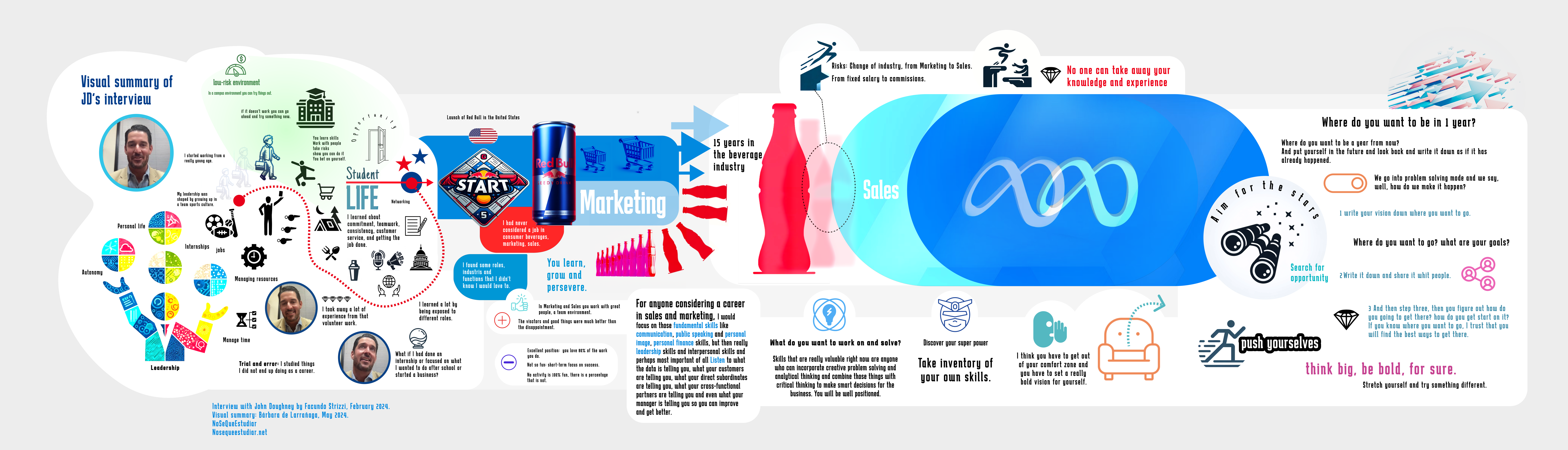
Transcript of the Interview with John Doughney in English:
In this interview the co-founder and interviewer, Facundo Strizzi talks with John Doughney about his professional transition from Coca-Cola® to the tech industry at Meta®.
Join us to explore the journey of a global marketing leader who not only pursues professional success but also values being able to support others. Let's dive in. Any questions to start?
Facundo: John, tell us a little about how you got started, about your beginnings
John: Absolutely. First of all, thank you for inviting me, and, I hope to have a conversation and share some of my experience with your audience your audience.
I think the first thing is that I started working from a very early age. I always had a job, even when I was a young teenager. Everything from refereeing youth sports, jobs in retail. I was a camp counselor, I worked in restaurants, I tried to do everything I could to earn some spending money And, the truth is that I think I learned a lot about commitment to hard work what it means to be part of a team, what it means to show up consistently and really how to serve people and how to get the job done I think I learned that at a very early age and then in college I think my focus was in a few different places but I also had many jobs and internships during college. I worked at a radio station in promotions. I worked for a lobbyist at the state capitol which was really interesting. At the time, I was studying political science and I thought it might be a career. I worked for a scholarship program for the Florida Department of Environmental Protection for a while And I also worked for the president of our university as a speechwriter and doing some public relations work none of those jobs were jobs that I had for a very long period of time. Some of them were, a couple of years, some were six months, some were internships, some paid, others didn't, but I learned a lot by exposing myself to many different roles.
Basically, you can say that you didn't always know what you wanted to do.
The truth is I still don't know what I want to be when I grow up, I think the things where I found my degree I got there through a lot of trial and error. In fact, I studied things that I never ended up making a career out of. I did jobs where I discovered that I didn't want to commit to doing as a career and then, finally, I found some roles, industries and functions that I didn't know I would love, but then, once I started doing the work, there was a real insight, and it was that it was great.
Facundo: And what can you say about what challenge you encountered when you were studying?
John: Yes. I think for me just balancing the different parts of your life as a student, like my life as a student. It was the first time I had a lot of autonomy in which I considered myself an independent adult in which I had to schedule my time and budget my resources. But balancing the classroom, academics with, you know, a personal life of, you know, friends and relationships and then also jobs and internships and student leadership, I don't know if I ever got the formula right, but that was a lot of balls to juggle at any given time And, so it was always a challenge to figure out what mattered and where to throw myself. I was really focused on student leadership, especially my first three years on campus, and sometimes I look back on that, and on the one hand I learned a ton about leadership and communication and and working with the administration and working through different very diverse, student groups. And I realized, wow. I took so much experience from doing that volunteer work. Other times, I look at it and think I wonder what would have happened if I had done an internship and focused more on what I wanted to do after school or if I had started a business. So I don't know that there's ever, like, a silver bullet or a perfect formula to figure it out but I enjoyed doing a lot of things And at the end of the day I really don't regret that. I loved being a student. I loved being able to try so many things, and have that autonomy and learn so many new things on campus. I really enjoyed school.
Facundo: About volunteering, how do you think that mainly impacted your professional career?
Oh, yes. You know, for me I think much of my leadership was built from two things:
The first was growing up in a team sports culture. I think in team sports you learn that your work and your role and your contribution really matter, toward the team's goals, but you also learn to work and function as a team and to communicate, set goals together. And I think the same is true of student leadership and volunteering in different organizations.
- You have to work well with others.
- You have to collaborate.
- You have to take turns leading and doing the work, and setting goals and communicating. And I think that is at least in my career, that's how most organizations and companies and client relationships have worked and so, learning those practical skills and learning them in a low-risk environment And what I mean by low-risk.
The environment means that this is not your career where you're shooting to be the senior vice president and your income and your well-being and your family depend on it. In a campus environment you can try things And if it doesn't work you can move on and try something new which, I obviously did quite a bit. So those lessons Whether you learn them the hard way or they come easily to you the cost is not very high. You have the opportunity to take a risk, bet on yourself, learn the skills work with people , and prove that you can do it and if you do it well, you open doors, and you leave with a portfolio of successes.
Facundo: Absolutely. That's what I totally agree with you on, I've done a whole bunch of different things and I think, you know, being able to do volunteer work and being able to, like you said, they are open doors. It creates networking.
John: It's really good. It gives you empathy for many things that other people do and are interested in. And I think that's always valuable or at least it makes you more interesting at a cocktail party too.
Facundo: What can you say about the satisfactions?
John: This career in your career and what disappointments you encounter, at university I ended up stumbling upon an opportunity. In fact, a friend of mine, Jason Sillett, introduced me to Red Bull® when they first launched in the United States and I had never considered a career in, you know, consumer products or beverages or marketing or sales. And when I took on that role it really inspired me and I loved learning about the packaged consumer goods industry and marketing, and sales and that ended up being what brought me into that industry. So I'll answer your question with that context of the things that have been really rewarding for me in marketing and sales roles and things that have been, you know, yeah, a bit disappointing or surprising.
So I'll start with the positive aspects: I think that in sales and marketing positions you can work with a lot of great people, and it really is a team environment. There are people who focus on all kinds of cross-functional experience and you need all of them to succeed. You need engineers and you need customers, you know, customer-facing people and you need product people, and you need strategists, and you need finance people. So working as part of a team and meeting really great people has been very rewarding for me and when you're in the market, for example, in a sales customer-facing role, you can also work with really big partners whether they're agencies or clients.
You get to understand, you know, what their needs are what their jobs are, you know, what their KPIs are how they get promoted. How you help them succeed, and that is really rewarding to be part of that journey. Also, the things that are amazing are that you can build new businesses, You have the opportunity to create new products, maybe entirely new categories, and you can feel the wins, and feel the wins as a team and that's just fun. That's fun. I think, on the other side of the ledger, the things that aren't always fun, and let me, let me say this first. I don't know that, like one hundred percent of anything is totally fun whether it's a job or whatever, there's always some part that isn't. I had a manager once who said: If you love eighty percent of your job and only twenty percent is things you don't really love, then you're in a great position. Be very happy. So let me preface it with that. The wins and the good things were much better than the disappointment, but there are parts you don't like.
I think many times in business, particularly in publicly traded companies, there is a short-term focus on success, there is, you know, bottom line and quarterly results and those things matter. But they are often lagging indicators and you could sometimes see a bit of guidance and short-term obsession and with that they could be unhealthy and maybe it's not that fun. I think often, as you see, organizations work in silos so that, for example the holistic approach, strategic thinking, mission and cross-functional teamwork that has to happen and that can be a bit that could confuse you a bit or or feel a bit heavy at times and you have to, work through that.
And then I think, well, I'll say that on the brand side, on the marketing side, sometimes great work is done, it takes time to see the results, right? So you have to be patient. On the other hand, in sales sometimes the problem is there and there can be an attitude of what have you done for me lately?, that is, you could be having great results every quarter for ten years in a row and you have one bad one, One bad quarter, and it feels terrible and the world is falling apart and everything is bad and, you know, that can also be a bit disappointing.
But like everything, you know, you learn, you grow, you grow, you persevere, but that has been my experience Amazing.
Facundo: Yes. Yes. I agree too. Yes. I would love to have 100 percent. Normally, you have to deal with things you don't like. That is in practically every position yes.
Facundo: What advice can you give me about something that is considered in sales or marketing studies? Do you think it is a degree that you know, is the future Or are we going to be replaced by AI or something like that?
John: Yes, Yes. So, I also have a bit of technology experience and, you know, maybe more than some people. I am very optimistic about the role of technology. It seems to me that we humans are, incredibly resourceful and innovative, and we find ways to invent and leverage technology that gives us, even more, impact and more powerful tools. Right? Whether it's the agricultural revolution or even what we are seeing today AI.
So I think we will leverage this to make ourselves even more impactful in whatever we commit to I think when it comes to marketing and sales specifically, you know, there is nothing I see on the short-term horizon over the next decade that tells me, that, you know, people who are good at sales and marketing and communication and strategy building and team leadership that is going to go out of fashion or value.
Organizations, to succeed, have to serve customers which means they have to have a deep understanding of the market, they also have to grow and very intentional strategies, discipline and execution are needed to achieve that. So I think for anyone considering a career in sales and marketing, you know, I would focus on those foundational skills like communication, public speaking and personal presence, personal finance skills, but then, really, like, leadership skills and interpersonal skills, and maybe most important of all listening. Like, listening, what the data tells you, what your customers tell you, what your direct reports tell you, what your cross-functional partners tell you and even what your manager tells you so you can improve and get better. I think some other skills that are really valuable right now are anyone who can bring creative problem solving and analytical thinking and combine those things together with critical thinking to make smart decisions for the business is going to be well positioned.
It helps to have solid business acumen and project management skills and to be a good team player. I think all of those things are things that I And separately, like, I would say if you want, if you want me to share some advice I have some thoughts there for people who are just starting out. Well, I didn't even start. I found myself doing this, I do this every year but I certainly did it midway through my career. And, I would say, you know, first of all, take an inventory of your own skills your strengths the things that make you different that are a superpower for you, your experiences.
They may not even be traditional. They may not be jobs, they can be very unorthodox, but you can figure out, for example, what you are good at from
those life experiences And then also, you know, some of those passions you have what do you want to work on and solve? And then consider, like, where is all that mix of greatness? Where is that valuable? Where can you create impact? And then this is the action This is what I this is what I do and I think it is incredibly valuable. And I recommend it to my team and I recommend it to anyone listening here.
But I think you have to get out of your comfort zone and you have to set a really bold vision for yourself and it doesn't have to be for your whole life.
I think a good place to start is like, where do you want to be in a year? And put yourself in the future and look back and write it down as if it had already happened.
And maybe if you're a student you can also see it five or ten years from now but start with one year and make it uncomfortable and be specific and write where
you want to be and then share it with people you know, That starts to make it real.
That starts to create accountability with ourselves, it starts to create accountability with other people. Once we say something is possible we're no longer afraid. Now we go into problem-solving mode and we say, well how do we make it happen?
So I'm not saying that you write a vision and you have to know exactly how to get get there. What I'm saying is that you write your vision of where you want to go. That's the first step. Where do you want to go? What are your goals? And then the second step write it down and share it with people. And then the third step: you figure out how you're going to get there and how you start doing it. If you know where you want to go I trust that you'll find the best ways to get there, And once you've committed to it, I feel like that's a really powerful approach.
And here's the deal: My mom used to tell me while I was growing up shoot for the stars and even if you miss you'll land on the moon.
So even if you don't make it all the way to where you're going I bet you'll achieve more and you'll be in a better place than what you thought was possible before starting And maybe you'll achieve all your wildest dreams and achieve a bold vision, which is even better.
Facundo: Very good line there. Let's see what you think it is let me rephrase this Do you think there's, like a plan or maybe, like you know, a real kind of step you can take that's not going to make you, you know, super successful.
This is, you know, this is going to help me get there, like you said, you have a plan. One thing I often think about and I had a manager who instilled this in me, really, instilled this in our whole team as a culture. And it was about having a bias toward action I think a lot of people we get stuck in our own heads we observe a lot. We pontificate. But, do we act? And I think we could spend all day planning scenarios and considering things but the only place where change is made, where something is built is, when you start doing, when you start writing, when you start solving problems, and then you can always learn and adapt.
So I would say first, like, have a bias toward action there and take some thoughtful risks. Don't jump off a cliff without a parachute. That's crazy. But think, if I do this this is what I can gain. And if I don't do it how much is it going to cost me? And then act on it. You can think about this in your personal life, and you can think about your career. But you have to bet on yourself and you must feel pretty good about what those bets are, betting on your strengths and where you can win I think is a foolproof plan no matter where you are in your career, you know, what you can learn and where you can grow in whatever situation you find yourself in or whatever comes next.
It's very easy to look at someone in the middle of their career and say: Wow. He's a global director at Meta. How do I get there? And I'll tell you one thing. That was not my first job. I had a lot of jobs, some that I didn't like but I learned a ton.
Some, I learned lessons the hard way, and I think people don't usually see the end or they see a result, but they don't see all the steps in between. Right? The process can be a bunch of steps that are not that fun. And I'll say the one thing that has been consistent for me, when I'm looking for a new opportunity and this is true whether it's a volunteering opportunity, whether it's an investment opportunity, whether it's a career change, whatever it is I always say, I'm choosing three things:
I want to find myself in places and be around people. I'm choosing the people I want to be with. It could be a manager, it could be a team, whatever but, for example, I choose the people, the experiences I want to have, are these experiences I want to have, where I want to be, whether in an industry, whether in a startup culture or in a large corporation.
What is the experience I will have when I move away from here? What do I want to experience and get? And finally, What skills can I gain here? What am I learning? How am I growing? If I could check those three boxes and be intentional about why I'm doing it I know I'm going to be better off in a year, in six months, in two years at that step in my journey. I think the other thing I try to do there is just go step by step. I know this doesn't work for everyone, but for me, I've never had, professional goals where, like, I definitely want to be, you know, the CEO or I definitely want this position. Like, I really feel like I'm trying to be, you know, be in the moment, take it day by day and if I could keep learning, growing, working with great people I'm pretty sure that journey is going to be rewarding and exciting. And so far, so far it has been for me. Yes.
Facundo: A few years ago you made a huge transition between Coca Cola® and Meta®, two big brands, and at the same time, completely different. Two different industries, two different things and two different stories, of course. What advice can you give us you know about a significant change in your career? And, also, what did you like about both industries?
If I put myself back in my shoes, that moment, it was about eleven-plus years ago, maybe a little more. It was actually a pretty scary transition for me because well, for a couple of reasons like, number one, I had spent fifteen years in the consumer packaged goods and beverages industry mostly on the brand marketing side and I felt very confident in my skills and my impact and in what I brought to the table and I had a very good career path. And, you know, I was working for one of the most well-known successful brands in the world. I was very happy and very comfortable.
I worked with great people and I had many opportunities to learn and grow at that company and in that industry. And I was approached with the opportunity to move to Facebook® at the time, now called Meta®. And it was well, a couple of things. On the one hand, the company had just gone public and the stock was not doing very well.
There are many questions, around is Facebook going to be able to figure out mobile devices?. They had launched an HTML 5 and not an app and there are a lot of questions in the air, the products were very different back then from what they are now.
So there were some risks:
- I didn't know the industry.
- The other thing is they were recruiting me to be a salesperson to build partnerships with Coca Cola® and companies like that.
And as I said, I was not a salesperson, I really didn't see myself as a salesperson, so I was afraid to go from a salary and bonus compensation to a commission-based schedule, what if I'm terrible at this? And then it's like, my wife and my kids? Are we going to be able to feed ourselves? And so there was a real fear a real fear of failure and change, but what I did was consult with a lot of people I trust, even some of the executives at Coca Cola® at the time, but people I considered mentors and who had a different perspective than mine and I asked them for their thoughts on it and I asked for their support and they really encouraged me to do it. And one of the pieces of advice I got was that no one could take away your expertise, experience and skills that you've built up over fifteen years in beverages. Like, you're going to bring that with you, just like a college degree and education. No one can take that away from you. You can take a risk in a new and exciting growth industry like technology, advertising and media and no one is going to punish you if it doesn't work out. I mean, you can always do something else. So you have to take some risks and bet on yourself. But no one is going to think you were crazy or foolish for trying to join an early-stage Facebook® and build that business, it might not work but it's a good calculated risk to bet on yourself. The truth is I'm really glad I did it. I'm really glad I got the advice and encouragement. I'm really glad I bet on myself and did it. I learned a lot.
I'm all the things I feared about being in a sales role turned out to be the things I liked most like, I really enjoyed working with clients and solving their problems. I really enjoyed seeing measurable results and growth and building businesses and teams. And truth be told. Working on a commission schedule when you're doing really well is a good way to build wealth and make money. So I didn't know and I'm glad I made that shift and I'd just say, how does that relate to someone else? It's, you know, just because you feel comfortable doesn't mean there isn't a bigger reward when you push yourself and try something different every time I put myself in an uncomfortable place like teaching in front of a classroom, I learn new things and we push ourselves to be better. And that makes me sharper but it also makes me more grateful for the experiences I have doing some of these things. So we have one life, I'd try to take on as many great, fun, exciting, you know, growth opportunities as you get.
Facundo: You talk about mentors. Do you think we need a mentor in our careers? How do you feel about that?
John: I mean, I think this is a lonely world and a set of industries, if we do it alone I think we are all super blessed and fortunate to have people in our lives who care about us, whether it's our parents or our siblings or our spouses or our children or wherever you or your friends, wherever you find yourself. But there are people you meet who could be teachers, and they could be colleagues and they could be managers, or they could just be, you know, senior people in the industry or different industries and if they are willing to offer you guidance and support whether by making introductions or listening to you or giving you advice or feedback, man, I think you are much better off being part of a team than doing it alone you get stuck in your head, you're trapped, and you're a prisoner of your own fears, or you can turn to someone who has seen it before and who has the benefit of experience and wisdom to share it with you and you can avoid some of the pitfalls or you can borrow their courage to make that bold decision for yourself OR you are underestimating your own strengths and your experience and how valuable it is in the market.
I mean, what you did here is super valuable. Like, don't settle. Go do this, or let me make that introduction for you here I think it would be crazy not to accept the support, the coaching, the guidance from someone you trust who has the right perspectives and your best interest at heart. And I would also say that works both ways like, I don't care if you are a high school student. There are middle and elementary school kids who can learn, same with high school with college, If you get to college and you're having a great experience, reach down and figure out who you can lift up. You could do this your whole life, you don't have to wait until you retire, you should help people the same way you receive help and it's amazing how rewarding it is.
Facundo: Yes. Yes Absolutely. Well, you can see it with our project. We try to help as many people as possible.
John: That's my belief that's how you make an impact in the world by helping each other. Man, and it's one person at a time. You know?
The power I have is the way I show up for people and other people in my life and my communities, and I want to lean in as much as I can whether it's coaching youth sports or teaching or mentoring you know, students who went to college or who are coming up it's not much for me to give especially when I've been given so much And I just hope and always ask the people I support that they offer that same support when the time comes to people in their networks.
Facundo: I don't want to take much more of your time. What would you like to add, comment, tell these young people listening to you
John: Well, I mean, hey. It's amazing, I mean, you already have mentors and support through a program like this where, you know, people are trying to help show you the way. And so I would say stick with it. Make an effort You know, think big. Be brave for sure Man, I've had a great life and I'll tell you one thing
If I had to do it again I'd sign up right now. So, you know, being a little older than you I envy the position you're in
I already know how my story goes at least, I mean, massive chapters of it. You get to define it. Write it. You get to make those decisions now.
They're yours, the consequences, the opportunities everything. So nothing could be more exciting than that. You only have one life. Like, this is it. Make the most of yours and do it with the people you care about and do it for the reasons that matter most to you And good luck.
Facundo: Very good advice. Well, thank you, John.
Coca-Cola®, Meta® and Red Bull® are registered trademarks belonging to their respective companies. None of these companies is affiliated with or sponsored this interview.
Coca-Cola ® is a registered trademark of The Coca-Cola Company. I am not affiliated with or sponsored by The Coca-Cola Company.
Meta ®: Meta is a registered trademark of Meta Platforms, Inc. I am not affiliated with or sponsored by Meta Platforms, Inc.
Red Bull ®: Red Bull is a registered trademark of Red Bull GmbH. I am not affiliated with or sponsored by Red Bull GmbH.