
Alain Garcia Vazquez
The virtual interview was conducted by Bárbara de Larrañaga, who explored in depth the career and achievements of the Dr. Alain Garcia Vázquez, a renowned surgeon and researcher in the field of liver surgery and minimally invasive. During the conversation, Dr. Garcia shared his focus on surgical innovation and the development of advanced technologies for the operating room, including the use of artificial intelligence and 5G communication.
Profile of Dr. Alain Garcia Vázquez
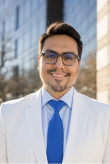 The Dr. Alain Garcia Vázquez is a prominent surgeon and researcher in the field of liver and minimally invasive surgery, with a particular focus on surgical innovation and the use of advanced technologies in the operating room, such as artificial intelligence and 5G communication. Currently, he serves as Research Officer at the Instituto de Cirugía Guiada por Imágenes (IHU-Strasbourg) in France, a world-leading center in minimally invasive surgery that integrates advanced imaging, AI and robotics to improve precision and safety in surgical procedures.
At the IHU, Dr. Garcia combines his experience in liver surgery with AI research and data management in surgical environments.
Education and Advanced Training:
- Doctor of Medicine (MD), Universidad Anáhuac, Ciudad de México, Mexico.
- Residency in General Surgery, Hospital Español, Ciudad de México, Mexico.
- Fellowship in Interventional Hepatobiliary Oncology, Fundación DAICIM, Argentina.
- Fellowship in Image-Guided Surgery, IRCAD, Estrasburgo, France.
- Diploma in Liver Surgery and Transplants, Universidades de Estrasburgo, Montpellier y Reims, France.
- Master's in Surgical Innovation and Business, Universidad de Estrasburgo, France.
Areas of Specialization
Minimally Invasive Digestive Surgery: Dr. Garcia is an expert in digestive surgery techniques that reduce invasiveness for the patient, minimizing recovery time, postoperative pain and complications. His techniques include the use of advanced laparoscopy and robotic assistance, enabling precise interventions in the digestive system with a focus on rapid recovery and improved patients' quality of life.
Hepatobiliary Surgery: In the field of hepatobiliary surgery, Dr. Garcia Vázquez specializes in complex procedures of the liver, pancreas and bile ducts, addressing conditions such as tumors and biliary obstructions. He has perfected advanced techniques in liver oncology and transplantation, using imaging tools to plan and perform highly precision interventions in these vital organs, with a special emphasis on risk reduction and optimal outcomes for patients.
Innovation in Surgery and Device Development: As a researcher in surgical innovation, Dr. Garcia Vázquez works on the development and pre-evaluation of surgical devices that incorporate artificial intelligence and 5G communication. His goal is to move toward a digitally integrated surgical environment, enabling real-time collaboration and remote assistance, as well as refining operative precision through innovative technologies. This work includes validating new instruments and designing technological solutions to improve the effectiveness and safety of procedures.
Current Contributions and Projects:
Dr. Garcia has made significant contributions to surgical research with multiple article publications, presentations and book chapters.
His current work focuses on preclinical innovation in surgical devices and on the adaptation of emerging technologies, such as AI and 5G, to improve surgery outcomes. His research explores how these technologies can transform the operating room, optimizing both precision in procedures and patient recovery.
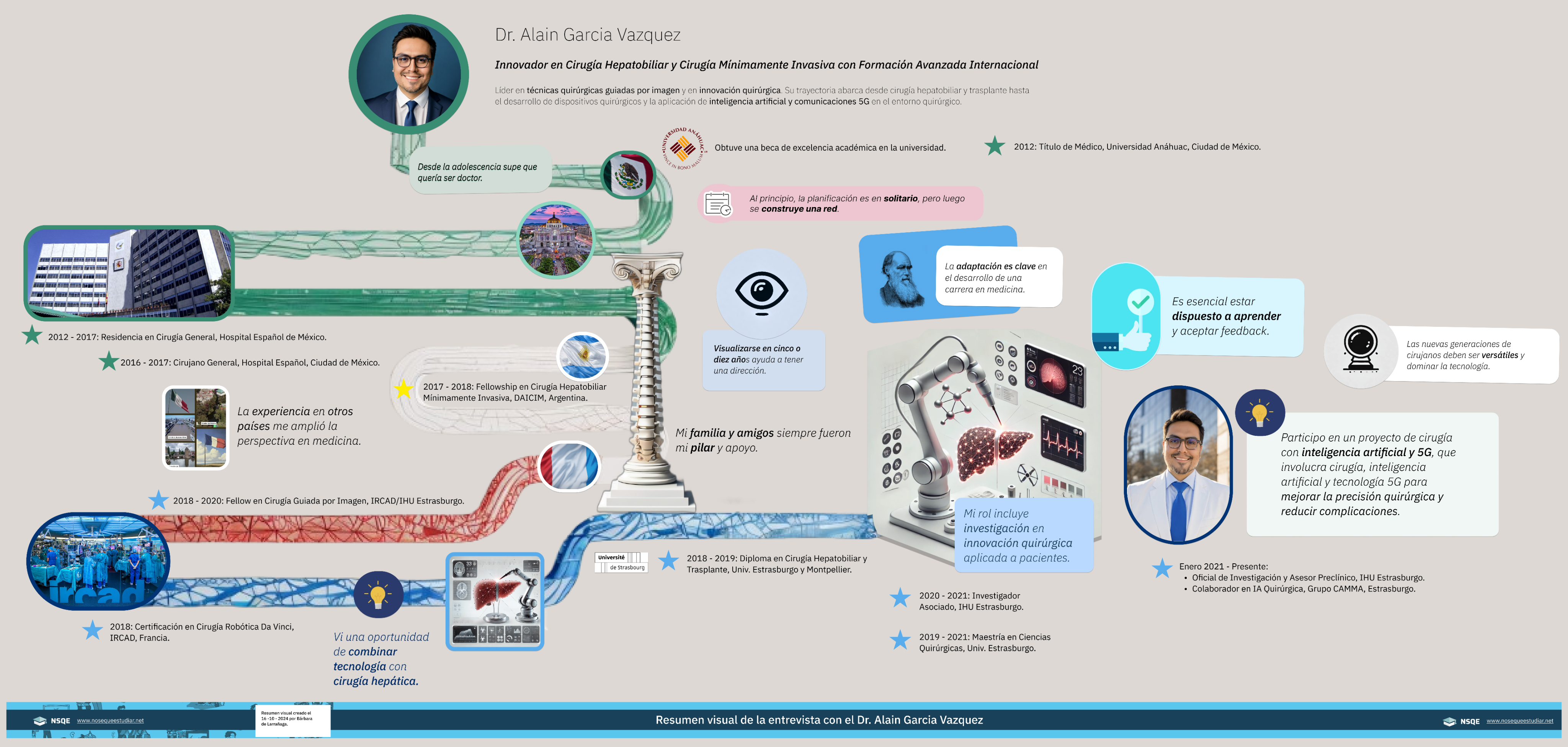
Visual summary of the interview Dr. Alain Garcia Vázquez
Interview
Bárbara de Larrañaga: How did you get started? How did you discover your vocation in medicine? Did you always know you wanted to be a doctor?
Dr. Alain Garcia Vázquez, MD: I think that in my basic education I began to realize that I liked helping people, the human body, science… Biology began to catch my attention. But it was, I think, in adolescence when I knew I wanted to be a doctor, and thanks to these ideas and what I already mentioned, that is what led me to study medicine.
Bárbara de Larrañaga: Did you have a role model or family member who motivated you to follow this path?
Dr. Alain Garcia Vázquez, MD: Yes, I have a relative who is a neurosurgeon, and I was always fascinated by his outlook on life, his professionalism, his education, his work, how he worked in a hospital, etc. So, he was a role model I had and my family always supported me in that regard.
Bárbara de Larrañaga: The support of a family is important, which is above all long-term support because the medicine degree lasts between six and ten years. A family has to consider supporting that person. In that sense, did you have family support to cover your studies or how did you manage the costs of medical education? How was it in your case?
Dr. Alain Garcia Vázquez, MD: Yes, well, the academic challenges at the beginning are intense, as in other degrees, but in medicine it is especially intense. Afterwards, it becomes an easier daily routine, but regarding financial support, I always had my family's support and I also had the opportunity to study at a university that gave me an academic excellence scholarship. So, I had that combination, but you always have to keep in mind planning the financial side, which is very important, especially, as you said, in a long degree.
Bárbara de Larrañaga: Did you have any kind of prior advising, in school or in high school? I mean whether you had some influence, or was it a personal decision?
Dr. Alain Garcia Vázquez, MD: During high school I leaned toward science and biology. Thanks to that, the tutors in charge of giving this professional advising guide you: "you can be a scientist, doctor, veterinarian," things like that. So, based on my personal wishes, I leaned toward medicine.
To identify the scholarship at my university was not easy; I entered the university without a scholarship and during the first semester I gained access to this program, so I had a scholarship from the second semester of the degree.
Bárbara de Larrañaga: And about the academic and personal challenges, how did you find balance? I mean whether you had support in some extracurricular, sports or artistic activity, that allowed you to balance the intensity of the study load of the degree. How did you manage to balance it?
Dr. Alain Garcia Vázquez, MD: I believe that at the beginning the degree is going to require a significant sacrifice, and it is essential for young people to know that it requires a sacrifice they have probably never made in their lives.
Bárbara de Larrañaga: How did you prepare for that sacrifice?
Dr. Alain Garcia Vázquez, MD: I think my family and friends were always my pillar, my backbone. When you have a problem, you feel sad, you are alone or you get home at midnight, it is always important to have support. In my case, my family was close by, but it can also happen that you live far away because the university is not in your city. So, I think it is important to surround yourself with a circle of trust, friends or people who can be a support and offer advice when you need it.
Bárbara de Larrañaga: In this sense, I see that you have lived in Argentina, Mexico and France, which also brings new challenges and anecdotes. Could you tell us what that transition from your country to another was like and how you prepared for that change? Sometimes it is not just a change of language, but also cultural, food, customs or schedule. I would like to know a little about what that change of country and culture was like for you.
Dr. Alain Garcia Vázquez, MD: Yes, as you mention, I think it is always an enriching experience to leave the country and have the ambition to learn from other cultures and other people. In the case of medicine, it is special because you cannot easily practice in the place where you did not study. So, you have to adapt to the health systems, the medical culture, the laws of the country and, of course, the language. In the end, this broadens your professional experience, and now I see that my perspective in the surgical discipline is richer or broader than that of my colleagues who have always been in my country. It does not mean that I am better, everyone has their pros and cons, but if someone is looking to gain access to culture, languages, new challenges, adapting quickly, all those things, going out and looking for experiences abroad is an option.
Bárbara de Larrañaga: I would like to know what motivated you to choose your specialty, from liver surgery to advanced technologies. How did you get there? What was the decision-making process that led you to choose your specialty?
Dr. Alain Garcia Vázquez, MD: Liver surgery is a difficult specialty with little access for young surgeons. It is complicated to learn anatomy, names and treatments because the liver, for example, is a very complex organ. I saw the opportunity to combine a lot of technology and innovation tools that can help simplify this acquisition of practical skills, simulating surgeries with 3D technologies, like in video games. That's how I found my path between innovation, liver surgery and other technologies.
Bárbara de Larrañaga: What skills do you consider most valuable for young people to develop during their degree in medicine, based on your experience?
Dr. Alain Garcia Vázquez, MD: I think an important skill is to always be willing to learn more. Someone who teaches you can be a peer your age, someone a year older or a much older professor. It is essential to be open to positive feedback and not close yourself off to other people's advice. Another skill is adaptation; as Darwin described, "the one who adapts best is the one who survives". Adaptation is key in situations that are not always optimal, in terms of time, finances or language. Discipline is also important, not in a rigid way, but by setting limits for study and rest hours. And the last one is long-term vision; visualizing yourself in five or ten years helps to give you direction.
Bárbara de Larrañaga: This future planning exercise, about your career in five or ten years, is it something you do alone or with the support of someone, like a friend or a family member?
Dr. Alain Garcia Vázquez, MD: At first, it is a lonely thing because, when you are young, you do not have access to a mentor, a surgeon or a doctor; you are at home and you come from high school, it is very limited. As you grow, you build a network that helps you make decisions. But I think most of the planning is in reflection with yourself. As you advance in your degree, family and other people get involved, and decisions become shared. But, in general, it is always important to project yourself into the future.
Bárbara de Larrañaga: Doctor, are you working on any innovative project or research that you can share?
Dr. Alain Garcia Vázquez, MD: Yes, I am fortunate to participate in a very important initiative that involves surgery, artificial intelligence, 5G technology and robotic surgery. At an institute we are trying to combine these elements to see how we can improve surgical precision, so that patients can go home faster, with less pain and fewer complications.
Bárbara de Larrañaga: How interesting. Is this part of your role as a professor at the Instituto de Cirugía Guiada por Imágenes, or is it another area? Could you tell a little more about your role?
Dr. Alain Garcia Vázquez, MD: Yes, in my role, I am a surgeon, but I dedicate part of my time to innovation research. It is important to differentiate between laboratory research, which is also valuable but different, and innovation research, whose objective is to transfer technology that at some point will be in contact with patients or in the hospital. This type of research is a little different, but that is my role: surgical innovation research oriented toward surgery.
Bárbara de Larrañaga: Anything else you would like to share about the future of surgery, what is coming or any vision for future surgeons?
Dr. Alain Garcia Vázquez, MD: I think it is very important that new generations of surgeons be versatile, that they like technology, that they understand how to apply these tools in the hospital or with the patient. New generations must know how to use technology in a practical way for their patients. The future is promising, and artificial intelligence, which we see in other areas, also has a place in surgery and in medicine. This field advances every day, so there are many opportunities for those who are interested in it.