
Jobs in geothermal energy and CO₂ storage
The knowledge traditionally used in the oil industry can also be applied to energy projects related to the harnessing of Earth's heat and the storage of fluids beneath the surface. This connection opens up specialization opportunities for petroleum engineers, geologists, geophysicists and simulation professionals.
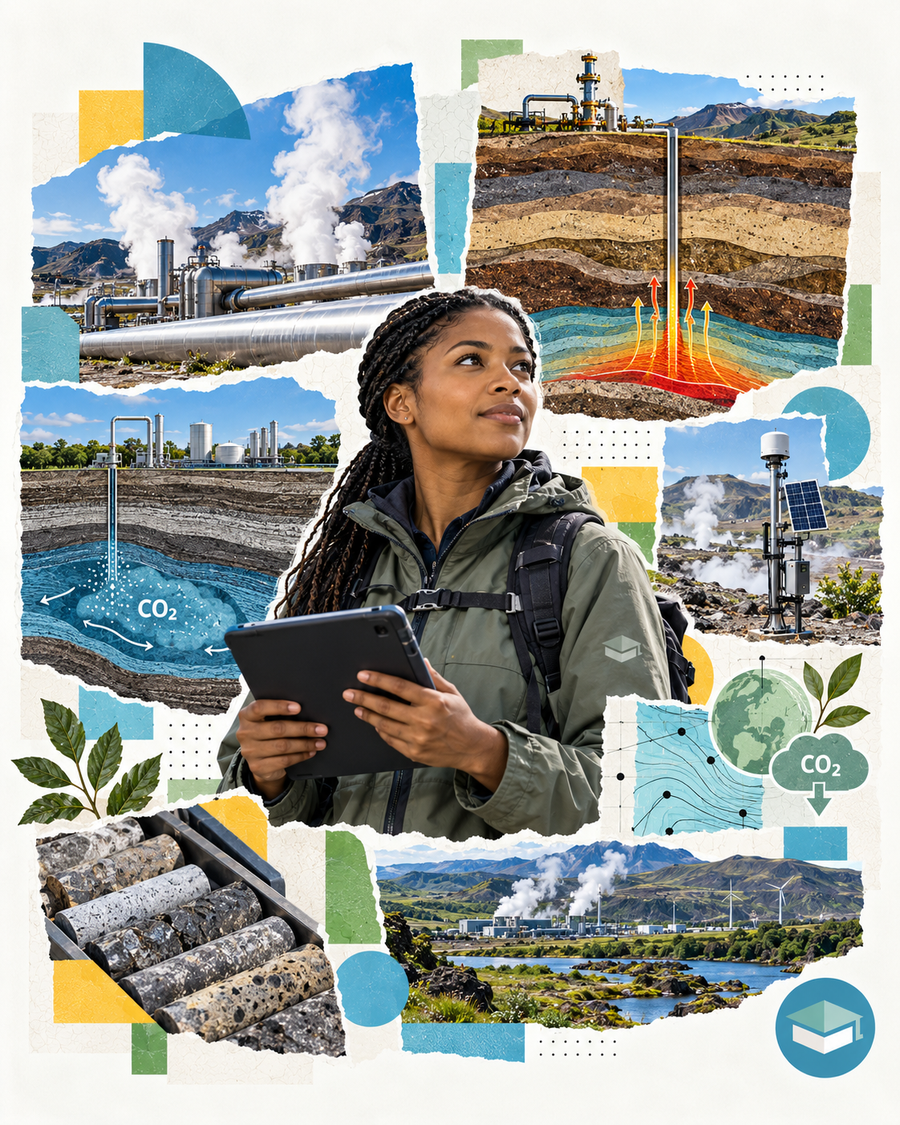
Jobs in geothermal energy and CO₂ storage: new applications of subsurface engineering
Application areas include geothermal energy, geological carbon dioxide storage and specific underground hydrogen storage projects.
How do these technologies relate to oil and gas?
Hydrocarbon exploration and production requires understanding the behavior of rocks, fluids, pressure and temperature within the subsurface.
These same scientific principles are relevant to different energy projects and geological storage. Therefore, some skills developed in reservoir engineering can be transferred to new applications.
Jobs in geothermal energy
The geothermal energy harnesses the heat inside the Earth. The report The Future of Geothermal Energy, published by the International Energy Agency, explains the technologies used to harness this resource and their relationship with subsurface engineering. To develop a project, specialists need to study the characteristics of the geological formations, temperatures, fluid properties and energy extraction possibilities.
Among the professionals who can take part are specialists in Geology, Geophysics, reservoir engineering and drilling engineering. For those who want to learn more about these activities, the article Studying Geology describes different professional applications of this discipline, including the exploration of geothermal resources.
Geothermal reservoir engineering
This specialty analyzes how fluids and heat behave within geological formations. Professionals can use numerical models to study circulation, extraction and injection processes, as well as evaluate the evolution of temperature and reservoir pressure.
Some subsurface simulation tools have capabilities applicable to geothermal studies. These applications require knowledge of thermodynamics, heat transfer, fluid mechanics and numerical methods. The Energy Engineering offers training related to thermal systems and energy utilization technologies.
Jobs in geological CO₂ storage
Geological carbon dioxide storage consists of injecting CO₂ into suitable underground formations with the purpose of keeping it confined long-term.
These projects require geological studies, evaluation of storage integrity, risk analysis and monitoring systems. A concrete example is found in Iceland, where Carbfix is developing a CO₂ storage technology through mineralization. The procedure consists of dissolving carbon dioxide in water and introducing it into reactive rocks, such as basalts, where it can transform into stable carbonate minerals.
Specialized positions include geological storage engineers, reservoir modelers, characterization geologists and monitoring specialists.
Storage modeling and simulation
Engineers use models to study how CO₂ might move, how pressures would change and what factors influence its confinement. Compositional simulation tools can help evaluate these processes.
For example, the Canadian company Computer Modelling Group develops GEM, a simulator for studying geological CO₂ storage processes, interactions between fluids and rocks, and the evolution of reservoir conditions. These studies require integrating knowledge of reservoir engineering, geology, and thermodynamics, as well as computing skills to interpret results and assess uncertainties.
Other applications: hydrogen and underground storage
The underground storage of hydrogen is another area where subsurface engineering knowledge can be applied. These projects require studying gas behavior, the characteristics of geological formations, and safety conditions.
In Austria, the company RAG develops underground hydrogen storage projects by using former natural gas reservoirs. Another example is Hystories, a European project developed between 2021 and 2023, which investigated the possibilities of storing hydrogen in depleted reservoirs and aquifers through geological studies, simulation, and technical-economic analyses. Its development depends on technical, geological, regulatory, and economic factors, so not all structures are suitable for this application.
What to study to work in these areas?
Related degrees include Petroleum Engineering, Geology, Geophysics, Chemical Engineering and Energy Engineering. Professionals from Applied Mathematics, Computer Science and Environmental Engineering may also participate, depending on the needs of the project.
For those who want to work in modeling, it is advisable to develop knowledge of numerical simulation, thermodynamics, fluid properties and risk analysis. Training can also be complemented with programming tools and Data Science, especially in roles related to the processing of measurements, interpretation of simulations and monitoring of facilities.
Geothermal and geological storage technologies show that subsurface engineering has broader applications than hydrocarbon extraction. This connection represents an opportunity for career diversification for those who want to combine Earth sciences, energy, and technology.