
Professional areas in the oil, gas and energy sector
The oil and gas sector includes different industrial, scientific and commercial activities. That's why its professional opportunities are broader than many people imagine.
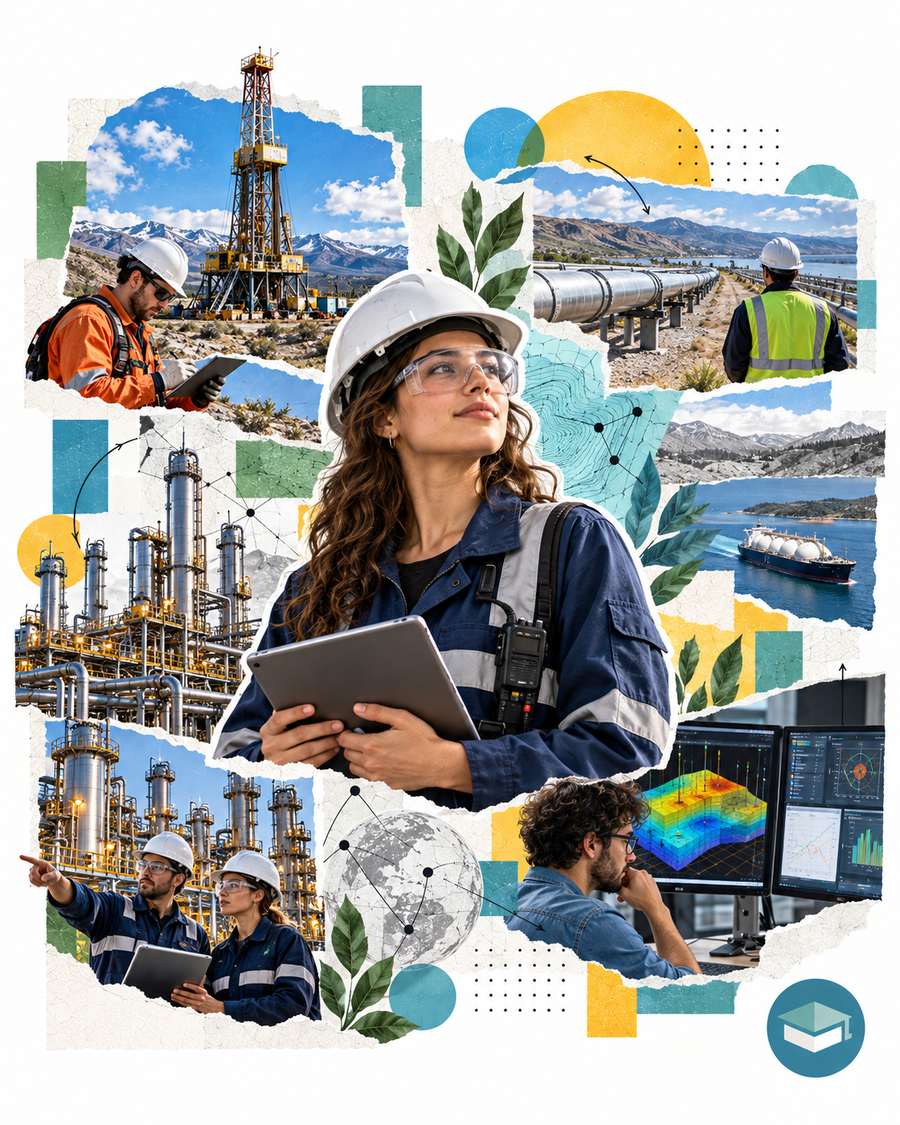
Oil, gas and energy sector: where can you work?
Understanding how this industry is organized, what machinery it uses and what its technological tools are helps identify the specializations that may relate to each student's interests.
How is the industry organized professionally?
Traditionally, the oil and gas value chain is divided into three major stages: upstream, midstream and downstream. Each brings together different activities, facilities, industrial equipment and professional profiles.
Upstream: exploration and production
This stage includes the search, evaluation, drilling, development and extraction of hydrocarbons.
Professionals in Geology, Geophysics and Petroleum Engineering work here, as well as drilling technicians, production specialists and reservoir engineers.
During exploration, seismic equipment is used to study underground structures. For example, the French company Sercel develops seismic acquisition systems like the 508XT, which record the signals used to investigate geological formations.
The information obtained can be processed using specialized programs such as Viridien's Geovation, used to process seismic data and generate images that facilitate subsurface interpretation.
To drill, rotary equipment is needed, steel pipes, drill bits, mud pumps and pressure control systems. The company NOV manufactures Top Drive systems, which provide the rotation needed for drilling, as well as other automation and pipe handling equipment.
In the production stage oil, gas and water separators, valves and artificial lift systems are used. For example, Weatherford develops pumping and artificial lift systems to maintain well production when their natural energy is insufficient.
The work also requires scientific software. Halliburton's DecisionSpace 365 allows subsurface studies to be developed, while Rock Flow Dynamics' tNavigator integrates geological modeling and reservoir simulation.
Another alternative is the Computer Modelling Group (CMG) simulators, used to study reservoir behavior and evaluate different hydrocarbon recovery strategies.
Midstream: transportation and storage
The midstream includes activities related to the transportation, storage and conditioning of oil and gas.
Its facilities include oil pipelines, gas pipelines, pumping stations, compressor plants, terminals and large storage tanks.
Among the equipment used are steel pipes, centrifugal pumps, compressors, control valves and sensors for measuring pressure, temperature and flow rate.
For example, Baker Hughes manufactures PCL compressors, used in gas transportation stations to maintain the necessary flow conditions through the pipelines.
Measurement is also essential. The company Endress+Hauser develops Coriolis flowmeters, capable of measuring the mass flow of liquids and gases in industrial facilities.
Pipeline integrity requires inspections to detect corrosion, deformations and other possible damage. The German company ROSEN develops smart internal inspection tools, known as instrumented pigs, which travel through the pipes and collect information about their condition.
Regarding software, DNV's Synergi Gas makes it possible to simulate gas transportation and distribution networks to study pressures, flow rates and operating alternatives.
Professionals in Mechanical Engineering, Electronic Engineering, maintenance, instrumentation, logistics and industrial safety work in these activities.
Downstream: refining and marketing
This stage includes the transformation of hydrocarbons into fuels, lubricants and other products, as well as certain distribution and marketing activities.
The refineries use distillation columns, chemical reactors, furnaces, heat exchangers, industrial pumps, valves and cooling systems.
They also use catalysts to facilitate certain chemical reactions. For example, the Danish company Topsoe develops hydrotreating catalysts used to produce low-sulfur fuels.
Another company in the sector is Honeywell UOP, which provides technologies and catalytic materials for different hydrocarbon transformation processes.
The engineers use simulators such as Aspen HYSYS Petroleum Refining by AspenTech, which makes it possible to build models of industrial processes and analyze how results change under different operating conditions.
The refinery operation also depends on automation systems. For example, Emerson's DeltaV allows integrating instruments, controllers and monitoring stations.
These activities offer opportunities for professionals in Chemical Engineering, process engineering, maintenance, automation, quality control and industrial safety.
Technical and digital areas
In addition to the three traditional stages, there are technology specialties involved in different activities of the value chain.
These include industrial automation, Data Science, cybersecurity, software development, project management and predictive maintenance.
For example, the sensors installed in pumps, turbines and compressors generate information about vibrations, temperatures and operating conditions. This data can be used to identify anomalies, evaluate performance and anticipate potential failures.
Among the available tools is Seeq, specialized in industrial data analysis and evaluation of process behavior.
To develop and implement these solutions, professionals with knowledge of Computer Engineering, statistics, automation and industrial processes are needed.
Specializations linked to other energy projects
Some knowledge developed in oil and gas can be used in geothermal energy projects, geological CO₂ storage and underground gas storage.
In geothermal energy, wells, pipes, pumps, heat exchangers and turbines are used to harness thermal energy from underground. For example, Ormat develops binary-cycle geothermal power plants, which use heat from underground fluids to generate electricity.
In Iceland, Carbfix develops carbon storage projects through mineralization. The process involves dissolving CO₂ in water and injecting it into suitable rock formations, where it reacts to form stable minerals.
These applications require knowledge of rock properties, fluid behavior, drilling and thermal processes. That is why professionals in Geology, Petroleum Engineering and Energy Engineering can take part, with the corresponding specializations.
Which career field should you choose?
If you are interested in researching the properties of the Earth, interpreting seismic data and building models of the subsurface, you can explore Geology, Geophysics or Petroleum Engineering.
If you prefer working with machinery, pumps, compressors and systems for industrial maintenance, you may be interested in Mechanical Engineering.
If you enjoy studying chemical reactions, separation processes and transformation of substances, consider Chemical Engineering.
If your main interest is programming, simulations, automation and information analysis, look into Computer Engineering or Data Science.
The energy industry brings together professionals who work with both physical equipment and digital tools. Knowing the machinery, materials and software used in each activity helps you better understand the tasks of its specialists and choose training related to your interests.